+ Reply to Thread
Page 1917 of 1918 FirstFirst 1 917 1417 1817 1867 1907 1917 1918 LastLast
Results 38,321 to 38,340 of 38347

Thread: Up At The Ranch And Beyond

  1. Link to Post #38321
    United States Avalon Member Bluegreen's Avatar
    Join Date
    18th July 2014
    Location
    Ø
    Language
    ¿
    Posts
    12,828
    Thanks
    51,231
    Thanked 63,854 times in 12,110 posts

    Default Re: Up At The Ranch And Beyond

    What's Up | November 2026 | Skywatching

    (3:34)


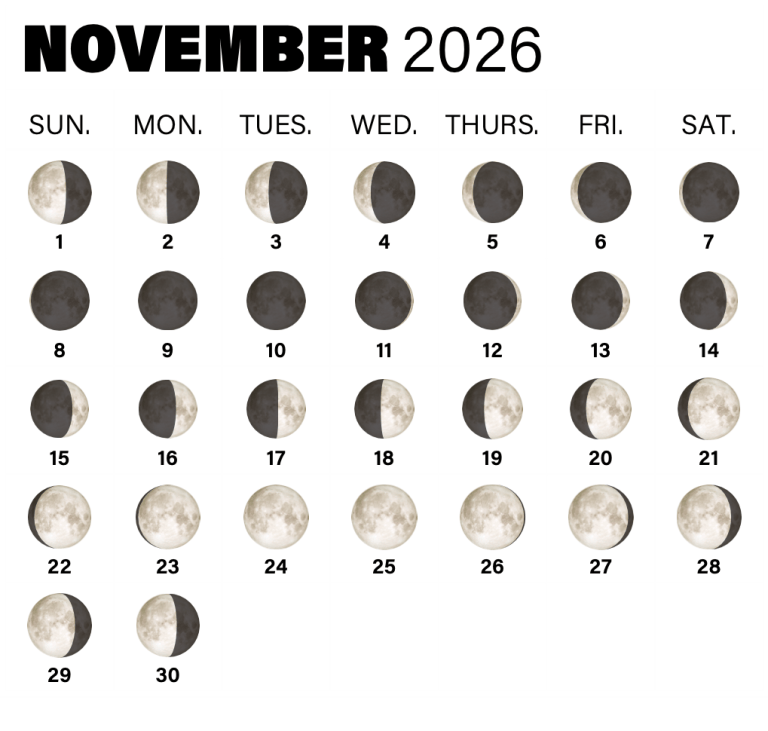
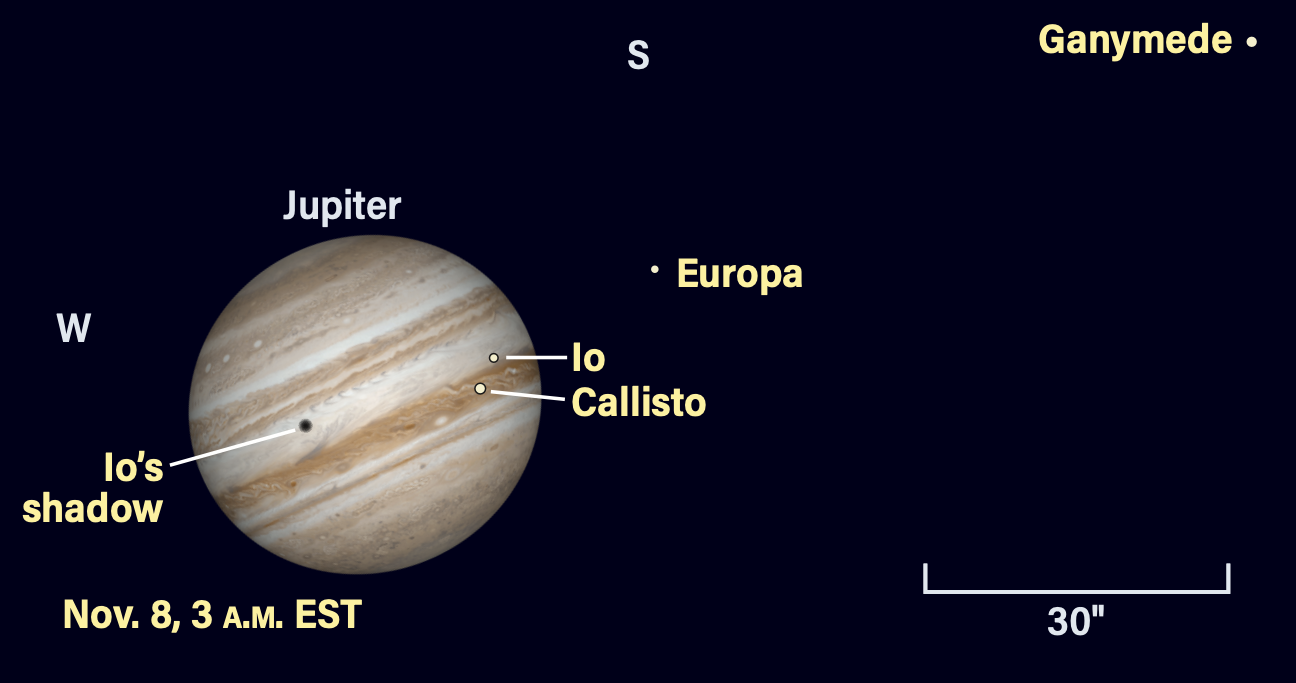
    • Io and Callisto are transiting Jupiter early on Nov. 8, with Io’s shadow visible on the cloud tops. Although Io’s transit begins after Callisto’s, the former will catch up with and overtake the latter by 3:30 a.m. EST.

    • Saturn is already visible as darkness falls; some challenging transits of its moons occur this month. Neptune is a binocular object close to Saturn, while Uranus is an easy target in Taurus. A Full Moon courses in front of the Pleiades in late November. Mars and Jupiter dominate the early-morning sky, and in the hour before dawn, look also for Venus and Mercury. 

    • Neptune and Saturn are well placed for observation after sunset. They’re about 7° apart all month, with Neptune in southern Pisces and Saturn just across the border in Cetus.

    • A waning gibbous Moon hangs 5° northwest of Neptune’s location on the 19th. The following night, Saturn is 6° south of the Moon.

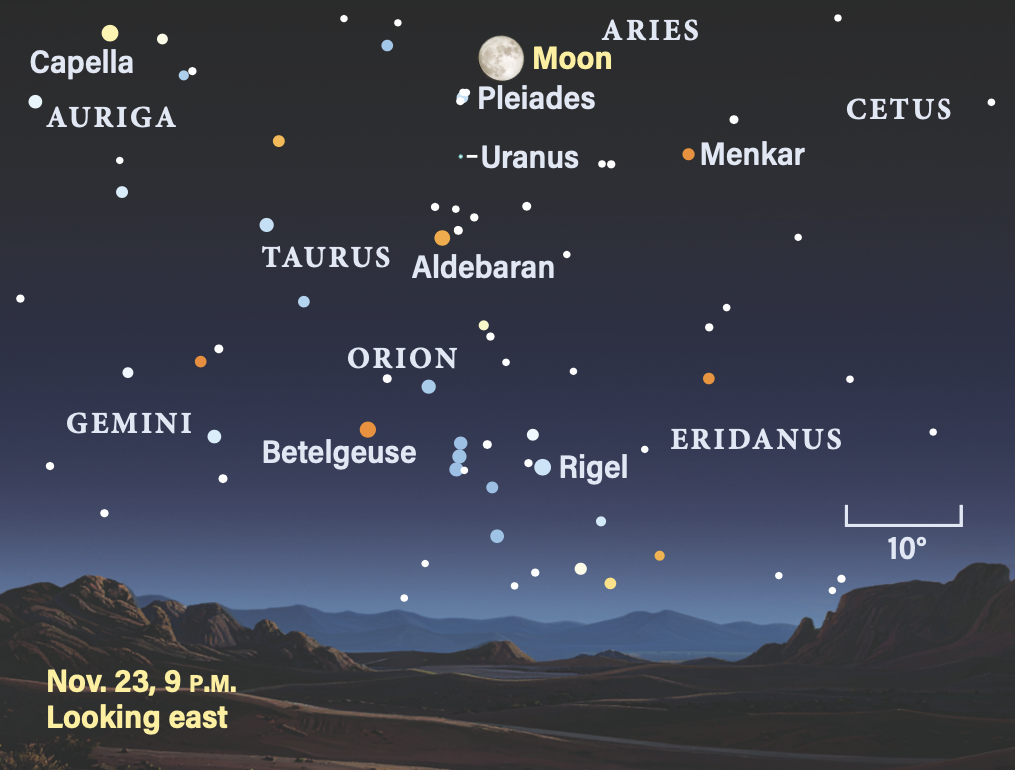
    • Uranus remains midway between Aldebaran and the Pleiades (M45). This position makes the planet easier to find than in previous years. It reaches opposition Nov. 25, visible from dusk to dawn. From 1.71 billion miles away, its disk spans 4″. Uranus shines at magnitude 5.6, within easy range of binoculars and potentially visible to the unaided eye from the darkest skies.


    • To find Uranus, look between Aldebaran and M45 for two stars: 37 and 39 Tauri (4.5° southeast of M45). Brighter 37 Tau glows at magnitude 4.4. On Nov. 1, Uranus is 1.6° southeast of 37 Tau, and by the end of November stands 1.5° due south of this star. Another star, some 2.7° southeast of 37 Tau, shines at magnitude 5.5. This is 43 Tau; in mid-November, Uranus is halfway between the two stars.


    • Uranus is in Taurus, easy to find between Aldebaran and the Pleiades. This chart depicts the sky shortly before the Moon occults the cluster on Nov. 24.

    https://www.astronomy.com/
    Last edited by Bluegreen; 5th November 2026 at 05:37.

  2. The Following 5 Users Say Thank You to Bluegreen For This Post:

    Bill Ryan (5th November 2026), Johnnycomelately (5th November 2026), kfm27917 (11th November 2026), skogvokter (5th November 2026), Yoda (6th November 2026)

  3. Link to Post #38322
    United States Avalon Member Bluegreen's Avatar
    Join Date
    18th July 2014
    Location
    Ø
    Language
    ¿
    Posts
    12,828
    Thanks
    51,231
    Thanked 63,854 times in 12,110 posts

    Default Re: Up At The Ranch And Beyond

    Lycurgus Cup: A Roman glass goblet made with ancient color-changing nanotechnology


    The Lycurgus Cup is a Roman-era glass goblet that changes color from jade green to ruby red depending on if a light is shining on its front or back. But experts are unsure where the cup was found, where it was made, or whether the glassblower who made it created the color-changing effect on purpose.

    In 1958, the British Museum acquired the cup from the Rothschild banking family, which had owned the artifact since the mid-19th century. Known colloquially as the Lycurgus Cup for its depiction of the mythical king who angered the god Dionysus, the glass is about 6.3 inches (15.9 centimeters) tall and weighs around 1.6 pounds (700 grams).

    The glass is a remarkably well-preserved example of a Roman "cage-cup," according to a 1959 study of the artifact by archaeologists D. B. Harden and Jocelyn Toynbee. Only a handful of cage-cups still exist, and experts believe the goblets were made by cutting and grinding decoration into thick glass.

    Because small bridges were left to ensure the decoration remained on the glass, the overall effect is like a cage. Harden and Toynbee estimated that the Lycurgus Cup was manufactured in the fourth century, likely in Italy, but they noted that the bronze frame that forms the stem and rim of the goblet is probably a 19th-century addition.

    Depicted on the cup is the myth of the punishment of Lycurgus, king of the Thracian tribe called the Edoni (also called the Edonians). Lycurgus did not approve of the worship of Dionysus and banished the god into the sea with an ax. But one of Dionysus' priestesses, Ambrosia, decided to fight Lycurgus. Ambrosia changed herself into a vine and wound herself around Lycurgus, who was unable to escape. The other priestesses thronged around them and tormented Lycurgus.

    Given that Dionysus was a god of wine and merriment, the depiction of Lycurgus' punishment may have been particularly appropriate for this goblet. Additionally, the change in color from green to red may have been meant to mimic the ripening of grapes on the vine.

    Green to red. Red to green.


    Published 1st November 2026 by Kristina Killgrove, Laura Geggel, Laura Mondragón – Live Science
    https://www.livescience.com/archaeol...nanotechnology

  4. The Following 6 Users Say Thank You to Bluegreen For This Post:

    Bill Ryan (5th November 2026), Johnnycomelately (5th November 2026), petra (6th November 2026), skogvokter (5th November 2026), ThePythonicCow (5th November 2026), Yoda (6th November 2026)

  5. Link to Post #38323
    United States Avalon Member Bluegreen's Avatar
    Join Date
    18th July 2014
    Location
    Ø
    Language
    ¿
    Posts
    12,828
    Thanks
    51,231
    Thanked 63,854 times in 12,110 posts

    Default Re: Up At The Ranch And Beyond

    Inside the Newport Mansion Where UFO Abductees Gathered | Anne Cuvelier | Ep 790


    Martin Willis sits down with Anne Ramsey Cuvelier, who for years opened her historic Newport, Rhode Island mansion to an extraordinary circle of UFO experiencers, researchers and investigators, some still with us. What began as informal gatherings became a rare safe place where people who said they had experienced UFO encounters and abductions could speak openly without fear of ridicule.

    Published 8th October 2026 (26:09)
    Last edited by Bluegreen; 14th November 2026 at 03:20.

  6. The Following 5 Users Say Thank You to Bluegreen For This Post:

    Bill Ryan (6th November 2026), Johnnycomelately (11th November 2026), kfm27917 (11th November 2026), skogvokter (6th November 2026), Yoda (6th November 2026)

  7. Link to Post #38324
    United States Avalon Member Bluegreen's Avatar
    Join Date
    18th July 2014
    Location
    Ø
    Language
    ¿
    Posts
    12,828
    Thanks
    51,231
    Thanked 63,854 times in 12,110 posts

    Default Re: Up At The Ranch And Beyond

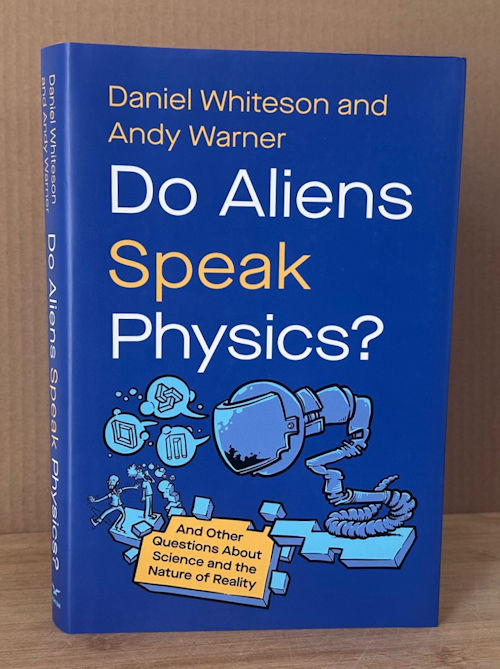
    The Strange Case for Dark Matter Aliens w/ Daniel Whiteson


    Interesting, measured interview covering telepathy, aliens, culture, and physics, with Mr Godier's guest, Daniel Whiteson, author of “Do Aliens Speak Physics?”.

    (54:07)


  8. The Following 4 Users Say Thank You to Bluegreen For This Post:

    Bill Ryan (6th November 2026), Johnnycomelately (11th November 2026), skogvokter (6th November 2026), Yoda (6th November 2026)

  9. Link to Post #38325
    United States Avalon Member Bluegreen's Avatar
    Join Date
    18th July 2014
    Location
    Ø
    Language
    ¿
    Posts
    12,828
    Thanks
    51,231
    Thanked 63,854 times in 12,110 posts

    Default Re: Up At The Ranch And Beyond

    Enceladus in Silhouette


    One of our Solar System's most tantalizing worlds, Enceladus is backlit by the Sun in this Cassini spacecraft image. The dramatic illumination reveals the plumes that continuously spew into space from the south pole of Saturn's 500 kilometer diameter moon. Discovered by Cassini in 2005, the icy plumes are likely connected to an ocean beneath the ice shell of Enceladus. They supply material directly to Saturn's outer, tenuous E ring and make the surface of Enceladus as reflective as snow. Across the scene, Saturn's icy rings scatter sunlight toward Cassini's cameras. Beyond the rings (lower right), the night side of 80 kilometer diameter moon Pandora is faintly lit by Saturnlight.

  10. The Following 4 Users Say Thank You to Bluegreen For This Post:

    Bill Ryan (6th November 2026), Johnnycomelately (11th November 2026), skogvokter (6th November 2026), Yoda (6th November 2026)

  11. Link to Post #38326
    United States Avalon Member Bluegreen's Avatar
    Join Date
    18th July 2014
    Location
    Ø
    Language
    ¿
    Posts
    12,828
    Thanks
    51,231
    Thanked 63,854 times in 12,110 posts

    Default Re: Up At The Ranch And Beyond

    Vera Rubin Observatory Spots Possible New Dwarf Planet Beyond Pluto


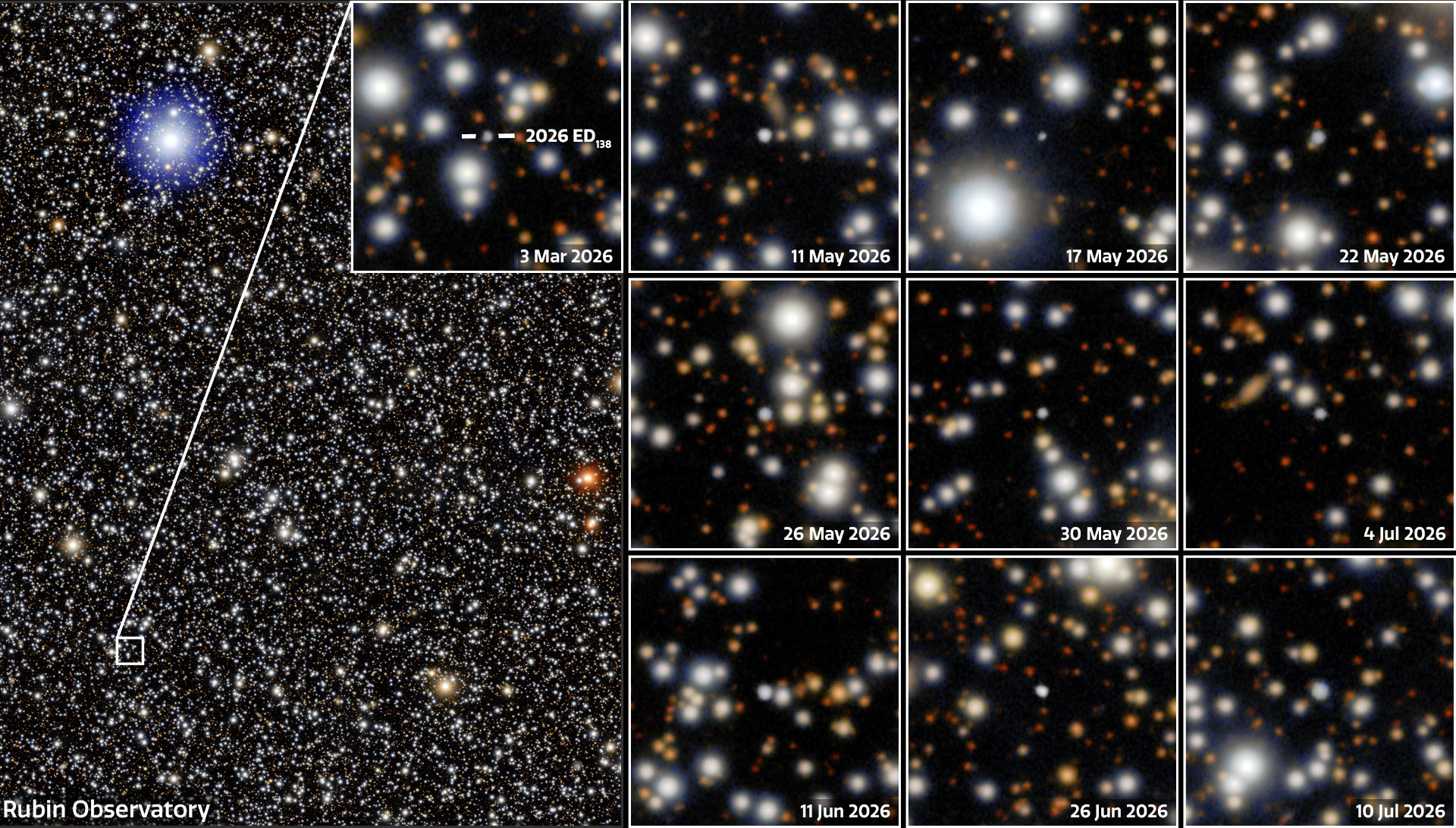
    Astronomers using the NSF-DOE Vera C. Rubin Observatory have found what may be a new dwarf planet in the outer Solar System. The large, icy object carries the provisional name 2026 ED138 (ED138 for short)


    A mosaic of images captured by the Vera Rubin Observatory of 2026 ED138

    “Rubin is giving us an unprecedented capacity to explore the sky through a combination of speed, depth, and precision,” said Dr. Mario Jurić, Rubin’s solar system lead scientist at the University of Washington.

    “And the discovery is just the beginning: once we identify a new object, we can search back months, and sometimes even decades, finding it in images where nobody knew to look.”

    “This ability to both discover and ‘precover’ objects is transforming how quickly and accurately we can determine their orbits and understand the distant Solar System.”

    Dr. Jurić and his colleagues estimate ED138 is between 600 and 1,500 km (373-932 miles) across, based on its brightness, distance and assumed reflectivity.

    Icy bodies that big should be pulled into a round shape by their own gravity, one of the requirements for dwarf planet status.

    Infrared observations will be needed to pin down its true size. If it is confirmed, ED138 would join Pluto, Ceres, Eris, Haumea and Makemake as the sixth dwarf planet.

    “Rubin Observatory’s super power is the ability to clearly capture movement and change among a vast number of objects and phenomena that humans have never seen before,” said Dr. Edward Ajhar, NSF program director for Rubin Observatory.

    “That power greatly extends our ability to reveal and understand new things about our Solar System, the Milky Way, and billions of other galaxies across the Universe.”

    “Rubin Observatory’s unique strengths make it an incredible tool for investigating a wide range of astrophysical phenomena, from dark energy to the discovery of this dwarf planet candidate,” added Dr. Kathy Turner, DOE’s program manager for Rubin Observatory.

    Published 2nd November 2026 by Natali Anderson – Sci News
    https://www.sci.news/astronomy/vera-...net-15166.html

    2026 ED138 3D Orbit

    (0:50)

  12. The Following 5 Users Say Thank You to Bluegreen For This Post:

    Bill Ryan (7th November 2026), Johnnycomelately (11th November 2026), skogvokter (8th November 2026), ThePythonicCow (7th November 2026), Yoda (10th November 2026)

  13. Link to Post #38327
    United States Avalon Member Bluegreen's Avatar
    Join Date
    18th July 2014
    Location
    Ø
    Language
    ¿
    Posts
    12,828
    Thanks
    51,231
    Thanked 63,854 times in 12,110 posts

    Default Re: Up At The Ranch And Beyond

    This Week in Space Bites w/ Fraser Cain


    Vera Rubin Delivers Even More BIG Discoveries

    Rubin's progress, China's Moon plans, splitting a black hole, Van Gogh, Earth’s “impenetrable” space radiation shield breached from within, a story ...

    Published 6th November 2026 (19:30)


    (a)The stars in The Starry Night (1889) overlaid by the real stars after matching for size, orientation, and position; red dashed lines show the residual differences. (b) The stars in Café Terrace at Night (1888), left, and the stars around the Summer Triangle.

    New Research Resolves the Mystery Behind Van Gogh's The Starry Night
    https://www.universetoday.com/articl...e-starry-night
    Last edited by Bluegreen; 8th November 2026 at 02:08.

  14. The Following 5 Users Say Thank You to Bluegreen For This Post:

    Bill Ryan (7th November 2026), Ewan (7th November 2026), Johnnycomelately (11th November 2026), skogvokter (8th November 2026), Yoda (10th November 2026)

  15. Link to Post #38328
    United States Avalon Member Bluegreen's Avatar
    Join Date
    18th July 2014
    Location
    Ø
    Language
    ¿
    Posts
    12,828
    Thanks
    51,231
    Thanked 63,854 times in 12,110 posts

    Default Re: Up At The Ranch And Beyond


    "The Astronomer's Dream" | Georges Méliès

    (3:31)

  16. The Following 7 Users Say Thank You to Bluegreen For This Post:

    Bill Ryan (7th November 2026), Ewan (7th November 2026), Johnnycomelately (11th November 2026), Mike (7th November 2026), skogvokter (8th November 2026), Sue (Ayt) (7th November 2026), Yoda (10th November 2026)

  17. Link to Post #38329
    United States Administrator Sue (Ayt)'s Avatar
    Join Date
    23rd December 2016
    Language
    English
    Posts
    3,847
    Thanks
    39,642
    Thanked 27,753 times in 3,541 posts

    Default Re: Up At The Ranch And Beyond

    Quote Posted by Bluegreen (here)


    "The Astronomer's Dream" | Georges Méliès

    (3:31)
    Wow! Made in 1898. Quite a dream.
    "We're all bozos on this bus"

  18. The Following 7 Users Say Thank You to Sue (Ayt) For This Post:

    Bill Ryan (7th November 2026), Bluegreen (7th November 2026), Ewan (7th November 2026), Johnnycomelately (11th November 2026), Mike (7th November 2026), skogvokter (8th November 2026), Yoda (10th November 2026)

  19. Link to Post #38330
    United States Avalon Member Bluegreen's Avatar
    Join Date
    18th July 2014
    Location
    Ø
    Language
    ¿
    Posts
    12,828
    Thanks
    51,231
    Thanked 63,854 times in 12,110 posts

    Default Re: Up At The Ranch And Beyond

    Spacewalkers Complete 5-Year Effort to Upgrade Space Station Power Supply


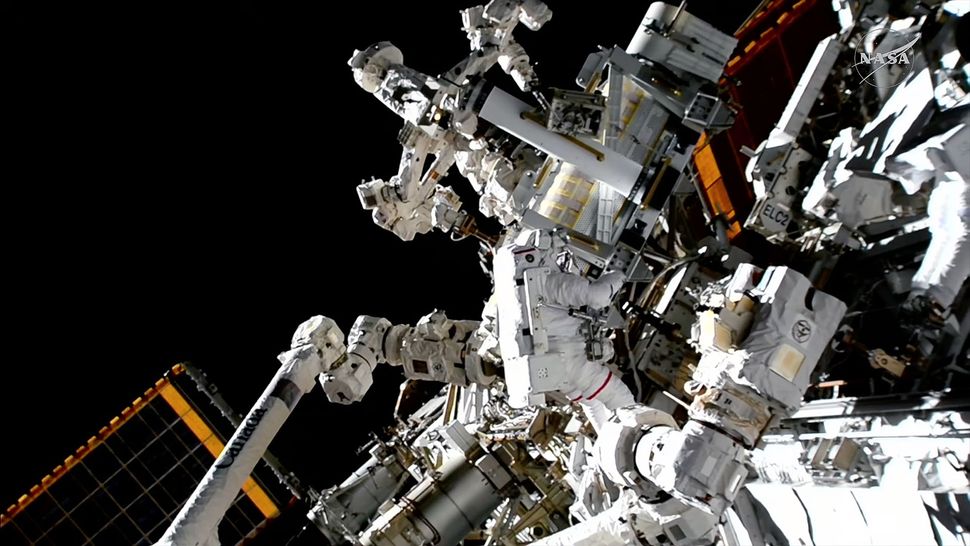
    NASA's Anil Menon, riding the space station robot arm, moves the folded, rolled-up IROSA assembly to its installation point at the Starboard end of the space station truss.

    Spacewalking astronauts Joshua Kutryk and Anil Menon unfurled the last of eight new solar arrays outside the International Space Station Thursday, working through an unexpected power snag to complete a five-year upgrade designed to keep the orbiting laboratory running through its retirement in 2030.

    The final International Space Station Roll-Out Solar Array, or IROSA, unrolled at the far starboard end of the station’s main truss at about 3:05 p.m. EST (2005 UTC), roughly six and a half hours into the spacewalk. That came only after flight controllers in Houston spotted lower-than-expected electrical current from the freshly connected array and held the deployment through another trip around the planet so Kutryk could inspect a power connector in the darkness of orbital night.

    “Josh, deployment is complete,” Mission Control radioed Kutryk after the previously rolled-up array reached its full length of 63 feet.

    According to NASA, the eight IROSAs will raise the station’s available power by up to 30 percent, supporting the outpost through its final years, including what the agency says will be its “safe and controlled deorbit.”


    "We got it done!"

    "Today marks the completion of not just one solar array but, over 15 years after its development, eight arrays," said Menon at the end of the 6-hour-and-59-minute spacewalk . "These solar arrays are incredible. Half the size of the old ones and bringing 40% more power."

    Published 5th November 2026 by Houston Harwood – Spaceflight Now
    https://spaceflightnow.com/2026/11/0...-power-supply/


    Canadian Space Agency astronaut Joshua Kutryk (at center) works on mounting the eighth and final International Space Station Roll-Out Solar Array (iROSA) on Nov. 5, 2026.

    HIGHLIGHTS of US SPACEWALK 101 – Kutryk / Menon


    Published 6th November 2026 (14:34)

    Quote The installation marks the completion of a major upgrade to the space station’s electrical power generation system, a project that began in February 2021. Since then, astronauts have conducted 18 spacewalks to prepare the power channel equipment and install all eight roll-out solar arrays. Together, the eight IROSAs increase the station’s power generation capacity from approximately 160 kilowatts to 215 kilowatts, providing significantly more electrical power for the station’s ongoing operations. U.S. Spacewalk 101 was Joshua Kutryk’s second spacewalk and Anil Menon’s fifth.

  20. The Following 6 Users Say Thank You to Bluegreen For This Post:

    Bill Ryan (8th November 2026), edina (8th November 2026), Ewan (8th November 2026), Johnnycomelately (11th November 2026), skogvokter (8th November 2026), Yoda (10th November 2026)

  21. Link to Post #38331
    United States Avalon Member Bluegreen's Avatar
    Join Date
    18th July 2014
    Location
    Ø
    Language
    ¿
    Posts
    12,828
    Thanks
    51,231
    Thanked 63,854 times in 12,110 posts

    Default Re: Up At The Ranch And Beyond

    Queen of Uranus by Richard Hughes (Thomas R. Drew) and Ogden Whitney


  22. The Following 4 Users Say Thank You to Bluegreen For This Post:

    Bill Ryan (10th November 2026), Johnnycomelately (11th November 2026), skogvokter (11th November 2026), Yoda (10th November 2026)

  23. Link to Post #38332
    United States Avalon Member Bluegreen's Avatar
    Join Date
    18th July 2014
    Location
    Ø
    Language
    ¿
    Posts
    12,828
    Thanks
    51,231
    Thanked 63,854 times in 12,110 posts

    Default Re: Up At The Ranch And Beyond

    The Polar Vortex Is About To Go Haywire

    “Everybody’s hair is on fire in the climate or meteorologist community”


    Something “unprecedented” is happening in the atmosphere: the Arctic polar vortex, a spinning mass of air high above the North Pole, is collapsing. This disruption isn’t unusual, but it is happening at what may be the earliest point in the year on record, climate experts say.

    Every winter the polar vortex strengthens in the stratosphere, a layer of the atmosphere that stretches from about 10 to 30 miles above Earth’s surface, explains Andrea Lopez Lang, an associate professor of atmospheric and oceanic sciences at the University of Wisconsin–Madison.

    Like a fast-spinning top, the polar vortex’s tight rotation helps keep cold air trapped over the pole, says Judah Cohen, a climatologist at Massachusetts Institute of Technology. But if the vortex is disrupted, it can push cold air down to other parts of the world, such as North America and Europe.

    That disruption is happening far earlier than expected, the experts say.

    “As a weather fan, this is a big event because it’s so unprecedented,” Cohen says. “It’s a lot of excitement. Everybody’s hair is on fire in the climate or meteorologist community.”

    In the Northern Hemisphere, the polar vortex typically begins forming in the late summer and reaches “peak intensity” in December and January, Lopez Lang says. Waves in the atmosphere known as “Rossby waves” can cause the polar vortex to wobble and weaken. During a big polar vortex disruption—what scientists call a “sudden stratospheric warming”—the vortex can drift, stretch, split into multiple swirls or change direction.

    This indirectly influences the polar jet stream, a band of wind that circles the entire polar region in the troposphere—the lowest layer of the atmosphere, where most of our weather happens.

    Polar vortex disruptions normally occur deep into the winter, Cohen says, so a sudden stratospheric warming in November is unusual. Before now, the earliest it had ever been recorded was November 28 in 1968.

    What that means for our weather forecast in the U.S. is still unclear. It’s an El Niño year, so meteorologists had expected winter in North America to be relatively mild. A polar vortex split could bring cooler temperatures across the continent in the coming weeks, but exactly when and where that will happen—and whether it will happen at all—remain unanswered.

    “It looks like we’re going to have a disruption,” Lopez Lang says. “Where everything sets up is still in question.”

    Published 9th November 2026 by Jackie Flynn Mogensen and Claire Cameron – Scientific American
    https://www.scientificamerican.com/a...to-go-haywire/
    Last edited by Bluegreen; 11th November 2026 at 03:07.

  24. The Following 5 Users Say Thank You to Bluegreen For This Post:

    Bill Ryan (11th November 2026), Ewan (11th November 2026), Johnnycomelately (11th November 2026), skogvokter (11th November 2026), Yoda (11th November 2026)

  25. Link to Post #38333
    United States Avalon Member Bluegreen's Avatar
    Join Date
    18th July 2014
    Location
    Ø
    Language
    ¿
    Posts
    12,828
    Thanks
    51,231
    Thanked 63,854 times in 12,110 posts

    Default Re: Up At The Ranch And Beyond

    'Historic Change’: What the 2026 US Mid-term Election Results Mean for Science


    Since Donald Trump became president for the second time in January 2025, his administration has pushed for unprecedented cuts to science funding, politicized decision-making at federal science agencies and interfered with policies at US universities that receive federal funding.

    The US mid-term elections swept the Democratic party to power in both chambers of the US Congress, raising hopes that lawmakers will now push back against disruptions to science introduced by the current administration.

    The results will mark the end of nearly two years in which the Republicans controlled the presidency and both congressional chambers — and many scientists around the world are celebrating the change as an opportunity to protect the country’s research system.

    “This is a big win,” says Megan Peters, a cognitive scientist who moved in 2025 from the University of California, Irvine, to University College London, in part because of worries about US science. “It’s a demonstration that US [voters] are dissatisfied with what the current administration has been doing.” Scientific research, she adds, “is America’s superpower, and it’s been cut at the knees”.

    Those hopeful for change include researchers affected by the US Agency for International Development (USAID) being shut down early in Trump’s presidency.

    “I’m cautiously optimistic,” says Quarraisha Abdool Karim, an epidemiologist at the Centre for the AIDS Programme of Research in South Africa, which is headquartered in Durban and had partnered with USAID on clinical trials. “What we’ve seen is that democracy and democratic principles, with individuals turning out to vote, can make a huge difference.” But, she adds, “we will not see overnight changes”.

    Published 4th November 2026 by Dan Garisto & Max Kozlov - Nature.com
    https://www.nature.com/articles/d41586-026-03579-x

  26. The Following 4 Users Say Thank You to Bluegreen For This Post:

    Bill Ryan (11th November 2026), Johnnycomelately (11th November 2026), skogvokter (11th November 2026), Yoda (11th November 2026)

  27. Link to Post #38334
    United States Avalon Member Bluegreen's Avatar
    Join Date
    18th July 2014
    Location
    Ø
    Language
    ¿
    Posts
    12,828
    Thanks
    51,231
    Thanked 63,854 times in 12,110 posts

    Default Re: Up At The Ranch And Beyond

    NASA’s CHAPEA Mars Crew Emerges After More Than a Year in Isolation

    After spending more than a year experiencing what life could be like on Mars, four NASA volunteers have finally stepped outside, marking the end of an ambitious experiment designed to prepare humans for future missions to the Red Planet.

    The crew completed their simulated Mars journey on October 31, 2026, emerging into the outside world for the first time in more than a year. Although the volunteers never actually left Earth, their extended mission recreated many of the challenges astronauts could encounter while living and working millions of miles from home.


    "Welcome to Mars" (L-R) Ross Elder, Ellen Ellis, Matthew Montgomery, James Spicer

    Throughout the experiment, the participants carried out tasks similar to those that future Mars explorers may need to perform. These included operating and testing essential systems, caring for crops, conserving limited supplies, and conducting extravehicular activities.

    The volunteers also had to manage communication delays, an important challenge for anyone traveling to Mars. Unlike astronauts aboard the International Space Station, who can communicate with Earth almost instantly, future Mars explorers will experience significant delays because radio signals take time to cross the enormous distance between the two planets.

    These delays mean astronauts cannot always depend on immediate guidance from mission control. They must be prepared to solve problems, make decisions, and manage unexpected situations with greater independence.

    One of the biggest challenges of sending people to Mars is keeping them healthy, productive, and safe during long periods away from Earth. A crew must be able to manage food, equipment, living conditions, and daily responsibilities while working together in a confined environment.

    NASA uses analog missions to explore these challenges before attempting actual journeys into deep space. An analog mission is a realistic simulation that reproduces selected conditions of space exploration while allowing scientists to study how people respond in a controlled setting on Earth.


    CHAPEA Science Officer Matthew Montgomery on his Year in Isolation


    Matthew conducts a geology experiment on 'Mars'

    What were your responsibilities as the mission’s science officer?

    Prior to the mission, I had worked in controlled-environment agriculture and studied factors such as the best LED lighting for crop growth, so I led the growing of our crops in the simulation. I’ve grown leafy greens, peppers and tomatoes outside of the mission in large growth facilities, and we were growing some of those same crops in the mission. It was also fun to grow those plants — just interacting with Earth-based things like plant life has a cognitive benefit as well as a nutrient benefit.

    What kind of experiments did you conduct?

    Geology was another huge portion of the mission. Rock collection is going to be incredibly important in a real mission to Mars, so we tried to mirror some of those aspects in the simulation. We analysed rock samples, performed mineral identification and simulated core analysis that Martian astronauts would do to study the geologic history of Mars.

    How did the crew get along in such close quarters?

    The crew spent a lot of time together prior to the mission, so we got to work on our teamwork and build relationships. We went on a winter camping expedition in Wyoming, where we encountered a blizzard! These high-pressure scenarios set a nice foundation for pre-training, where we spent five weeks together before going into isolation. Through all of those tools that we built, we had a really good dynamic as a team inside of the habitat, and conflict was very minimal.

    https://www.nature.com/articles/d41586-026-03588-w
    https://www.sciencedaily.com/release...1109205406.htm

  28. The Following 6 Users Say Thank You to Bluegreen For This Post:

    Bill Ryan (11th November 2026), Ewan (11th November 2026), Johnnycomelately (11th November 2026), kfm27917 (11th November 2026), skogvokter (11th November 2026), Yoda (11th November 2026)

  29. Link to Post #38335
    United States Avalon Member Bluegreen's Avatar
    Join Date
    18th July 2014
    Location
    Ø
    Language
    ¿
    Posts
    12,828
    Thanks
    51,231
    Thanked 63,854 times in 12,110 posts

    Default Re: Up At The Ranch And Beyond

    Ev Cochrane: Kali's Tongue | Thunderbolts


    The Hindu goddess Kali: a mean and spiteful woman.

    Published 1st November 2026 (15:03)

    Quote The Hindu goddess Kali presents a truly terrifying specter in ancient Indic myth. Renowned for her rampage which threatened to destroy mankind, the goddess was distinguished by her abnormally protruding red tongue—which was expressly compared to the sword of sacrifice and described as miles-long in length.

    In their analyses of ancient myth and religion, both David Talbott and Ev Cochrane emphasize converging patterns are key to discovery. A comparison with the Sumerian warrior-goddess Inanna/Ishtar offers the all-important clue. It is Inanna who, as the planet Venus, was described as warring against mankind and threatening to destroy the world.

    Such otherwise inexplicable parallels seem to point to common observations—in this case the displacement of the planet Mars from the center of Venus. As Mars descended along the polar axis uniting the various planets, it appeared to take on the shape of a giant sword or knife beneath Venus.

  30. The Following 5 Users Say Thank You to Bluegreen For This Post:

    Bill Ryan (11th November 2026), Johnnycomelately (11th November 2026), onawah (11th November 2026), skogvokter (11th November 2026), Yoda (11th November 2026)

  31. Link to Post #38336
    Canada Avalon Member Johnnycomelately's Avatar
    Join Date
    14th January 2022
    Location
    Edmonton, Alberta, Canada
    Language
    English
    Age
    67
    Posts
    2,235
    Thanks
    27,804
    Thanked 13,744 times in 2,207 posts

    Default Re: Up At The Ranch And Beyond

    Don’t want to say “old me” for this, am keeping that for 30 yrs from now, if things go as planned.

    Flashbacks to

    Book ‘im, Dano.


    Hawaii Five-O: The Best TV Open Ever Made?

    The Media Download with John Ondo
    3.29K subscribers

    Nov 5, 2026


    Quote On this episode of The Media Download, I take an exhaustive look at what I consider the best television open ever created: Hawaii Five-O. Shot and directed by Resa Badiyl, this 1968 open moved faster than anything else on TV at the time, with around 60 edits in about a minute.

    We go shot by shot through the wave, the aerial, and that legendary Jack Lord balcony turn; look at how the helicopter shot was pulled off, and pick apart the swish pans and transitions. Then we get into the music. Resa originally cut the open to a different song, and when the Ventures track came in, it lined up almost perfectly. I added a click track so you can see the cuts land on the beat, and why knowing your beats per minute matters when you cut to music.

    It was a full-fledged music video years before MTV, and it still has the one thing every open needs: a wow.

    Hawaii Five-O footage is shown for commentary and educational purposes.

    CHAPTERS
    0:00 The best TV open ever?
    1:12 Meet Resa Badiyl
    2:28 The Hawaii Five-O open
    5:38 Counting the cuts
    6:38 The Jack Lord shot
    10:44 Swish pans and transitions
    15:55 From hotels to cop lights
    17:20 Cutting to the beat
    18:33 The click track test

    On side note I missed in the rush of information. Morton Stevens composed the theme song and then later the Ventures famously covered it for the series. I know most folks probably know it from the radio as the Ventures song but that’s not correct.

    For more on Resa Badiyi's interview about the Hawaii Five-O open:
    https://interviews.televisionacademy....

    Bernie Oseransky, Former Executive in charge of Production for CBS
    https://interviews.televisionacademy....

    More on Hawaii Five-O
    https://en.wikipedia.org/wiki/Hawaii_...)


  32. The Following 6 Users Say Thank You to Johnnycomelately For This Post:

    Bill Ryan (12th November 2026), Bluegreen (12th November 2026), kfm27917 (11th November 2026), Mike (11th November 2026), skogvokter (14th November 2026), Yoda (11th November 2026)

  33. Link to Post #38337
    United States Avalon Member Bluegreen's Avatar
    Join Date
    18th July 2014
    Location
    Ø
    Language
    ¿
    Posts
    12,828
    Thanks
    51,231
    Thanked 63,854 times in 12,110 posts

    Default Re: Up At The Ranch And Beyond
    Thx Johnny very cool

    ? & The Mysterians


    Space Rock | Carbon Based Life Forms

    Incompressible Flow - Mix


    (2:01:41)


    NOTE: Epicentre Second Movement (55:05) was muted due to a copyright strike. Skip to 1:00:00 to get past it. I will re-upload another version without a mute.

    1. Abiogenesis 0:00
    2. Proton/Electron 6:30
    3. Central Plain 12:01
    4. MOS 6581 19:01
    5. Right Where It Ends 24:57
    6. Erratic Patterns 31:31
    7. T-Rex Echoes 37:40
    8. Accede 43:38
    9. Supersede 48:55
    10. Epicentre Second Movement (muted by copyright strike) 55:05
    11. Station Blue 1:00:00
    12. Neurotransmitter 1:04:40
    13. Interloper 1:11:23
    14. Photosynthesis 1:17:00
    15. Equilibrium 1:22:08
    16. And Contact 1:29:04
    17. Derelicts 1:34:00
    18. Vortex 1:39:05
    19. Tensor 1:43:50
    20. Dodecahedron 1:47:55
    21. Rise To Tomorrow 1:55:15
    Last edited by Bluegreen; 14th November 2026 at 03:33.

  34. The Following 4 Users Say Thank You to Bluegreen For This Post:

    Bill Ryan (12th November 2026), Johnnycomelately (12th November 2026), skogvokter (14th November 2026), Yoda (12th November 2026)

  35. Link to Post #38338
    United States Avalon Member Bluegreen's Avatar
    Join Date
    18th July 2014
    Location
    Ø
    Language
    ¿
    Posts
    12,828
    Thanks
    51,231
    Thanked 63,854 times in 12,110 posts

    Default Re: Up At The Ranch And Beyond

    The Night Sky

    FRIDAY, NOVEMBER 13

    ■ Orion now clears the eastern horizon by about 8 or 9 p.m., depending on how far east or west you live in your time zone. High above Orion shines orange Aldebaran. Above Aldebaran is the little Pleiades cluster, the size of your fingertip at arm's length. Far left of Aldebaran and the Pleiades shines bright Capella.

    Down below Orion, Sirius rises around 10 or 11 p.m. No matter where they are, Sirius always follows two hours behind Orion. Or equivalently, one month behind Orion.

    ■ Jupiter and Mars, high before and during dawn, are getting close to their November 16th conjunction as shown below.

    P.S.: It's Friday the 13th. Heed the ancient wisdom from NY Yankee great Yogi Berra: "I'm not superstitious, it brings bad luck."


    SATURDAY, NOVEMBER 14

    ■ Orion now clears the eastern horizon by about 9 p.m., depending on how far east or west you live in your time zone. High above Orion shines orange Aldebaran. Above Aldebaran is the little Pleiades cluster, the size of your fingertip at arm's length. Far left of Aldebaran and the Pleiades shines bright Capella.

    Down below Orion, Sirius rises around 10 or 11 p.m. No matter where they are, Sirius always follows two hours behind Orion. Or equivalently, one month behind Orion.


    SUNDAY, NOVEMBER 15

    ■ Vega is the brightest star high in the west on November evenings. Its little constellation Lyra extends to its left, pointing as always more or less toward Altair, currently the brightest star in the southwest.

    Three of Lyra's stars near Vega are interesting doubles. Barely above Vega is 4th-magnitude Epsilon Lyrae, the Double-Double. Epsilon forms one corner of a roughly equilateral triangle with Vega and Zeta Lyrae. The triangle is less than 2° on a side, hardly the width of your thumb at arm's length.


    A deep closeup of Lyra oriented as it appears high in the west on November evenings. Celestial north is to the right.

  36. The Following 4 Users Say Thank You to Bluegreen For This Post:

    Bill Ryan (13th November 2026), Johnnycomelately (14th November 2026), skogvokter (14th November 2026), Yoda (13th November 2026)

  37. Link to Post #38339
    United States Avalon Member Bluegreen's Avatar
    Join Date
    18th July 2014
    Location
    Ø
    Language
    ¿
    Posts
    12,828
    Thanks
    51,231
    Thanked 63,854 times in 12,110 posts

    Default Re: Up At The Ranch And Beyond

    Our Increasingly Cluttered Skies


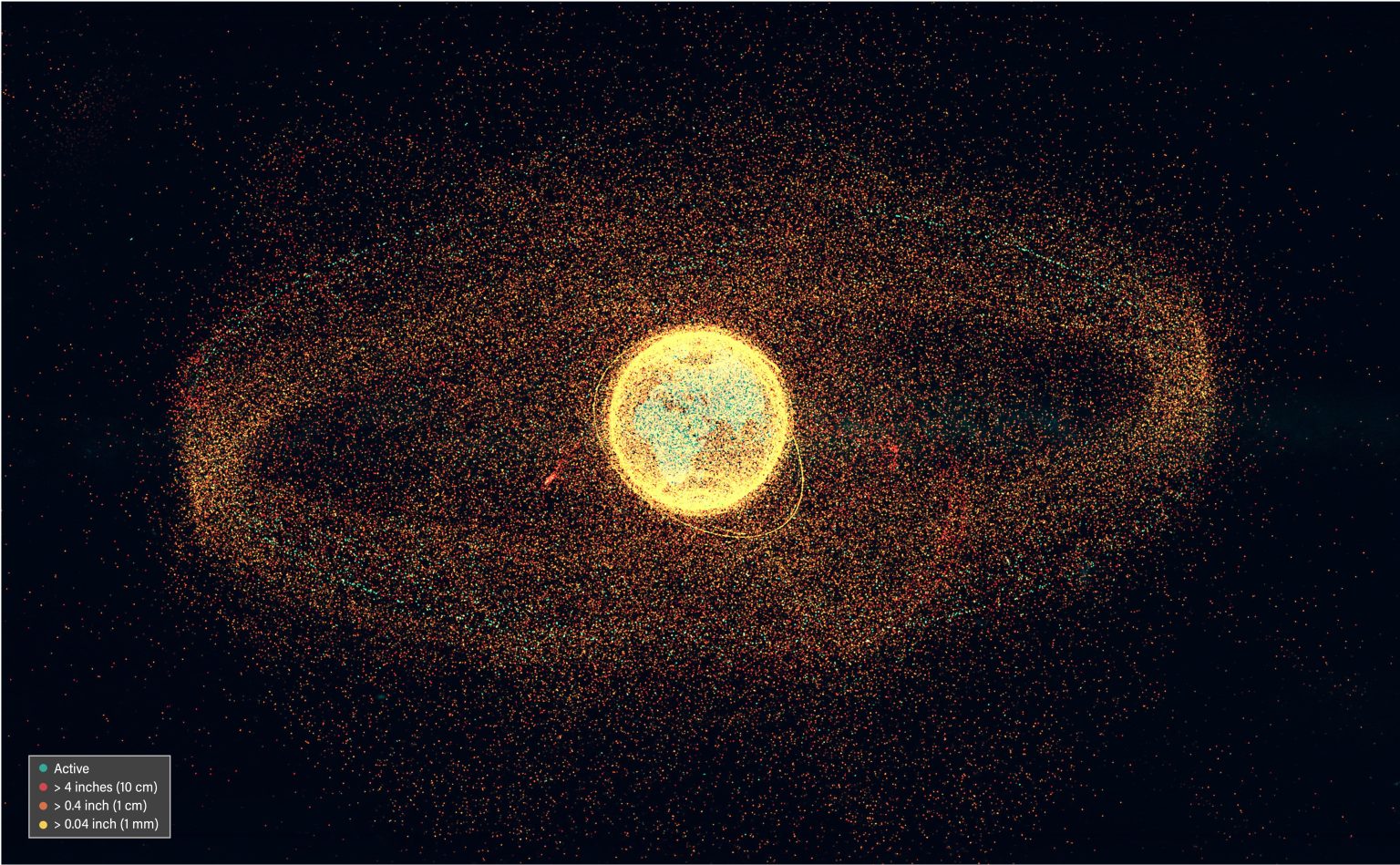
    This visualization maps the active satellites and tracked pieces of space debris orbiting Earth as of August 2024. Green shows active satellites (10,200 objects), red shows debris larger than 4 inches (10 cm; 50,000 objects), orange shows debris larger than 0.4 inch (1 cm; 1.2 million objects), and yellow shows objects larger than 0.04 inch (1 mm; 130 million objects). Not much green (active). Not shown are the approximately 2 trillion pieces of space debris larger than 0.0004 inch (0.01 mm), as they would completely cover the image, overwhelming the field of view.


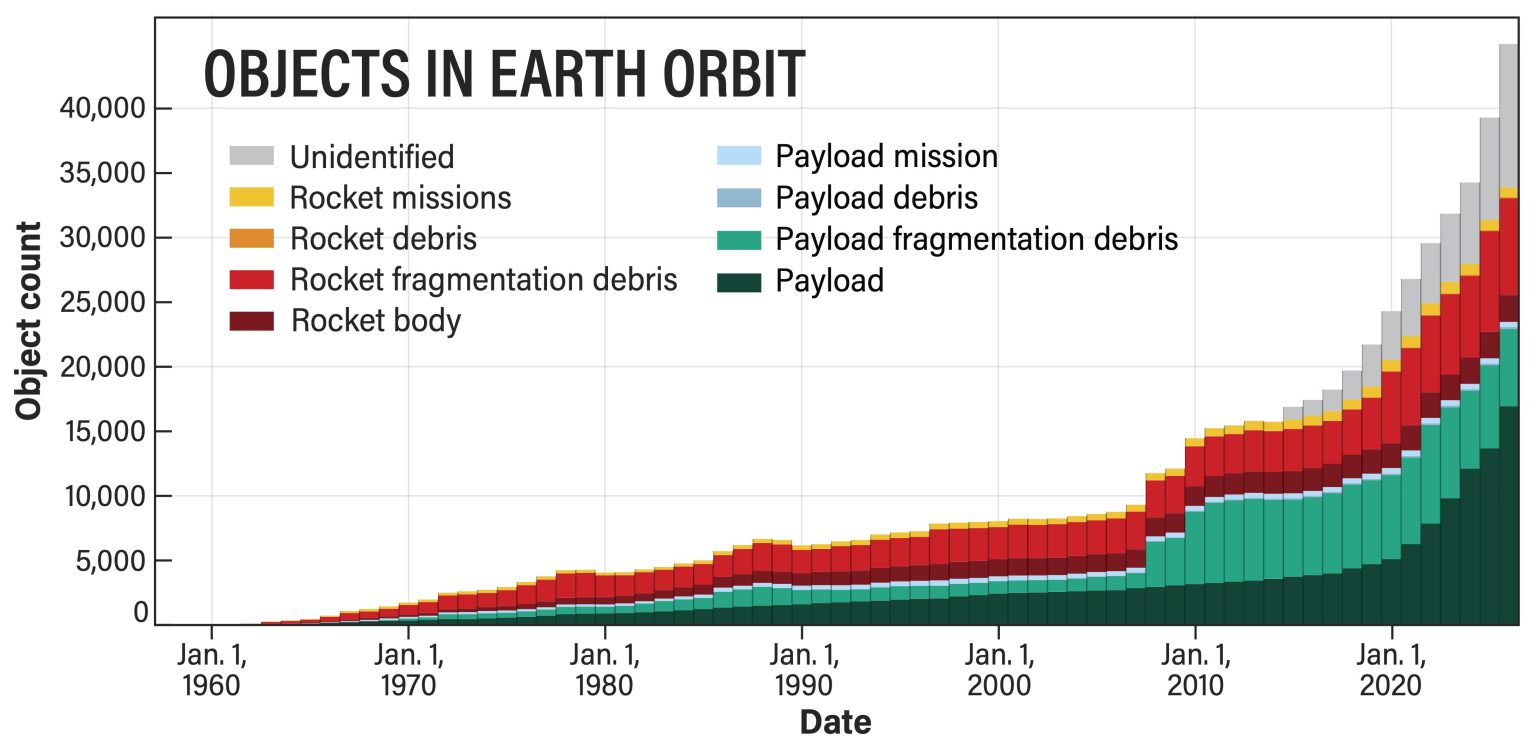
    This chart from ESA’s 2026 Space Environment Report shows the number of tracked objects in all orbits over time. In addition to unidentified material, this includes leftover rocket stages (rocket bodies) and other pieces such as shrouds and engines (rocket missions).

    Rocket fragmentation debris refers to debris generated by rocket-related objects that can be traced to a single unique event, such as a collision or explosion; rocket debris is debris that cannot be tied to a source. Payload mission material refers to objects carried to orbit for a specific function, such as satellites and observatories, as well as shrouds or covers ejected prior to operation.

    As with the previous category, payload fragmentation debris is debris that can be traced back to a specific damage event involving a payload object, while payload debris cannot be associated with an event or source.


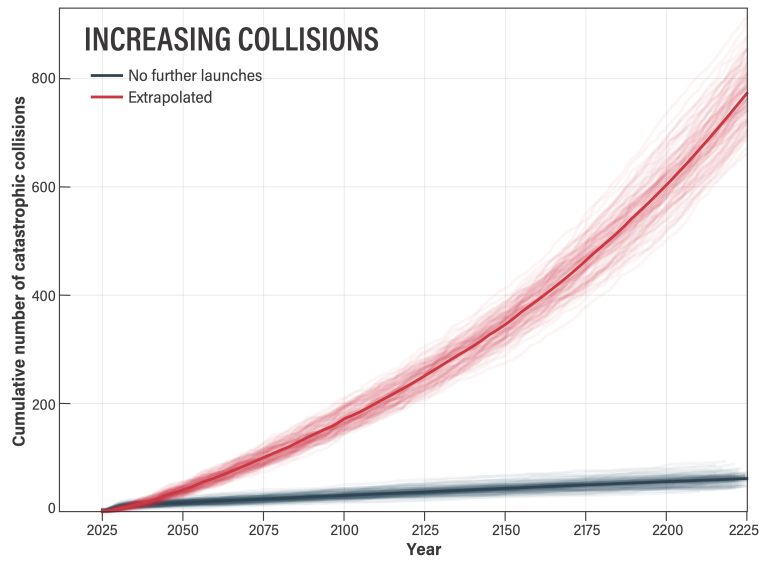
    ESA’s 2026 Space Environment Report compares the cumulative number of future catastrophic collisions expected in LEO over time for two scenarios.

    The top red line shows the projected cascading number of collisions expected if current trends continue regarding launch cadences, space debris fragmentation, and the lack of targeted debris removal as of 2025. The bottom blue line shows the case with no future launches from 2025 onward; even in this unrealistic scenario, some increase in collisions is expected.


    https://www.astronomy.com/science/ou...uttered-skies/

    _______


    An Artificial CORTEX to Guide Satellite Rescue Missions


    The growing problem of satellites crowding one another is generating concern in the space community, for good reason. Almost 20,000 satellites orbit Earth now, and with more satellite constellations and other satellites being launched every year, Low-Earth Orbit (LEO) is starting to look like it's reaching its limit. Of particular concern are the 3,500+ plus satellites that are basically zombies. They are either completely non-functional or not sending any signals alerting other satellites to their presence.

    A collision between two satellites could be catastrophic. Satellite constellations have some built-in redundancy which would help deal with the loss, but there's an additional risk. A collision could also create a debris cloud, multiplying the ongoing risk. The Kessler syndrome (https://en.wikipedia.org/wiki/Kessler_syndrome) describes a cascade of collisions generated from debris created in a single, initial collision, that goes on to create even more collisions. It's like a feedback loop that keeps getting worse.

    Somehow, this problem must be dealt with. The existing debris is one thing, but intact zombie satellites are another. These have lost the ability to communicate and warn other satellites of their presence. These can be repaired, and that's the subject of new research in Acta Astronautica. It's titled "CORTEX: An autonomous, end-to-end, convex-based framework for close-range rendezvous trajectory design and guidance with hardware testbed validation," and the lead author is Minduli Wijayatunga, a new aerospace engineering faculty member in The Grainger College of Engineering, at the University of Illinois Urbana-Champaign.

    CORTEX Companion Video

    (1:41)

    This work is all about the growing idea of Rendezvous and Proximity Operations (RPO). Spacecraft docking operations have been custom-designed solutions for individual situations, like docking with the ISS. But with thousands of zombie satellites, custom docking solutions aren't realistic.

    "Rendezvous and Proximity Operations (RPO) are shifting from bespoke demonstration missions such as Northrop Grumman’s Mission Extension Vehicles, China’s Tianyuan–1, and Astroscale’s ADRAS-J, to routine missions due to the growth of in-orbit assets and the resulting demand for inspection, servicing, assembly, and debris mitigation," the authors write. They point out that while there were only about 13,700 tracked objects in LEO in 2019, there were more than 24,000 in 2025. That's a shocking increase, and there's no signs of it slowing down.


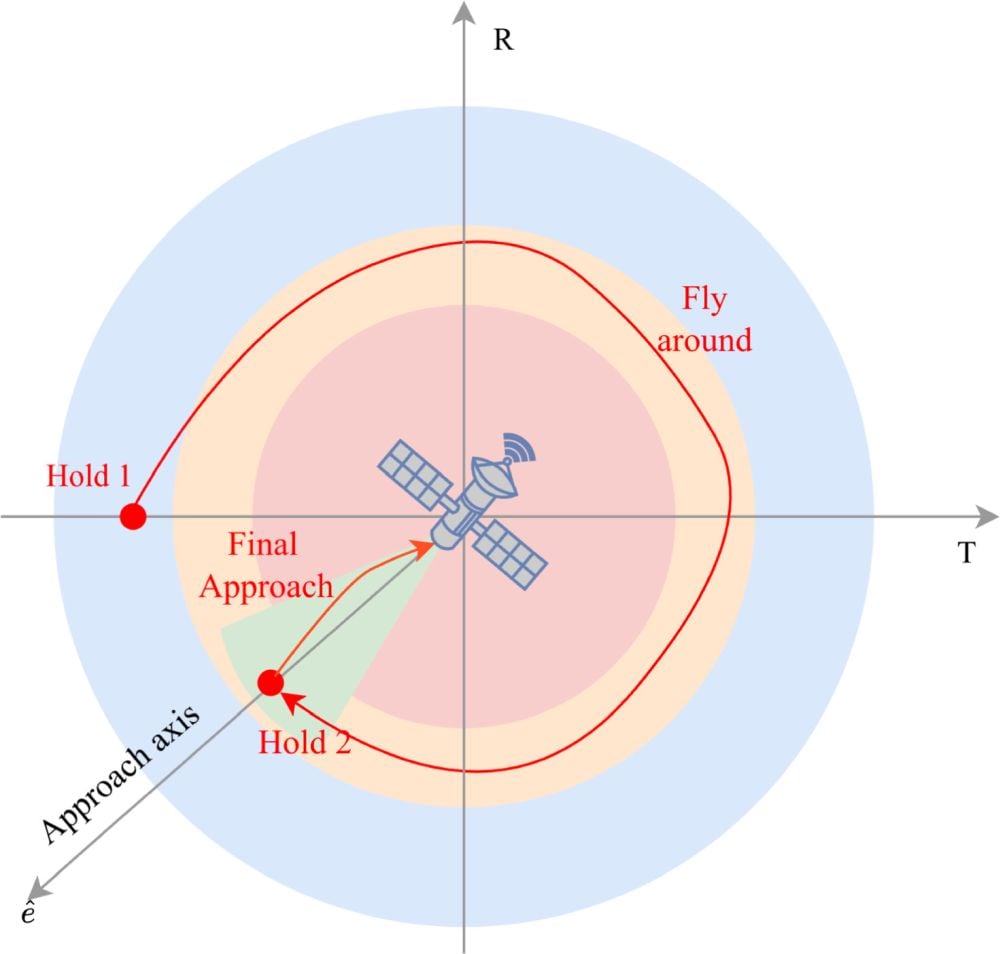
    This figure shows some aspects of CORTEX controlling a servicing spacecraft while it approaches and rendezvous with a client satellite. Blue shows the Rendezvous Sphere, orange shows the Approach Sphere, and red is the Keep Out Sphere. The approach axes is identified as CORTEX's successful solution to the docking problem.


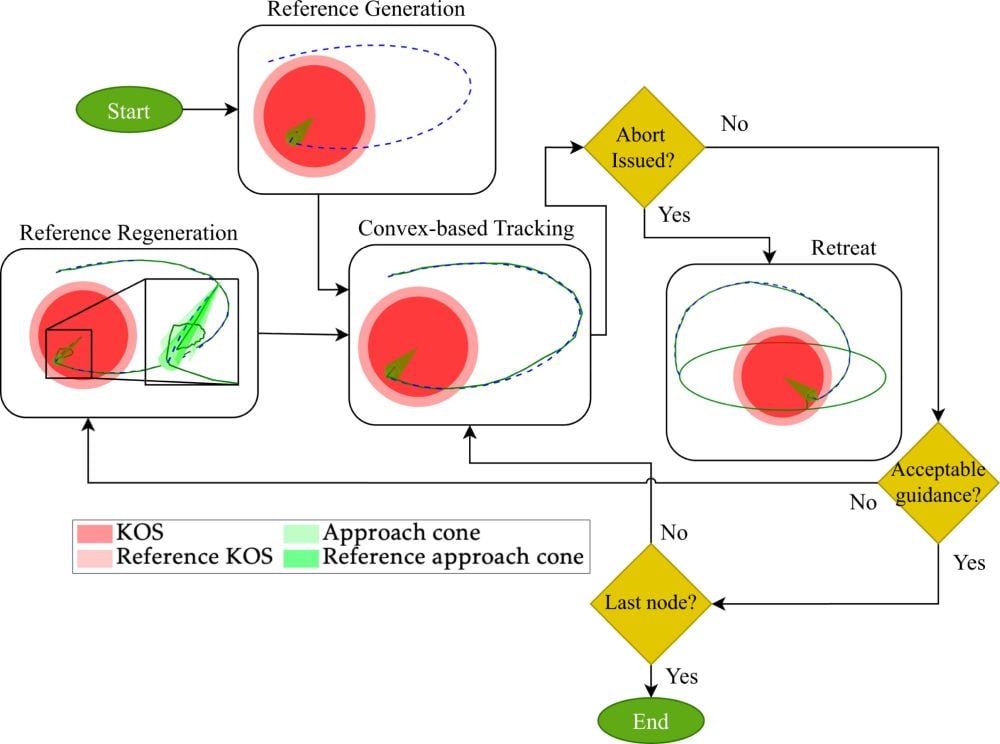
    This schematic flow-chart shows how CORTEX works. CORTEX has the ability to abort its approach if necessary, and instead of giving up, it can determine how to re-approach its client.


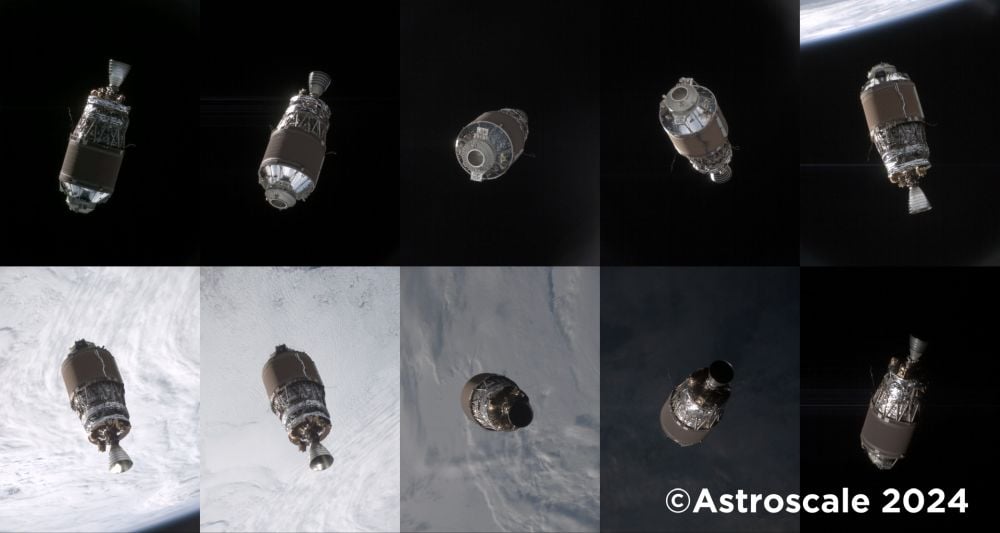
    Astroscale's ADRAS-J autonomous spacecraft approached a spent rocket booster, a typical piece of space debris, and captured images of it from multiple angles. It's a step toward eventual servicing of zombie satellites.

    Published 9th November 2026 by Evan Gough – Universe Today
    https://www.universetoday.com/articl...escue-missions
    Last edited by Bluegreen; 14th November 2026 at 03:23.

  38. The Following 7 Users Say Thank You to Bluegreen For This Post:

    Bill Ryan (13th November 2026), Ewan (13th November 2026), grapevine (13th November 2026), Inversion (13th November 2026), Johnnycomelately (14th November 2026), skogvokter (14th November 2026), Yoda (14th November 2026)

  39. Link to Post #38340
    UK Avalon Founder Bill Ryan's Avatar
    Join Date
    7th February 2010
    Location
    Ecuador
    Posts
    40,341
    Thanks
    300,733
    Thanked 533,391 times in 38,881 posts

    Default Re: Up At The Ranch And Beyond
    Quote Posted by Bluegreen (here)
    Our Increasingly Cluttered Skies
    SpaceX has filed an application with the US Federal Communications Commission (FCC) to launch up to 1 million solar-powered satellites to serve as orbital data centers.
    NO.

  40. The Following 8 Users Say Thank You to Bill Ryan For This Post:

    Bluegreen (14th November 2026), grapevine (13th November 2026), Inversion (13th November 2026), jc71 (14th November 2026), Johnnycomelately (14th November 2026), skogvokter (14th November 2026), ThePythonicCow (15th November 2026), Yoda (14th November 2026)

+ Reply to Thread
Page 1917 of 1918 FirstFirst 1 917 1417 1817 1867 1907 1917 1918 LastLast

Similar Threads

  1. The Indian Lake Project
    By Mluck in forum The Vault
    Replies: 35
    Last Post: 17th February 2013, 17:02
  2. Very Good News-James Gilliland
    By Snowbird in forum Movies, TV, and Games
    Replies: 1
    Last Post: 9th November 2010, 01:50
  3. M 5.0, Lake Victoria region, Kenya
    By EMSC in forum Earthquakes, Latest reports and discussions
    Replies: 0
    Last Post: 13th June 2010, 13:00

Tags for this Thread

Posting Permissions

  • You may not post new threads
  • You may not post replies
  • You may not post attachments
  • You may not edit your posts