+ Reply to Thread
Results 1 to 2 of 2

Thread: Beringia and the Altai Flood into Recorded History

  1. Link to Post #1
    United States Avalon Member
    Join Date
    1st April 2016
    Posts
    7,108
    Thanks
    36,254
    Thanked 40,678 times in 6,757 posts

    Default Beringia and the Altai Flood into Recorded History

    Here is a new approach, which is a scene and a disaster implicated in the way that we keep returning to Siberia as an important origin for the modern human species.

    The total amount of information directly related to the thread title is not more than a few paragraphs, so, the intent is to use it as a frame for more extensive archeogenetics and the like, opening like an umbrella under it.


    This idea balances why I've refuted the Black Sea Deluge hypothesis so many times.

    What I argued was simply it doesn't represent a universal flood, leaving no justification for the Flood Myth, at least not literally.

    It probably does and should show multiple fluctuations, which is closer to what we'll be taking into account here.

    This is in effort to make what I suppose you might call physical markers, that is, materials and genetics that can be fitted to fairly precise date ranges. Most importantly is the Ice Age. That is to say, everything that can be determined about language and intellectual history comes after the Ice Age.

    Rock Art and even Gobekeli Tepe do not in fact prove speech.

    They probably did speak, since even the most primitive Andaman Islanders speak; but no thing such as a primitive language has been discovered. There are lower levels of technology, but that does not mean a low-level brain capable of only grunting noises. We just don't know what was thought or said about a picture of a Vulture or a geometrical design.


    I have sometimes said, in the Ice Age, Central Asia was a paradise, but this doesn't mean a tropical paradise, and it was lovely mostly in terms of being inhabitable.

    Now, knowing that humanity tends to be a riverine species, and, Siberia did not go downhill to the sea because it was hemmed by glacial highlands, there are some things that have been recently measured. Such as about 13,000 years ago, a doubling of Mediterranean outflow increased salinity, and the Atlantic current and warmth.


    That was virtually a positive-to-negative pole, since, during glaciation, the Arctic becomes a sealed freshwater capsule:


    Quote The result was unambiguous. During the low-thorium glacial intervals, reactive beryllium-10 to beryllium-9 ratios fell to between 0.06 and 0.64 times ten to the minus eight—uniformly low values that are not merely riverine but even below the range of modern Arctic rivers. Remarkably, this signature appeared at every site, across all the major basins of the Arctic Mediterranean, despite huge differences in water depth, sedimentation rate and sediment source. Such basin-wide homogeneity is exactly what an isolated, freshened sea would produce, and it is utterly incompatible with an active Atlantic inflow, which would have delivered beryllium with ratios one to two orders of magnitude higher.

    Until the salt water melts the capsule, this "paradise" is a relatively limited region:

    Quote In southern and southeastern Siberia (such as the Altai-Sayan mountains and areas near the Amur region), the landscape mixed larch and birch forests with open terrain, allowing species like the Amur tiger, elk, and ancient human populations (like Denisovans) to persist.

    Although it has that name because found in Russia, Denisovan genetics are highest among natives of New Guinea, about 5%.


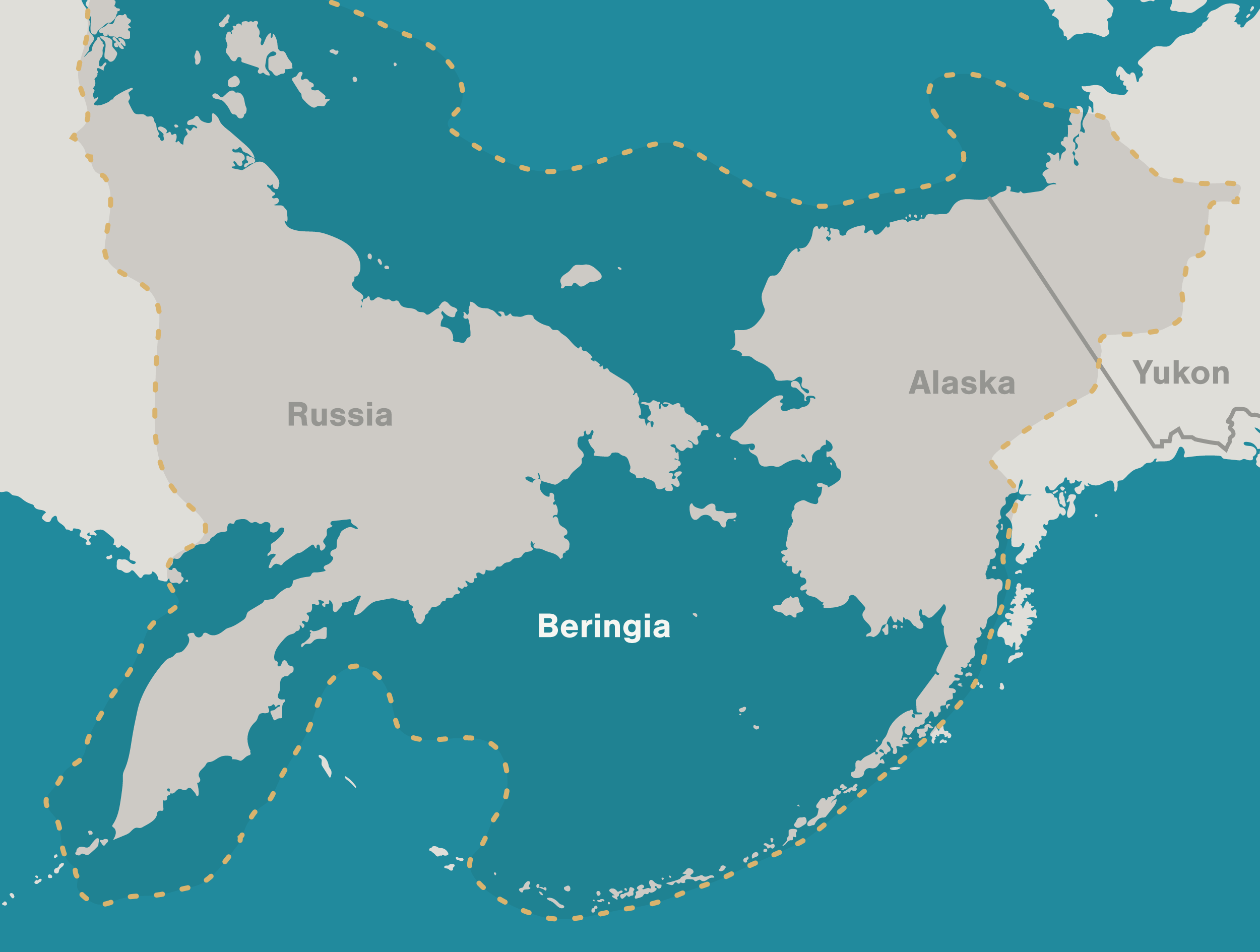
    It may be plausible to extrapolate that same thinking to the "land bridge" and Alaska and Yukon:


    Quote ...the Beringian Standstill Hypothesis.

    Archaeological remains, pollen analysis and climate records show that Beringia was less cold and less bleak than we had previously believed. The area that is now the Bering Sea (north of the Aleutian Islands, south of the Bering Strait) may have had a climate similar to Siberia and Interior Alaska today. Brutally cold in winter, to be sure, but pleasant and full of life in the summer. Glaciers may have dominated what is now Canada, New England and the northern Great Plains, but they never touched low-lying Beringia.

    At that deep level of glaciation something like 30,000 years ago, there is a related population in eastern Europe, Siberia, and North America, non-Denisovan, actually non-Asiatic contrasted to the ancestors of the Koreans, etc. Likewise, it is non-European compared to the westerners who were African.

    The second part is that Indo-Iranians last shared a common ancestor from this branch 10 -12,000 years ago. And these typical names are inadequate, because what came from India is not human stock, but a considerable volume of trade. Biologically, the east is more like Irano-Indians, and the west is more like Irano-Europeans.

    What happens is humans emerge from refugia, most of which are smaller than the Siberian one. There were pockets of survivors in Kandahar, sites on the east and west Caspian shores, Armenia, and perhaps a few others, which were contributors, perhaps responsible for language isolates, but so far nothing else seems comparable to the Siberian traffic.


    We saw something horrible happen recently in Nepal that I thought was the most dreadful thing I had ever witnessed, and this is a phenomenon called a Glacial Lake Outburst Flood that currently threatens about fifteen million Asians, has happened many times in recorded history, and in terms of the Ice Age, happened in cataclysmic proportions that altered geography. One (or a series) is called the Missoula flood that erupted from Montana towards Washington state, or a singular massive Bonneville flood from what is now Great Salt Lake.

    The vast alteration of landscapes means these events are hard to hide, so the instances are fairly limited.

    Now, considering this seems to be where people were living, although the quantities known in recent floods are staggering, the Altai Flood broke a 650m dam with about 600 cubic kilometers of water that rushed out about 300m deep at around 200 km/h, perhaps more than triple what we saw.

    Quote The catastrophic flood(s) occurred between 12000 BC and 9000 BC.

    Most of the water discharge is thought to have occurred during one day...

    Or perhaps up to about 34 hours.


    Quote Giant current ripples, (gravel wave trains, gravel dunes and antidunes) up to 18 meters high and 225 meters in wavelength were created in several locations along the lake bottom.

    Giant bars are found along the lower Chuya and the Katun rivers, rising as much as 300m above modern river levels, with lengths up to five kilometers.

    Ice-rafted boulders up to several meters in diameter exist in the area.

    It's Soviet research from the 80s, which is why it does not sound prominent to us. It may however be the most significant such incident.

    It would have washed into something about twice as big as the Caspian Sea, because the Arctic Ocean was frozen off, it hit Mansi or West Siberia Lake:


    Overall, that thing rose by about 12m, and then flooded its own drainage:


    Quote It is theorized that because drainage to the Arctic Ocean basin (e.g. by the Ob and Yenisei Rivers) was prevented, the lake would eventually overflow to the Mediterranean Sea through a circuitous route that would include the Aral Sea, the Caspian Sea, and the Black Sea. This would have resulted in water from the Selenga River and Lake Baikal draining over a course of some 9,700 kilometres (6,000 mi), considerably longer than any river's course today.

    The underlying thesis is that one massive river went through all those waterways that are mostly separated today, Siberia to this lake and onwards.


    Looking at the map pins the Altai Flood's source to the corner with Kazakhstan and Mongolia.

    It is difficult to imagine that did not annihilate a river's worth of settlements. Probably more, since it is estimated the cascaded flood out of the Siberian lake might have been about 8m. It may have continued to harm the Black Sea and increase the Mediterranean.


    It might be something that would make you want to search for India or otherwise get away from that or those rivers.

    We have to do some hypothesis, but, the event and the Irano-Indian genetics are at about the same time and place.

    Likewise, what is speculated they had, prior to thawing, was not a bridge, but a land mass nearly the size of Australia:


    And, of course, it is nearly impossible to study by scientific means. It's possible some stone artifacts have been found in today's sea. But if we are thinking the ice got really bad 30,000 years ago, Siberian humans (related to Romanians) are detectable at that age, and the inhabitable corridor probably really did go east into North America. In other words, this was a huge, continuous zone, when everyone else was in tiny little isolated bubbles.


    I have posted several times about Haplogroup U4 in the maternal lineage, and, almost all the records say female genetics travels narrowly and in packs; male genetics tend to go much further and drift around. U4 is extremely rare in the modern world; but it is relatively normal in ancient Siberia and "exploded" in the Bronze Age, until slinking back again. The most astonishing preservation is among the Kalash of Citral, 34%.

    It is almost as if the ancient Siberians teleported to modern Pakistan. The group is so pristine, they are statistically equivalent to their own isolated continent.

    The fact is that genetics tell us who people are, which is not the same as a language group or a culture, leaving questions as to why not or how do people move or change. The Kalash speak their own mix of Sanskrit -- Dardic, which is not quite Vedic, but is probably a derivative, such as chaturmasa becomes Kalash chowmas.

    Their oral tradition is wrong, saying they came from the south, which is meaningful to the extent some Indian males mixed into them, but nowhere near the scale of their mitochondrial genetics, which are as old as Beringia.

    But almost no historical tradition is true beyond maybe a couple hundred years.

    They are symbolically unfalsifiable, if you were to say Noah came from an Ice Age Refuge and Shem started agriculture, it makes sense, in a fairly particular setting, but most likely this was done independently around all the refugia.

    In other words, agriculture did not spread from Anatolia single-handedly, and in terms of genetics, the lactose-tolerance gene is simply another marker that came around 2,700 B. C. E., while dairying happens in the earliest agriculture. That gene is just a trigger for the pancreas to digest lactose in the small intestine, which is irrelevant, because people lived on ferments that would digest it in the large intestine. Mongolia still dairies about seven species while only having about a 7% inclusion of this gene.


    The Kalash are a stark facet on how such archaic ancestry moved around, which is like a 20,000 year Ice Age mystery across the inhabitable strip, and some 10,000 years of world-building as we know it.


    U4 seems to have a preferred father, R1. This is the origin of R1a:


    This is where R1a is found in living populations:


    And this is not just my personal conjecture from reading the clues; most of the scientific community sees it the same way:


    Quote Even though R1a occurs as a Y-chromosome haplogroup among speakers of various languages such as Slavic and Indo-Iranian, the question of the origins of R1a1a is relevant to the ongoing debate concerning the urheimat of the Proto-Indo-European people, and may also be relevant to the origins of the Indus Valley civilization. R1a shows a strong correlation with Indo-European languages of Southern and Western Asia, Central and Eastern Europe and to Scandinavia being most prevalent in Eastern Europe, Central Asia, and South Asia.

    Genetics works like a tree, but we do not always have specimens from every stage of its development. So for example when U6 is found in Romania at about 30,000 years old, it's extrapolated the Basal U is probably around 40,000 years old.

    Although genes change, that does not make the original one go away.

    Quote Only one confirmed example of basal R* has been found, in 24,000-year-old remains, known as MA1, found at Mal'ta–Buret' culture near Lake Baikal in Siberia.

    That is to say, he carries the ancestral gene of what is on that map, even if the gene itself is probably 10,000 by his time.

    What is extraordinary is he also carries a sort of Basal U*, except it works a little differently because the U subclades are not the typical derivatives, but are more lateral and simultaneous.

    For instance, U4 and U9 are originally the same, until the U9 variant heightens on the Makran coast, crosses to Arabia, settles in Yemen, and then Ethiopia.

    That means at something like 5,000 B. C. E., west Europeans were dark Africans, some of whom had blue eyes, and Indians and Ethiopians are Siberian white folk, which means something close to Native Americans.

    Mal'ta Buret Boy is a curious retention of a quite primordial father and mother. He also has a collection of crafts and Venus figurines. Significant but still unreadable. But he is readable as the only known representative of the top of these haplogroup trees.


    If I took Puranic Sanskrit at face value, they simply knew Lake Baikal as Uttara Kuru.

    I'm not sure it's that easy, but this kind of Hyperborean hypothesis is the substrate of what we have more findings on, that is, the beginnings of material culture and language which appear to emanate from Ulug Depe in Turkmenistan at the foothills of Kopet Dagh, within the Jeitun Culture prior to 7,000 B. C. E..

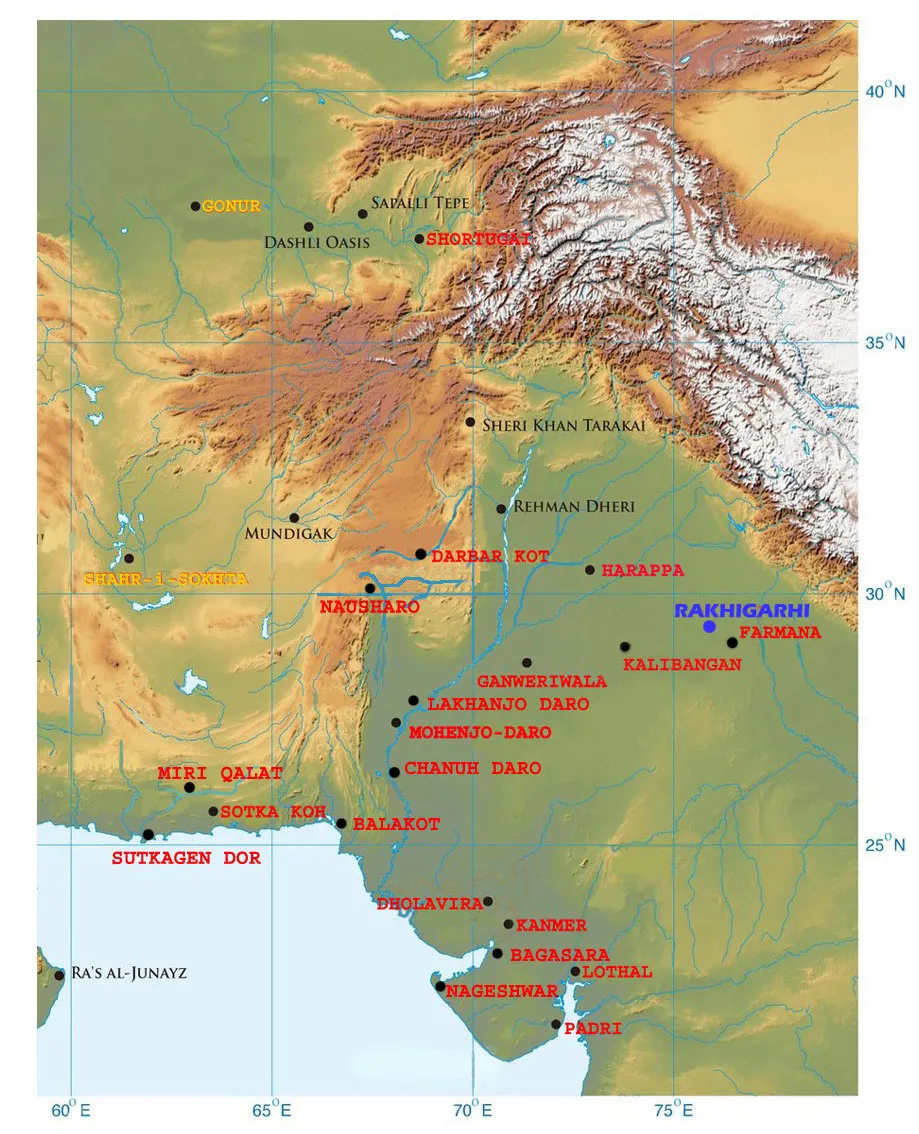
    The extreme opposite end is Rakhigarhi in Haryana, with research ongoing and the announcement of 2026 new remains unearthed. It started only in 2019 1/61 successful samples.


    Quote Steppe pastoralist DNA is absent in the ancient Indus Valley individual, suggesting similarities between these nomadic herders and modern populations arose from migrations after the IVC’s decline.

    The successful sample was female in about the 2,500 - 2,300 B. C. E, range, with nothing from Yamnaya Steppe ancestry, or Anatolian -- Iranian Farmer.

    Most Indians are like her, which is primarily Irano-Siberian Hunter - Gatherer with a small admixture of south Indian. Those other ancestries begin to trickle in only after about 1,000 B. C. E..

    At the time, her best match was genetic outliers, that is, minorities that represent usually less than 25% of a site's finds, therefor presumed as travelers or migrants. Her nearest relatives are IVC-type people found at the sites labeled yellow:


    Gonur Tepe and Shortugai are among numerous cities that have a lifespan of about 2,300 - 1,800 B. C. E., including Mari and Sintashta. Gonur was the seat of Bactria, an entire kingdom or civilization that rose and fell with it.

    Shortugai is more like an Indian colony, in the headwaters of the Oxus connected to the Kochka and therefor Badakhshan, the source of lapis lazuli.

    That's probably the most important era. If I could name it for something, Soma culture appears in Gonur and Ulug Depe around 2,300 B. C. E.. It by far is the main theme of IVC seals.

    On the map of sites, it's the central area that appears to have more to do with the beginning of intellectual history, meaning evolved art and writing, Mundigak and Shahr i sokta. What's on the map as Nausharo is a relatively new settlement, near Mehrgarh, which was much older but abandoned; and it is a very narrow route that begins there and leads to Mundigak. It is this which I have written up as the background for a thread examining IVC Seals, which is far better than any individual source because it combines them all.

    For this thread, we might look at exported IVC seals and those of Dilmun and Old Syria.

    Comparatively, gold is not that hard to find, and is easily workable, found as artifacts in Romania at 4,000 B. C. E.; silver is almost never found as its own ore, and has to be extracted by metallurgical processes, with its first known artifacts in Isfahan, central Iran, about 3,300 B. C. E., much closer in time and space to art and writing found in east Iran. This type of evidence pre-dates anything comparable in Sumeria or India.


    The full report on the first Rakhigarhi genome is at the National Institute of Health:


    Quote After building a mitochondrial DNA consensus sequence, we determined that its haplogroup was U2b2, which is absent in data from about 400 ancient Central Asians and today is nearly exclusive to South Asia.


    If you can imagine a triangle from Ulug Depe, which is far enough north it is off the edge of that map, to Rakhigarhi, through Mehrgarh to Shahr i sokta, that appears to have been a trade route staggeringly early at something like 6,000 B. C. E..

    Moreover, one thing appears to have shaped the human intellect far more than anything else, lapis lazuli, which is in the oldest Egyptian and Sumerian writings as the stone of Heaven. It was the most valuable substance for millennia.

    So there was a way to export it to Rakhigarhi and Egypt that pre-existed writing.

    Something worse than a flood happened such that by around 1,000 B. C. E., much of the ancient world and even several of its languages are lost. The hymns of the Rg Veda and Mazda Yasna are intact, though surrounded by later literature.

    The intent in this thread is towards this truly ancient system, and what may have happened to it. Concerning the many wars that took place, they all have the nature of power struggles; that is, we do not see beliefs that any race is inferior or a religion is wrong. There's more of a bridging across different languages.

    That's the key, bridged differences and shared values, along with early definitions of good government such as Hammurabi or Zoroaster.

    The clearest shared value of debt relief is with the Semitic Amorites and the isolate Hurrians, who allow in a Vedic Sanskrit settlement and intermarry with the Egyptian dynasty.

    The intellectual point is continuous through the Parthian syncretic deity, and, after that, just in Asia.

    The main pivot seems to be Sintashta; whereas horses were domestically bred on the steppe, Sintashta in the Urals was like a massive copper workshop, and is credited with invention of the spoked wheel, the fastest and most decisive factor soon appearing in India and in the Hurrian -- Mittani Kingdom. However it has no kind of writing.


    It has many genetic samples, showing it to be related to European Corded Ware but not Yamnaya:


    Quote It's also generally accepted to be the Proto-Indo-Iranian culture, and thus linguistically ancestral to a myriad of present-day peoples of Asia, including Indo-Aryans and Persians. No wonder then, that its origin, and that of its population, have been hotly debated issues.

    Moreover, many ancient and present-day South and Central Asians, particularly those identified with or speaking Indo-Iranian languages, appear to be strongly attracted to the main Sintashta cluster, forming an almost perfect cline between this cluster and the likely Indus Valley diaspora individuals who show no evidence of steppe ancestry.

    It may be "of the culture", which pre-dates its existence. It is the origin of one thing, the spoked wheel, and is otherwise like a small genetic family serving as a massive distribution center.

    Sintashta's Metallurgy is also incompatible with Steppe origins.


    Quote The ancestors of Fatyanovo-Balanovo originated in the South-Eastern Poland Carpathia region (3000 BC Chłopice-Vesele Culture, the ancestors of Proto-Slavic Mierzanowice Culture) where the first R1a-Z93 samples were found. From there next to the Fatyanovo group towards north went the migration of the Corded Ware Culture Baltic group, moving towards the region of Lithuania and Latvia and creating there the Eastern Baltic Corded Ware Culture. On the basis of numerous old Proto-Indo-European words in the Baltic languages it is even possible to assume that this migration happened jointly with the Fatyanovo people (the future inhabitants of India and Persia, the Indo-Iranian Aryans - the creators and users of Sanskrit and Avestan languages) and a long close neighborhood of the Balts with them. It made it easier for the Balts to retain many elements of the Proto-Indo-European vocabulary and culture in common with the Sintashta.

    A proof of the theory above in linguistics is a verb "to swim", which is uniquely the same only in Slavic and Sanskrit languages. Those two branches of Indo-European kept its unchanged form for over 5000 years:

    Sanskrit: प्लवते (plavate)
    Old Church Slavonic: плавати (plavati)
    Slovene: plávati
    Ukrainian: пла́вати (plávaty)
    Russian: пла́вать (plávatʹ)
    Old Polish: pławać, spławiać
    Slovak: plávať

    Again, it is inadequate to assume that Sanskrit was invented in Poland and somehow sent over; but Aryas were probably parallel and linked to these other areas and so there was a common development.

    Dredging for cognates of Arya in European languages is far weaker than "swim". But it is the self-name that distinguishes Indians and Iranians from others, or, really, the followers of Veda and of Zoroaster.


    Physically, if not in the most refined explanation:


    Quote Z93 was not in India before the Bronze Age. Ancient DNA from the Indus Valley Civilisation, including the Rakhigarhi individual, carries Iranian-farmer and indigenous ancestry but no R1a and no steppe ancestry at all. The lineage appears in South Asian remains only after about 2000 to 1500 BCE, exactly when the steppe ancestry arrives.

    It's not Iranian farmer and it's not steppe ancestry. It's in Corded Ware, all males of Fatyonovo, and dominant in Sintashta.


    There was definitely a divergence with R1a splitting in Europe, whose descendants cluster in Pakistan:


    Quote In Europe, Z282 is prevalent particularly while in Asia Z93 dominates.

    Examined males of the Bronze Age Fatyanovo culture belong entirely to R1a, specifically subclade R1a-Z93.

    R1a1a1 (R-M417) is the most widely found subclade, in two variations which are found respectively in Europe (R1a1a1b1 (R-Z282) ([R1a1a1a*] (R-Z282) (Underhill 2014)[2]) and Central and South Asia (R1a1a1b2 (R-Z93) ([R1a1a2*] (R-Z93) Underhill 2014)[2]).

    The oldest known basal R1a1a1 genotype so far published has been dated to c. 5650 BCE, and was recovered from a site at Trestiana, Romania.

    So again we have to be careful about talking about this starting something. It's a change on the heels of R1a --> R1 --> R*.

    That is to say, starting all those languages; Z93 happened in the greater context of much larger R1a ancestry and established routes. The languages already arose; copper was in wide production. R1a-Z93 tracks with the spoked wheel.

    It's not steppe ancestry, it's a close relative of what Indians already were. They happen to be receiving these genetics when Sintashta itself begins to fade away.


    Or you could think of it as Corded Ware is simply a different track from its Yamnaya cousin:


    Quote ...westward migration from the steppes was responsible for the introduction of a component of ancestry referred to as "Ancient North Eurasian" admixture into western Europe. "Ancient North Eurasian" is the name given in genetic literature to a component that represents descent from the people of the Mal'ta-Buret' culture or a population closely related to them. The "Ancient North Eurasian" genetic component is visible in tests of the Yamnaya people as well as modern-day Europeans, but not of Western or Central Europeans predating the Corded Ware culture.

    The majority of CWC-men carried haplogroup R1a-M417, the remaining ones R1b and I2a. Note that, although related to the Corded Ware population, Yamnaya males mainly carried R1b-Z2103, while R1b-bearing Corded Ware males had R1b-L51, suggesting that Corded Ware culture males cannot be directly patrilineally descended from Yamnaya individuals.

    When it meets someone, for instance, by going west, you find things like the following:

    Quote One hundred percent of the Bohemian Corded Ware samples found without steppe-derived ancestry were female, indicating that this genetic diversity was a result of Corded Ware males marrying and assimilating local Globular Amphora females.

    But then we can be sure a paternal lineage from Europe goes east via Sintashta into India, separate from any, probably much later, motion of the Yamnaya.

    Previously, this was all supposed to have been about how horse-riding elites took over and told everyone what to do, but, as we all know, that basically doesn't work. You can't sit on a horse and bash me over the head and force me to learn Sanskrit. If you present it to me as instructions for craftwork and in divine hymns, I become interested. And I just don't think they rode in on that horse and did that stuff, probably, anywhere.


    What we call the Arabian horse (a term coined in 1330) is geographically Syrian:


    Quote It’s thought to be the oldest breed of riding horse, its distinctive dished nose, wide-set eyes, and large, flared nostrils—that once helped these early chariot horses dissipate heat in the desert—the subject of ancient art for centuries. Arabians are found in Saudi Arabian rock carvings dating from 800 BCE to 200 CE, in terracotta figurines from Syria (2300 BCE), and gracing the tombs of the ancient Egyptians (1427-1401 BCE).

    ...by concentrating on the DNA showing the greatest genetic variation (populations further away from the source tend to have smaller gene pools), Dr. Khanshour discovered that the region in and around Syria is most likely the birthplace of the breed.

    So it is actually Nabatean spread by Bedouins, and, if we only find one figurine around 2,300 B. C., E. from Tell Brak, Hasakah, it is quite notable that what is being featured is not really the horse but the details of harness and bridle. However that image is "protected" so you have to look to see it.

    Therefor, the Ukrainian steppe horse may even be subsidiary to this, whether by ancestry or by adaptation of the process to a wild population.


    The dirtier question is if Dravidic and Altaic languages are related as archaic blasted-away bits. That is if India was populated about 8,000 B. C. E. by Dravidians who came from Siberia. The upper bound on Sanskrit or its Prakrits is perhaps about 3,000 B. C. E., which I have suggested was part of the technology and cultural transfer from Mundigak. This was the freaking highway before the Z93 individual was born.

    One can try to guess about a "proto" Irano-European language that may have circulated prior to 3,000 B. C. E., which has no art or writing to support it. Just known contact over long distances. India, so far, seems to be the accumulation of various imported technologies, which may have well brought Irano-Sanskrit as a lingua franca of the artisanal world.

    It certainly wasn't taken over and put into a forced conversion to anything. It was, however, highly selective, like if you go through finished goods, you find almost nothing Mesopotamian. There might be about ten Akkadian-type seals in India, virtually negligible compared to the amount and distance of Indian products.


    If we begin to insinuate the horse was from Tell Brak, it's one of the oldest and largest sites in Upper Mesopotamia, Semitic with a later Hurrian -- Mitanni phase before being destroyed.

    It has a unique and unidentified Eye Temple that matches nothing in the world:


    Its development was slightly ahead of southern Mesopotamian sites such as Uruk, and it shows transportational phases of donkeys and hybrids prior to horses, wagons and two-wheeled carts prior to chariots. It was famous for acrobats and obsidian.

    IVC iconography is based on the Donkey, and, certainly, Sinauli Chariots is a misnomer because they are solid-wheeled carts.

    Quote According to historian Ruchika Sharma, Jawaharlal Nehru University,

    We should first obtain clarity on why ASI is calling them 'chariots'. It isn't uncommon for a Late Harappan site to have bullock carts. There is already evidence of such terracotta carts [...] ASI has a tendency to colour their discoveries from the lens of Hindutva. They had earlier interpreted female figures as 'mother goddesses', even though there was no evidence to suggest it.

    There is a lack of horse remains in IVC or BMAC, with their earliest substantial finds with Gandhara grave culture at ca. 1,400 B. C. E..


    But that is a simply awful comparison to Vedic practice, which far more strongly matches the ca. 1,900 B. C. E. Cemetery H Cultureand the appearance of rice:


    Quote Some of the designs painted on the Cemetery H funerary urns have been interpreted through the lens of Vedic mythology:

    For instance, peacocks with hollow bodies and a small human form inside, which has been interpreted as the souls of the dead, and a hound that can be seen as the hound of Yama, the god of death. This may indicate the introduction of new religious beliefs during this period, but the archaeological evidence does not support the hypothesis that the Cemetery H people were the destroyers of the Harappan cities.


    Cremation in India is first attested in the Cemetery H culture, a practice previously described in the Vedas. The Rigveda contains a reference to the emerging practice, in RV 10.15.14, where the forefathers "both cremated (agnidagdhá-) and uncremated (ánagnidagdha-)" are invoked.


    Blessings because, there, they actually cite the relevant verse. Proponents of the "Kurgan hypothesis" bandy about the misty phrase "burials similar to Vedic rituals", and I have bothered to excavate what they are talking about, which contradicts the claim. It talks about burial maybe a couple miles outside the village, with a perhaps small, symbolic stone fence placed halfway in between to prevent you from returning.


    Horse burial would not be expected to be a part of that, so, the Vedic textual evidence for horses may well be older than the 1,400 B. C. E. burial evidence; in fact, that's about the same age as Kikkuli's Horse Manual.


    So there was a Vedic settlement among the Hurrians, who, themselves, are difficult to identify, having their own language family; but culturally are perhaps the most influential group in west Asia. There isn't genetic information on them, but, they are presumed as an offshoot of Kura-Araxes, which is more or less Armenia from about 4,000 B. C. E., which has yielded the masculine and feminine haplogroups:


    Quote R1b1-M415 (xM269)

    U1a1a, U2e, U3a2, U3b1a1, U3b2, U4

    The data indicate a largely stable genetic profile over time, with limited gene flow from Steppe populations, distinguishing them from later Bronze Age groups that incorporated more Yamnaya-related ancestry.
    Those were selected from among others, just to show their presence, in what is probably a melting pot and multi-lingual interface.

    Doubly curious again, the Kalash also have U2e, meaning "European", as contrasted to U2i which is standard in India. Those are not the best terms; U2i is really the group of U2a, U2b, and U2c, and India also has U2e. In fact, U2e is simply found in Europe at about 1%, while it is in India across castes and tribes, Pakistan, Iran, and Central Asia. In the above, we can say, well, those samples are from about 4,000 - 2,000 B. C. E.; the maternal lines are not very European, but the paternal one is (and those were just a selection).


    Kura-Axes introduced a horse to the Caucasus around 3,300 B. C. E.. In transitions, we are not sure if this is a domesticated wild horse, such as the Botai of Kyrgyzstan had, which was a milch animal. It was not specially bred for riding. This Kura-Araxes spread to the Caucasus, Iran, Syria, and Palestine, making it notable that you do see an unmistakably dressed horse in 2,300 B. C. E..

    They were advanced metallurgists who exported to Russia; and also distributed the grape and wine, similarly to Dionysus.

    Their paternal R1b traces to Villabruna, Italy, about 12,000 B. C. E.. And yet he has a descendant among the Botai ca. 5,500 B. C. E.. Otherwise it is very meager in the east, and does not enter India at all.

    The Kalash do not have it; they have R*, R1*, R1a.

    These Armenians have two of the same U-lineages that account for half of the Kalash. Those are ultimately Siberian, but who are the other Kalash mothers?


    R0 (Arabian)

    J2, extremely rare, Arabian, whose closest cousin is the 19% J1 Polish Roma; J2 ranks probably less than a percent in the rest of Pakistan, while it has a high presence of about 2%:

    Quote J2 is more localised around the Mediterranean, Greece, Italy/Sardinia and Spain.

    So the figure of 9% is, for this, extremely high.

    They have altars with horse heads and use wine as a sacred beverage.

    This is "elite", in the sense that two of the rarest mothers in the world have their highest concentrations here.

    It's like a Hurrian -- Nabatean mix speaking Sanskrit.

    Much like the Mitanni. Problematically, they are not chariot warriors, and are thought to be aboriginal, meaning they displaced no one and have not been smashed themselves. And they have strong affinity to the neighboring Kho.

    So we'll look at very ancient things that funneled in to the Mitanni and Kalash, and how things significantly changed after a "Dark Age". The point is to look at it more carefully, since almost everything that has been said (or written) is usually either a pre-conceived notion projected onto the findings, or, a guess that does not bear out.

  2. The Following 6 Users Say Thank You to shaberon For This Post:

    Bill Ryan (8th November 2026), Ewan (8th November 2026), Harmony (8th November 2026), Irminsül (8th November 2026), samsdice (8th November 2026), Yoda (Yesterday)

  3. Link to Post #2
    United States Avalon Member
    Join Date
    1st April 2016
    Posts
    7,108
    Thanks
    36,254
    Thanked 40,678 times in 6,757 posts

    Default Re: Beringia and the Altai Flood into Recorded History

    Today we'll bring in a verbal mystery and a visual one.

    Then my brain is going to explode into thousands of tiny little pieces. Anyone who studies historic trends may get the same result.


    Verbally is a glimpse into the root of Indo-European. I am not a fan of re-constructed "Proto" languages that have no documentation. For instance, if Aramaic appears to be among the oldest forms of Semitic, and, at its origin point, why would you not just consider any older form to be Aramaic? And that's just in a fairly small area. Well, Aramaic as a business language extended to Sogdia, but Semitic languages and their associated lore are in a relatively small spot. Something else accounts for Sanskrit and almost everything spoken in Europe.

    At least in terms of the underlying words. Ideas and knowledge are perhaps different. Trusting what someone says can be worse.


    Something notable about small stand-alone populations like the Munja or Brahui is they have basically nothing in terms of self-legendry; the Brahui were "introduced" to the concept of history in the 1700s. So this type of thing is not an inherent criterion of existence.

    Probably one of the worst rips against mankind knowing much of its own history is found in what may be the "Indo-European center", Armenia.

    That's not their personal name for themselves (Hay).

    What happens is the Orontid Dynasty converted to Zoroastriamism in the Achemenid Period -- and they take the Armenian epynomous founder, Hayk, and merge him with Zoroastrian mythology; we know those stories are not original Zoroastrianism either, but there is a surge of storytelling in this era, and the Armenians take it and say "that's us".

    Later, it was the first kingdom to independently convert to Christianity -- and they re-write it all and re-define themselves and their national hero as associated with Biblical patriarchs -- "that's us".

    What is odd is that it was not all that long from a perfectly fine recording of objective history in the Lake Van Cuneiforms, and this is not a mystery at all, because they have dual-language inscriptions with Neo-Assyrian; and this is in the 900 - 600 B. C. E. range. So, yes, that more or less is textbook for what actually happened, and the Armenians had no clue by one or two hundred years later.

    Armenian itself refers to the language, since the cuneiforms are the sole branch of this isolate family:


    Hurro-Urartian


    The first refers to Hurrian speakers with no state until the Mitanni Kingdom, and, after the Dark Age, this is a state:


    Urartu


    Others have recorded it as Ararat, but after the demise of the state, no one remembered it there.


    For the most part, the Hurrians are known in Greater Armenia, and, the difference is, Urartu includes the Highlands, which have been occupied for millennia, but, apparently, not as a country. It's like IVC is not clearly a country or has any countries. But the Highlanders are definitely "a people":


    Quote Recent studies have shown that Armenians are indigenous to the Armenian highlands and form a distinct genetic isolate in the region. There are signs of considerable genetic admixture in Armenians between 3000 BC and 2000 BC, these mixture dates also coincide with the legendary establishment of Armenia in 2492 BCE, but they subside to insignificant levels since 1200 BC, remaining stable until today.

    Genetic studies explain Armenian diversity by several mixtures of Eurasian populations that occurred between 3000 and 2000 BCE. But genetic signals of population mixture cease after 1200 BCE when Bronze Age civilizations in the Eastern Mediterranean world suddenly and violently collapsed.

    And this is a sponge for a different kind of Bronze Age migration:


    Quote A large genetic study in 2022 showed that many Armenians are "direct patrilineal descendants of the Yamnaya".

    Considering that Urartian began to diverge from Hurrian around 2,000 B. C. E.:


    Quote It must have had long contact with, and been gradually totally replaced by, an early form of Armenian.

    Before that happens, I know something Hurrian when I see it, the deity of Teisebaini ca. 650 B. C. E. in Armenia, fortified to defend against Scythians and Cimmerians:


    Teisheba or Teišeba


    Is that a Unicorn?

    Quote Theispas was often depicted as a man standing on a bull, holding a handful of thunderbolts. His wife was the goddess Huba, counterpart to the Hurrian goddess Ḫepat.

    Theispas is associated with the Assyrian god Adad, the Vedic god Indra, and with Teshub, a god of the Hittites and Hurrians.

    It's Hittite because they also got it from the Hurrians. But Teshub has been considered the major cultural influence in the region since he was first heard of. He must be about two thousand and this is his last hold.

    About 585 B. C. E., the city is thought to have been attacked during the night, as it was burned in such a way that there are people trying to run with gold objects in their hands and human remains are everywhere.


    Until that point, there are states which previously are thought to have expanded towards the highlands, such as Hayasa, which is potentially the source for Hay and Hayk, although Sumerian Ea -- Hayya is another possibility. A Hittite copy of one of its legends curiously includes Canaanite Elkurnisa, which is considered to be related to this verse:


    Vayvarechehu vayomer baruch Avram l'El Elyon koneh shamayim va'aretz


    It's also found in bi-lingual Phoenician -- Luwian. If the equivalency is correct, it comes out as El Possessor/Creator (El koneh from the above), but of course it is really a Baal story. Point being how widely copied it is.

    The first kings of Urartu instead said they were of Nairi, an amorphous confederation having this record:


    Quote An early documented reference to Nairi from the 13th century BCE is a tablet which describes the purchase of 128 horses from the Nairi region.

    It sounds like a Hurrian League after the destruction of Mitanni by the Hittites. You find a Hurrian-derived language and their chief deity coming out of this. It's Greater Armenia with an eye to the mountains. There absolutely is a reason why this should be happening.


    Here's what would make "Van" or Urartu even more significant:


    Quote The Armenian Plateau has been called the "epicenter of the Iron Age", since it appears to be the location of the first appearance of Iron Age metallurgy in the late 2nd millennium BC.

    So they say. But it's practically a mirror of India. In that case, also around 1,200 B. C. E., it seems that iron was really in the hands of "tribes" in the mountains, and new contacts were made and businesses started, and what we call Damascus steel is really Indian; Armenia is certainly closer to where more writings start to re-appear, and Indian steel is top quality. This is paralleled by the older Sanskrit Aya, metal, appearing in new phrases that say red or black, with black metal indicating iron. Therefor there is no conclusive appearance of iron in the Rg Veda.


    It has been known for a long time:


    Quote Assyrian inscriptions of Shalmaneser I (c. 1274 BC) first mention Uruatri as one of the states of Nairi, a loose confederation of smaller kingdoms and tribal states in the Armenian Highlands in the thirteenth to eleventh centuries BC which he conquered. Uruartri itself was in the region around Lake Van.

    Because the Assyrians continually and repeatedly attack it, until it seems to unify or replace the Nairi becoming its own power about 860 B. C. E., until they continue to attack it, are joined by others, enough so that it's not even known who finished it off. By around 500 B. C. E.:


    Quote In the late 6th–early 5th century BC, with the emergence of the Satrapy of Armenia in the region, Urartu (Urashtu in Babylonian) was used as a synonym for Armenia (Old Persian Armina) in the trilingual Behistun Inscription.

    Armenia means you don't remember anything Hurrian, I guess. That sounds like being plundered for six centuries in a row, corresponding to a period of no genetic mixing. The presence of Urartia did not cause any physical changes to the inhabitants, and if its language died, it was probably one of those official languages like Aramaic in Gandhara.


    After the wipeout, it was taken in to the Achemenid Empire around 570 B. C. E..


    Not surprisingly, prior to the Ice Age there was mixing of individuals from north to south Mesopotamia, then, a period of isolation, after it, a population explosion with stability in the maternal line for 8,000 years, and then the Yamnaya and Armenians really have a common ancestor, Caucasus Hunter - Gatherer:


    Quote Caucasus hunter-gatherer (CHG) "genomes significantly contributed to the Yamnaya steppe herders who migrated into Europe ~3,000 BCE, supporting a formative Caucasus influence on this important Early Bronze Age culture. CHG left their imprint on modern populations from the Caucasus and also Central and South Asia possibly correlating with the arrival of Indo-Aryan languages." For example, about 50–70% of Armenian ancestry is derived from CHG, persisting from Neolithic times to the present.

    This early CHG is part eastern, perhaps Siberian, and it is not found in corresponding western Anatolians. The takeaway is that the theoretical language-spreading Yamnaya contributed nothing to Bactria at its zenith, but they do contribute to Armenia, findable as R1b, which is not in the east.

    Its Orontid Dynasty is not until about 400 B. C. E., which is when they re-enter the records and we find they are ripe for Zoroastrian revisionism, because they have forgotten Urartu, which means this Hurrian regime must not have whitewashed their Armenian language. Nevertheless, they have forgotten the cuneiform and whatever may have come before that, and appear to roll with the versions given by two religious conversions.

    The region may have been Gilgamesh's Aratta.

    So, that's curious, they were beside Hurrians, they had a Hurrian state for three centuries, and yet that language evaporated. There aren't loan words or cultural influences, although there are no Armenian records until the 300s, so they are basically silent, apart from external evidence. From that evidence, we conclude they were always there, speaking their language, except the Yamnaya moved in and had kids, which is more of a way to get your language used than a court language or commercial lingua franca. That makes them indistinguishable, until further evidence comes along. That's hard to get, when we presume to be talking about places with no writing whatsoever.


    There is, of course, a visual back story to what we looked at above.

    There is shared symbolism throughout most of the seals and other art forms, in a way you could almost say excludes Egypt but includes India. And throughout all the known writing that accompanies this, one of the most important subjects is Time, in all its aspects, from the involvement of deities to the civil calendar. It so happens that our current year of 365 1/4 days is from Ptolemaic Egypt.

    Because I don't believe humanity passed along a whole lot of specific information over a long period of time, I don't believe they had any clue about the precession of equinoxes and certainly not the Great Year.

    With this, the most likely observation is again from Egypt, since temples were built around Aswan prior to 3,000 B. C. E. in stellar alignment of that time, which would be noticed, because the building remained intact and the Egyptians weren't miscegenated.

    You have nothing scientific without observations. And it probably was true that most people were looking at the sky at night, and they weren't tracking equinoxes, but they were highly interested in Space or Direction. And what anyone would more easily be able to find is the Pole Star quits working. You know, we're talking about a huge amount of maritime activity; some of the reviews I have seen come off as thinking language and knowledge and so forth is based on land routes. Traversing Iran has never been anyone's favorite. There was a lot of activity by sea, so, questions about north are in constant demand.


    In general, there was a script of Animal Hieroglyphs, that we suppose may have had a common international meaning, with regional differences.

    Because of that, I tend to think the Unicorn was a joke about people who never saw a Rhinoceros. In the Bronze Age, it inhabited Pakistan, and IVC has a perfectly well-detailed Rhinoceros. The normal animals it uses, numerically, are minor, small things, like each their own subject, or industry, or something. But the Unicorn occupies 60-80% of it, making it look like Unicorn People with Unicorn Speech. And/or it is Sanskrit itself; it clearly visually is Soma culture, which is also Iranic.

    In most of the rest of the world, there are few unicorns, and you could debate whether Urartia has one or not. If its heritage is Hurrian, it has continuity for over a thousand years, this being the last part of it.


    We'll find a definite unicorn and one you will have to contemplate visually.


    First is something not really worth looking at, and, is not really the earliest sample of writing. We want to emphasize the location. The site of Konar Sandal South occupation has been dated to c. 2880 BC to c. 2200 BC in the Early Bronze Age. However it is considered to be part of the older Jiroft Culture of eastern Iran, which may have the earliest writing or even experimental systems.

    It possibly was known to Sumeria or Akkadia:


    Quote ...they may be the remains of the lost Aratta Kingdom. Other conjectures have connected the site with the obscure city-state of Marhashi.

    There was a known mound site since 1936, but, here is why there are so many newer finds including the Konar Sandal Unicorn:


    Quote ...in 2001 following
    a disastrous flood the Halil river cut its banks, exposing
    thousands of graves full of precious artefacts. Local
    inhabitants and antique dealers immediately started to
    systematically loot these treasures until Iranian security
    forces put an end to the illegal excavations and seized
    some of the artefacts. Thereafter Iranian archaeologists
    have recorded hundreds of archaeological sites dating to
    Chalcolithic, Bronze and Iron Age, and some late
    Neolithic sites have been also found in the northern
    mountain valleys.

    It's literally not until the 2000s that we have realized how old and massive all that is. Enough that it persuaded me they exported technology to India. That would place Iranic Mehrgarh as the radiation point. The suggestion would be they came out of the mountain pass around 6,000 B. C. E. and settled near the mouth of it. And comparatively, it looks like Indian art begins a little after Iranian, using Iranian symbols. I would not hesitate to guess that if someone from India went to visit a developed Mundigak and Jiroft, they would want to imitate it immediately.

    The Konar Sandal find is likewise a locally-produced IVC reproduction.


    It's a particular kind of cylinder seal:


    Quote ...the ‘whitestone group’. The seals of this group, found at
    Konar Sandal South, Tepe Yahya, and Shahdad, but
    also in southern Turkmenistan and eastwards at
    Mohenjo-Daro, have diverse iconographies, but share
    the use of a similar white stone, a carving technology
    employing drills to carve crucial points of the figures,
    and the characteristic of being strongly worn after a
    prolonged use. According to Pittman, this group of
    finds originated in central Iran and marks a wide network
    of Middle-Asian cultural connections.

    We always question continuity; there are certainly much older sites nearby:


    Quote Excavation of the early Chalcolithic levels at
    Mahtoutabad brought to light the remnants of a large
    hut-like structure, fragments of a distinctive polychrome
    pottery, evidence of leaded copper processing
    and manufacturing of different types of semi-precious
    stones, including calcite-alabaster, chlorite, and lapis
    lazuli. A later settlement dating to the last centuries
    of the fourth millennium BC consumed large amounts
    of bevelled rim bowls, flowerpots, nose-lugged jars,
    elongated jars with downwards-flected spouts, and
    other ceramic types closely comparable with the ceramics
    assemblages of Susiana (Susa, Acropolis, level
    XVIIa), Choga Mish, and other sites of the central and
    south-western Iranian Plateau.

    Knowing another particular thing was made here:


    Quote Carved chlorite objects from Marhashi have been found
    from Mari to the Indus Valley, and from the southern
    shores of the Gulf to the interior of Uzbekistan.

    Things that seem to be brought here:


    Quote ...compartmented metal
    seals imported from Bactria and Margiana.

    A bronze stamp seal found on the surface of Konar Sandal South bears a standing caprid or
    antelope with long wavy horns and a gharial (Gavialis
    gangeticus) of indisputable Indus inspiration, if not
    origin.


    This image has only a few relatives:


    Quote The only other unicorn-like
    animal so far discovered in the typical Halil style appear
    on two chlorite carved vessels and a hand-bag weight.
    The creature, always represented standing among palms...

    Again, those are artistic, rather than seals, which we presume have or develop an extensive meaning. We find that same change in other places; an IVC symbol is used, and then it is re-done with the native Tree of Life, the Date Palm. The Unicorn on the white seal however is just among some animals. It was noted they appear to follow "IVC rules", such as facing right, with the Zebu leading. Similarly, the object art unicorns are slightly iconographically different, having:


    Quote ...a long, straight horn covered
    with segments or ridges clearly indicating a spiral-like
    twisting. The horn of the Indus unicorn is instead rarely
    represented with inner hatchings.

    It's good to notice the differences, but, I can tell you, "hatching" has a lot to do with the message in the Indus seals, in fact you can follow an evolution of the IVC Unicorn, visually and in behavior, giving its livery to the Goat, having an impersonator or Fake Unicorn, and other nuances, which are not arbitrary style choices, but follow a scheme.

    In the same trench with the seal were four flakes of Lapis Lazuli that have been run through X-ray diffraction and electron microscopy, to return the answer that they probably are from Badakhshan; there are minor sources in the Pamir and at Lake Baikal. It's a rock that has a large number of minerals that vary from place to place, but it has no sources in Iran, and it has been exported for over a thousand years at this point, including to older parts of Jiroft.

    The seal itself is relatively uninteresting because it is worn out to nearly nothing. You can make it out just enough to tell it resembles a more intact mother-of-pearl Mari Unicorn.


    Quote In the winter of 1933-34, André Parrot excavated the
    Ishtar temple of the city of Mari on the Euphrates in
    northern Mesopotamia. In the courtyard of the temple
    Parrot discovered remains of a mosaic panel that
    consisted of separate carved mother-of-pearl plates
    about 10 cm high. The panel (Figure 7), now in the Musée
    du Louvre in Paris (AO 19820), cannot be quite reliably
    reconstructed because it was completely mutilated and
    dispersed when the city was sacked, but its components
    make it possible to recognize in it a victory parade,
    with dignitaries in military uniform and weapons,
    bundled prisoners (an important component of other
    Mesopotamian victory parades, like that depicted
    on Sargon’s stela from Susa), and most interesting
    in this connection, a unicorn bull carried at the top
    of a stand (Figure 8). The panel is dated to Late Early
    Dynastic Period, around 2500-2400 BC

    It wasn't compared to the IVC motifs Unicorn Parade and Monumental Objects. The stand was in the hands of a standard-bearer, meaning a realistic animal is not being supported; would they use a terra cotta figurine?

    In this montage is an IVC Unicorn being conveyed in the same manner:


    What humans do in that art that is realistic is basically nothing.

    The Mari Procession looks fairly realistic, until you ask what is that thing being carried.

    The problem with calling it a profile is animals don't have forward-projecting horns.

    And 3-D figurines have a single, central horn. So, it is a creature, maybe not a real one, but something intricately Indian that has been found natively over distance. I'm not sure this is a bi-lingual "Rosetta Stone", but the similarity is a little stronger than just maybe the creature. How someone could carry anything like a real bull is somewhat preposterous. Maybe it means a golden one, or a special statue, but it is most similar to these other ones from quite far away.


    We are very curious about what goes from here (Mari) to the Mitanni Kingdom a thousand years later.

    I'm not saying that is definitely an IVC Unicorn. I'm saying those images are the same kind of weird. The Indian one's definitely a unicorn.

    Among raking arguments about the evidence, there is a tendency to re-ify The Mitanni as if they are "a people", whereas it is just the name of a state. There are no "the Mitanni"; there are Hurrians who have osmosed Sanskrit culture.

    A somewhat weak argument from Mari and older establishments is the use of Marya for "horse-riding elite"; it is a Sanskrit word, but it does not have this connotation, "warrior". In fact its most common meaning is "mortal", such as in Dirghatamas I.150.3:


    Quote sa candro vipra martyo maho vrādhantamo divi |

    the mortal (who propitiates you) becomes a moon in heaven, the most eminent of the great

    So by extension, it may derive to "man", and then "young man", corresponding to which the Rg Veda, at least, imputes it with a connotation of lover in a few areas, while if it is used for "warrior" at all, it is very difficult to find. It's a short form, martaya --> marya, and who would want to call a warrior "those whom death affects"? But yes it has this meaning in Semitic. Does that make it a Sanskrit loan word?

    I'm not so sure. But there are several points about the Superstrate of Mitanni that just slip past. One is that it is not "the deities" Mitra and Varuna, it is the duality, Mitravaruna, which has specific Vedic contexts. And some other personal names are not mere words:


    Ṛtadhāman, not a name in the Veda, but Rta or "order" is one of the main tenets

    Indrota, "Indra has helped", possibly Sudas

    Subandhu is actually the target of Resurrection in hymns X.59-61

    Priyamedha is probably the most important, since he is followed by "the Priyamedhas", which are important to the whole thing, possibly indicating the Syrian one derives from this lineage. It's claimed to be only in the "Late Books", but, Books Eight and Ten also contain some of the earliest material, which has simply been included in later development, or, Book Eight of the Kanvas contains almost the entire epoch, minus the very first few generations.

    If I want to be generous, I could say Maraya is the command kill, which is fine, if you do it to the implication that "Marya" is something from the Rg Veda. It's not an order of knighthood. It's a type of linguistic possibility, if there is a good reason Semites would want to to that, despite the horse being native right there.

    The, so far, lack of warlike evidences in IVC, leaves little reason to seek it in pre-Vedic Sanskrit.


    Part of the noise being made is that the Mitanni gives the appearance of an older and more Iranic pronunciation of the names. And so it must have been them who somehow blanketed it across India. Problematically for this, the difference between Mazda Yasna and Veda is that Zoroaster does not seem to like the Aswins, who were here given their alias Nasatyas, "Not Untrue". You would not seem to be honoring this if it was an Iranian settlement. The root term for "horse" is of course prevalent there:


    Quote aśva-sana- "master horse trainer" (Kikkuli himself)

    So for the Aswins to be regarded as a local village deity, is a little unusual, since they are not among the standard cosmological forces Sun, Moon, Rain, which consist of the vast majority of examples; they fit no standard because I am not aware of any other culture that has a true equal.


    na-ša-ti-ya-an-na


    It's the only one to be attributed the suffix -nna, such as is done in selective constructions like Marya-nnu. Nasatya-nna.

    Nasatya and Dasra do not appear to be used as individual names in the Veda; they are a pair, just like "the Aswins". It's all synonymous. That brings us to a terribly specific instance of unexplainable drift.


    Lithuanian Asvieniai have a slightly different form -- it is a pair of horses pulling the sun's chariot, or, a sole charioteer.


    Its Mythology is hashed and battered but here is something bewildering to find:


    Quote Indraja: Jupiter (Vedic Indra)

    It is the same word, although it sounds to me, like the word was used in a generic meaning, until it was applied to a planet. They have all seven planets. But that is the Chaldean system; it's not Indian. In Sanskrit, Indra is arguably not a personal name. but a title, similar to "lord or king", given to someone who is called Maghavan, Vrtrahan, Purandar, and other names. In Buddhism, you might be able to say he is referred to as Indra, and addressed as Sakra. The planet Jupiter is Brhaspati. So here they are using a Sanskrit word, not a Vedic deity.


    This aspect however is usually accepted as equivalent:


    Quote Perkūnas: The dievaitis of thunder (Parjanya/Indra in Vedism)

    The expression for solar chariot:


    Quote saulės ratai

    We just dodged a lot of mud about Ratha as a common Mitanni name, like it is in the Veda, although supposedly only in the late part. And at any rate, you have the sun goddess, with an invention from Sintashta. Maybe it is their name for their own invention. More plausibly, it is an older word for "cart" cognate to Latin rota "to roll; wheel" which makes it unclear if it is a chariot in the Veda. Nevertheless, with the horses, the Lithuanian vocabulary seems constrained to the Vedic period.

    It's cognate to Surya in the way that "l" drifts or splits to "r".

    To sun goddess Saule':


    Quote "mīļā, balte"

    dear white


    It also has the same Venus -- Dawn as Ushas:


    Quote Aušrinė was first mentioned by 16th-century Polish historian Jan Łasicki as Ausca. He described a "goddess of the rays of the sun that descend and rise above the horizon".

    Yes, goddess of rays. In this context, dawn does not refer to the solar orb, but to civil twilight. Venus is usually the last thing visible in that interval.

    They have some kind of tale about her temporarily mating with the Moon, which is similar to the Veda, which actually is exceptionally detailed about this. It would beg the question of why she marries the Moon and then the Aswins.


    The Lithuanian context of the Aswins is broadly similar, having to do with the sun and power of life, but the Veda is far more technically advanced. They have multiple divine episodes and interactions with humanity. Most of that I think is metaphorical, i. e., something like curing of leprosy represents a mental or spiritual problem that was overcome. It's probably being very poetic about this.

    There are a ton of Lithuanian entries, most of which have nothing to do with Sanskrit, except the most basic core deities, such as:


    Quote Vėjopatis: God of the wind and master of Dausos (paradise)

    The suffix -pati changes context, in the sense that "lord of" something can also be "lover of" something. Their Earth goddess is a cognate of Greek Semele, and her spouse may be named in reference to her:


    Quote Žemėpatis ('Earth Spouse') and Žemininkas, male deities associated with cattle, agriculture and the fertility of the land.

    This appears to be not Indic, but Thracian -- Phrygian. And this is exactly where Greek myth will bang into objective history:


    Quote Semele was the youngest daughter of Cadmus and Harmonia, and the mother of Dionysus by Zeus (her own great-grandfather).

    Cadmus is also the father of Illyrius, namesake of the Illyrians.

    He is notably absent from Hesiod's Cosmogony, but Homer knows "the Cadmeans".

    The sense in which something historical must be true here is that he brought the Phoenician alphabet for the Greeks to use. He has only one kind of antecedent:


    Quote The fact that Hermes was worshipped in Samothrace under the name of Cadmus or Cadmilus seems to show that the Theban Cadmus was interpreted as an ancestral Theban hero corresponding to the Samothracians.

    In turn, the origin of Hermes is from Cretan E Ma Ha.

    Under his wing, so to speak, Semele and Cadmus are drifters from slightly outside the Greek mainland, and directly involve their re-invention of writing, which begins with Hesiod. There is no truly archaic source for them, they don't have Sanskrit equivalents, and they correspond to actual events, the new or classical Greek mythology, and the appearance of the Illyrians. That is something that happened around 1,000 - 800 B. C. E.

    The Argives argue that his father was one of them, while Thebans say he had come centuries before the Trojan War, which, compared to the real event, is impossible. So, we think this is the same principle, over-claiming something about a real event.

    I tend to think the Greeks are getting real input from Luwian Apollo and Cretan Hermes and Zeus, after some kind of Trojan War, and if Cadmus is based on some kind of real person associated with a particular pedigree:


    Quote Unsuccessful in his search—or unwilling to go against Zeus—he came to Samothrace, the island sacred to the "Great Gods" or the Kabeiroi, whose mysteries would be celebrated also at Thebes.

    That's a lot like putting Cretan Hermes and the Samothracian Kabiri into Greek writing.
    ,
    It's not necessarily surprising it reached Lithuania, if, the goddess is important enough so that a male is simply called Husband of Zemele.

    They may have the Aswins expressed with the overall heavenly deity Dievas:


    Quote Dievas had two sons (Dievo sūneliai (Lithuanian) or Dieva dēli (Latvian)) known as the Heavenly Twins.

    Cognate to Sanskrit deva and Avestan, having the meaning of light, divine.

    Zeus "Sky Father" is cognate to Sanskrit Dyaus Pitr.

    Those are two different things which sometimes become conflated.

    Most of their language looks Slavic, so, it seems a little unusual that the most important deities are Sanskrit, Aswins, Usas, Parjanya, and although Saule' is considered cognate, it's not a theological equivalent, nor the moon which may have been taken from the word for month.

    Parjanya/Perkunas is the agent of punishment for the Moon for mating with Dawn. So these cognates are all being used together in a really basic way that the Rg Veda is like hundreds of Homers responding to.


    The premise of deity and heaven is close to the same, as is this other thing of importance:


    Quote Auštaras (Auštra): The god of the northeast wind, who stands at the gates of Paradise and lights the way for those going to the afterlife. This function makes him similar to Aušrinė; some consider him to be her cousin.

    Dausos contains trees which bear golden apples. Day in the garden is perpetual but outside its confines lies perpetual night. Master of Dausos is Vėjopatis (Lord of the wind) or Vėjas (Wind) who is also one of the oldest gods in Lithuanian mythology. Vėjas is identical to Vayu of Hinduism. Auštaras and Vėjopatis are the gatekeepers of Dausos (Dausų Vartai). While Auštaras acts as the psychopomp of good souls, Vėjas (Vėjopatis) blows bad souls into oblivion.

    And there is this curious definition:


    Quote mirti (Verb) to die (used only for humans and bees) ; mirtis (Noun) death

    It lacks Agni and I don't think that's Indra in any normal way, and there is no Soma culture. There perhaps was a reason or the introduction of perhaps even the Samothracian Mysteries, to use Semele, which is not Sanskrit, although her husband has the -pati Sanskrit construction.

    It's like the Sanskrit language without any Vedic content whatsoever. Like you find Agni in Hittite, also meaning fire, but it is not Vedic Agni whatsoever, it is a destructive force.

    However it's a shared Sanskrit language within the age of horse and chariot. It has ugnis as an ordinary noun.

    In that concentrated way, it is about like the better half of Avestan is like reading Sanskrit.

    Armenian has nothing of this, except for cow, kov, gov, Lithuanian karvė, galvijai, galvijas.


    Overlooking three theoretical Proto-languages, Sanskrit Haya:


    Quote Cognate with Old Armenian ձի (ji, “horse”).

    Asva and Haya are not normal nouns, but, verbs or adjectives with the connotation "go fast". And in the Rg Veda, you will find a few instances of haya where it just describes rapid motion. There is a single use of it as a noun meaning "horse" by Pratiksatra Atreya, who I would contend is probably in the last generation.

    Vedic horses are called New Wealth as contrasted to the cow being Old Wealth. All three languages have the same cow in slightly different pronunciations, like I just called it a cow, still the same word.

    Asva is the new and going thing written in hundreds of ways, and this is shared with Lithuania in its core mythology?


    If they won't tell us in words, we'll take their teeth. Most genetic research is done on teeth. Here is a good point made on a regional survey of seventy-three Bronze Age individuals:


    Quote Limited evidence suggests successive waves and local continuity rather than a single population replacement; the millennium-long span (2100 BCE–1625 CE) sampled here includes cultural transitions that archaeology records as shifts in burial practice, settlement pattern and material style. Where the DNA and material culture diverge, it highlights the complexity of identity: people could adopt new practices without wholesale genetic turnover.

    Comparatively, an older migration with Anatolian Farmer entered Sweden around 4,000 B. C. E. and established Megaliths around 3,300 B. C. E..

    Lithuania and environs was considerably later to begin agriculture as well as its Bronze Age was not until 1,200 B. C. E..

    So, physical and technological changes do not mean one people was replaced by another, or even mixed. It is possible different populations can dwell near each other with very little mixing, i. e., farmers and gatherers remain nearby but mostly separate. Perhaps nobles and knights don't usually mix with peasants.

    Here, there definitely is an eastern contribution:


    Quote R dominates (R lineages ~78%), consistent with widespread Steppe‑associated paternal ancestry in Bronze Age Eurasia. Haplogroup N (~13%) is present and likely reflects later or regionally specific connections tied to Uralic‑language‑associated group.

    U (~37%) and H (~32%), mitochondrial clades common across northern and central Europe and often associated respectively with Mesolithic hunter‑gatherer continuity (U) and Neolithic farmer expansions (H).

    Rather than an older Anatolian Farmer, it was Corded Ware that mostly contributed to Lithuania; and we know that it was a certain stripe distinguishable from Yamnaya. And then Lithuania is probably receiving a backflow from both Sintashta and Yamnaya.

    Drawing from Prehistory of the Baltic:


    Quote The presence of ancestry from the Pontic-Caspian Steppe among Baltic CWC individuals without the genetic component from north-western Anatolian Neolithic farmers must be due to a direct migration of steppe pastoralists that did not pick up this ancestry in Central Europe. It suggests import of the new economy by an incoming steppe-like population independent of the agricultural societies that were already established to the south and west of the Baltic Sea. The presence of direct contacts to the steppe could lend support to a linguistic model that sees an early branching of Balto-Slavic from a Proto-Indo-European language, for which the west Eurasian steppe was proposed as a homeland. However, as farmer ancestry is found in later Eastern Baltic individuals, it is likely that considerable individual mobility and a network of contact throughout the range of the CWC facilitated its spread eastward, possibly through exogamous marriage practices. Conversely, the appearance of mitochondrial haplogroup U4 in the Central European Late Neolithic after millennia of absence could indicate female gene-flow from the Eastern Baltic, where this haplogroup was present at high frequency.
    It seems to have been. That's familiar. Judging by the data, it is R1a-dominant over R1b, and it has the Kalash subclade from one individual:


    Quote Kivisaare3 4730–4540 calBCE Baltic EMN Narva Kivisaare, Estonia M 176533 0.186 U4a1

    Currently, although it is somewhat present (1-2%) on the European cusp, it is next strongest in the Siberian Ket (29%) and moderately present in the Volga-Ural region (6-26%).

    Archaically, it was Corded Ware.

    Most likely it tells us these groups shared a common ancestor with the Kalash about 12,000 years ago, and seems to confirm that eastern circulation is largely its own entity.


    Eastern Hunter-Gatherers:


    Quote ...derived part of their ancestry, referred to as Ancient North Eurasian (ANE) ancestry, from a population related to the Upper Palaeolithic Mal’ta boy found in Siberia (MA1).

    And it turns out to be here that you find an interface of otherwise highly-distinct eastern and western peoples:


    Quote Our results suggest continued admixture between groups in the south of the Eastern Baltic region, who are more closely related to WHG, and northern or eastern groups, more closely related to EHG.

    That tells me why Greek and Slavic transfer to Lithuanian, but we are still a bit out there on why the Lithuanian deities are not so much cognates, but simply are Sanskrit. It's transparent. At least to that extent, it is identical, while Kalash is vague and fuzzy and probably more like the suppressed Nuristani, in other words, entirely local. Culturally, they fit as a fringe community that has kept to itself, so much so that you could say they are no kind of separate migration, but then why are they filled out with Arabian ancestry. Is this an expansion of something Iranic, from the south, say, Dorah Pass and Mehrgarh.

    On the other hand, if U9 is a split from U4,, then U4 is already the mother of a large migration across Arabia. Similar to Armenia, I believe this means before 1,200 B. C. E., and the historicity of the Queen of Saba is afterwards.

    It sounds a bit like extensive commerce between Pakistan and Dilmun for at least a few centuries. The Kalash potentially embody women moving in both directions, which is a bit against the idea of a "closed" society, although there could be a reason for it.

    As just a medical fact, they are incredibly highly related to the R1a + U4 track that appears most strongly in Sintashta, Lithuania, and Corded Ware, but they also have mothers anywhere from Nabathea to Yemen. Their language and culture would probably just be regionally normal prior to Islamicization.

    These Lithuanian relatives, however, manifest the Asvieniai to this day, such as on this rooftop:


    Horses did not come from here; they are somewhat modern on this scale of things. They came from the Steppe, which has a different R1b line that went to Armenia, which is I guess an Indo-European language, but, so far, from the view of Sanskrit, has nothing like the above.

    It's not an old name for a wild horse, donkey, ass, onager, or any of that, but it is the main term used in the Veda and by Zoroaster.

    When it is said to be related to equus and hippos, you see how much of a bend that is, compared to the fact that it is instantaneously recognizable.

    The Lithuanian response is that their deity in pagan terms is the same deity now also expressed in Christian terms.

    It almost places Sanskrit as the Eastern Hunter-Gatherer language, or, if you want to call it Irano-Indian or something, and the horse could have come with this name already given to it. If one were to see the Veda as a specifically-Indian reaction to a broader Sanskrit ethos, Lithuania fits that perfectly. It's very simple, and it shows Greek characteristics, e. g. the sun entering a boat to pass the night on the ocean, which is not apparent in the Rg Veda, because it is about other things.

    Anticipating Lithuania to be a late receiver, we find the standard for humans was Cremation at the first signs of horse burial in its Early Metal Age. This is a bit misleading, because it is late to metal work, and it just uses what look to be parts of leftover horse remains; in a couple of cases, two teeth are being called a "burial". These are more like luck pieces. A bit later on, you find the whole horse, buried like a person, near a group of people. In a later phase, it finally becomes a horse buried with a person, which they persisted in doing until 1386.

    Older remains of horses have been found, but it is unclear if they are anything other than wild or milch animals, or if, indeed, there was any particular human relationship to them. And, it seems to be later than most other places when they become used for draught or anything else. The linked article believes they are responding to regional shifts in horses and burial practices that started around 2,000 B. C. E.; the time they are receiving this is probably post-Kikkuli.

    That may be the best explanation for horse-related deities, but it doesn't answer why they already had Sanskrit with the Sun and so on so that Asvieniai could be its offspring. Otherwise you'd have to say the Indo-Aryans took over Lithuania, not India.


    DD Mishra brings up Medus for "honey".

    Parpola digs into Vatsa -- Year and reminds us this is significant for cire perdu or lost wax casting technique:


    Quote *mete-śišta ‘beeswax

    madhu-śiṣṭa

    Well, it turns out the Rg Veda is more popular in Lithuania than in India. You know, I'm focusing the fact that the main pantheon is identical, and it is worth noting where groups of related words travel together, in which case the ones for brother, daughter, etc., are the same. Sveta and syama, light and dark.

    And I'm calling it Sanskrit which I know, but there is in fact a Lithuanian -- Hindi Lexicon, because Hindi is a much larger living language with zillions of terms for all the tiny details in the world. And, guess what...it is thousands of details where Lithiuanian is identical to Hindi, leaving Sanskrit as a sub-set.

    Finally we don't have to have a third party like Parpola cherry-pick something to fit his pre-conceived claim that this was spontaneously delivered to India by authors of the Rg Veda who invaded from the north around 1,300 B. C. E.. Here's Lithuania just telling us what they find that is Hindi:


    kraujas - hi. kravya (cremation fire)

    širdis - hi. hriday (heart)

    vilkas - hi. vrik (wolf, although most animals are not equivalents, aside from kurma -- turtle)

    amalas - hi. amla (gooseberry)

    bebras, bebrus (plg. dar bėras) - hi. babhru (brown, attested in Mitanni)

    kukurbezdalis, kukurdvelkis - hi. kukurmutta m. "grybas". Skr. atitikmens (oyster mushroom)

    garas - hi. gham (heat or ghee offering)

    laukas - hi. lok (I saw this in the deity lists but did not want to be the one to say it was the same)

    mėnuo - hi. mahlna (which, as I did say, is masa -- mas, "month")

    rasa - hi. rasa (taste)

    srautas - hi. srot (hearing)

    tamsa - hi. tamas (heavy or dark)

    ugnis - hi. ag (Agni, fire, unknown in Avestan where it is called Atar)

    ašis - hi. aksa (eyes)

    duona - hi. dhan (to give)

    durys - hi. dvar (door)

    jungas - hi. yug (yuga or age)

    siūlas - hi. sūt (Sutra)

    tinklas - hi. tantu (Tantra)

    žambas, žambis (Jambhala)

    baimė - hi. bhay (fear)

    giesmė - hi. git (song)

    rauda -hi.rudan (Rodas)

    sapnas - hi. sapna (sleep)

    raudonas - hi. rudhir

    sausas - hi. sūkha


    What the heck? It's not "Sanskrit, imposed by the roaming elite", it's freaking "Hindi, common everyday" to an abruptly disconcerting level of detail.

    Unlike Armenia, this was the last Christianized place.

    It sounds like a Greek form of Pali. Not in its entirety, not by looking at the Lithuanian that is in that article because it is unintelligible, but by combing the vocabulary there are a significant number of what I, at least, would be willing to take as equals. This is severe.

    It's above and beyond most concepts of drift and borrowing; it can't prove its primacy, but has every reason to appear late and perceived. Like I have been thinking IVC represents the voluntary adaption of Sanskrit, which includes Dravidian in the Rg Veda, this looks like the same thing happening again. At any rate, it is near-identity throughout...everything...in a way that is not rivaled by anything between the two places. Uralic is an entirely different family, so if Sintashta had Sanskrit, it may have been an un-cemented official language.

    Lithuania has caused an uproar, and, as you see, the work is buried except by Lithuanian specialists.


    Ca. 1912 Saule' and her daughters:


  4. The Following 3 Users Say Thank You to shaberon For This Post:

    Bill Ryan (Yesterday), Harmony (Today), Yoda (Yesterday)

+ Reply to Thread

Posting Permissions

  • You may not post new threads
  • You may not post replies
  • You may not post attachments
  • You may not edit your posts