+ Reply to Thread
Results 1 to 4 of 4

Thread: Beringia and the Altai Flood into Recorded History

  1. Link to Post #1
    United States Avalon Member
    Join Date
    1st April 2016
    Posts
    7,133
    Thanks
    36,364
    Thanked 40,814 times in 6,782 posts

    Default Beringia and the Altai Flood into Recorded History

    Here is a new approach, which is a scene and a disaster implicated in the way that we keep returning to Siberia as an important origin for the modern human species.

    The total amount of information directly related to the thread title is not more than a few paragraphs, so, the intent is to use it as a frame for more extensive archeogenetics and the like, opening like an umbrella under it.


    This idea balances why I've refuted the Black Sea Deluge hypothesis so many times.

    What I argued was simply it doesn't represent a universal flood, leaving no justification for the Flood Myth, at least not literally.

    It probably does and should show multiple fluctuations, which is closer to what we'll be taking into account here.

    This is in effort to make what I suppose you might call physical markers, that is, materials and genetics that can be fitted to fairly precise date ranges. Most importantly is the Ice Age. That is to say, everything that can be determined about language and intellectual history comes after the Ice Age.

    Rock Art and even Gobekeli Tepe do not in fact prove speech.

    They probably did speak, since even the most primitive Andaman Islanders speak; but no thing such as a primitive language has been discovered. There are lower levels of technology, but that does not mean a low-level brain capable of only grunting noises. We just don't know what was thought or said about a picture of a Vulture or a geometrical design.


    I have sometimes said, in the Ice Age, Central Asia was a paradise, but this doesn't mean a tropical paradise, and it was lovely mostly in terms of being inhabitable.

    Now, knowing that humanity tends to be a riverine species, and, Siberia did not go downhill to the sea because it was hemmed by glacial highlands, there are some things that have been recently measured. Such as about 13,000 years ago, a doubling of Mediterranean outflow increased salinity, and the Atlantic current and warmth.


    That was virtually a positive-to-negative pole, since, during glaciation, the Arctic becomes a sealed freshwater capsule:


    Quote The result was unambiguous. During the low-thorium glacial intervals, reactive beryllium-10 to beryllium-9 ratios fell to between 0.06 and 0.64 times ten to the minus eight—uniformly low values that are not merely riverine but even below the range of modern Arctic rivers. Remarkably, this signature appeared at every site, across all the major basins of the Arctic Mediterranean, despite huge differences in water depth, sedimentation rate and sediment source. Such basin-wide homogeneity is exactly what an isolated, freshened sea would produce, and it is utterly incompatible with an active Atlantic inflow, which would have delivered beryllium with ratios one to two orders of magnitude higher.

    Until the salt water melts the capsule, this "paradise" is a relatively limited region:

    Quote In southern and southeastern Siberia (such as the Altai-Sayan mountains and areas near the Amur region), the landscape mixed larch and birch forests with open terrain, allowing species like the Amur tiger, elk, and ancient human populations (like Denisovans) to persist.

    Although it has that name because found in Russia, Denisovan genetics are highest among natives of New Guinea, about 5%.


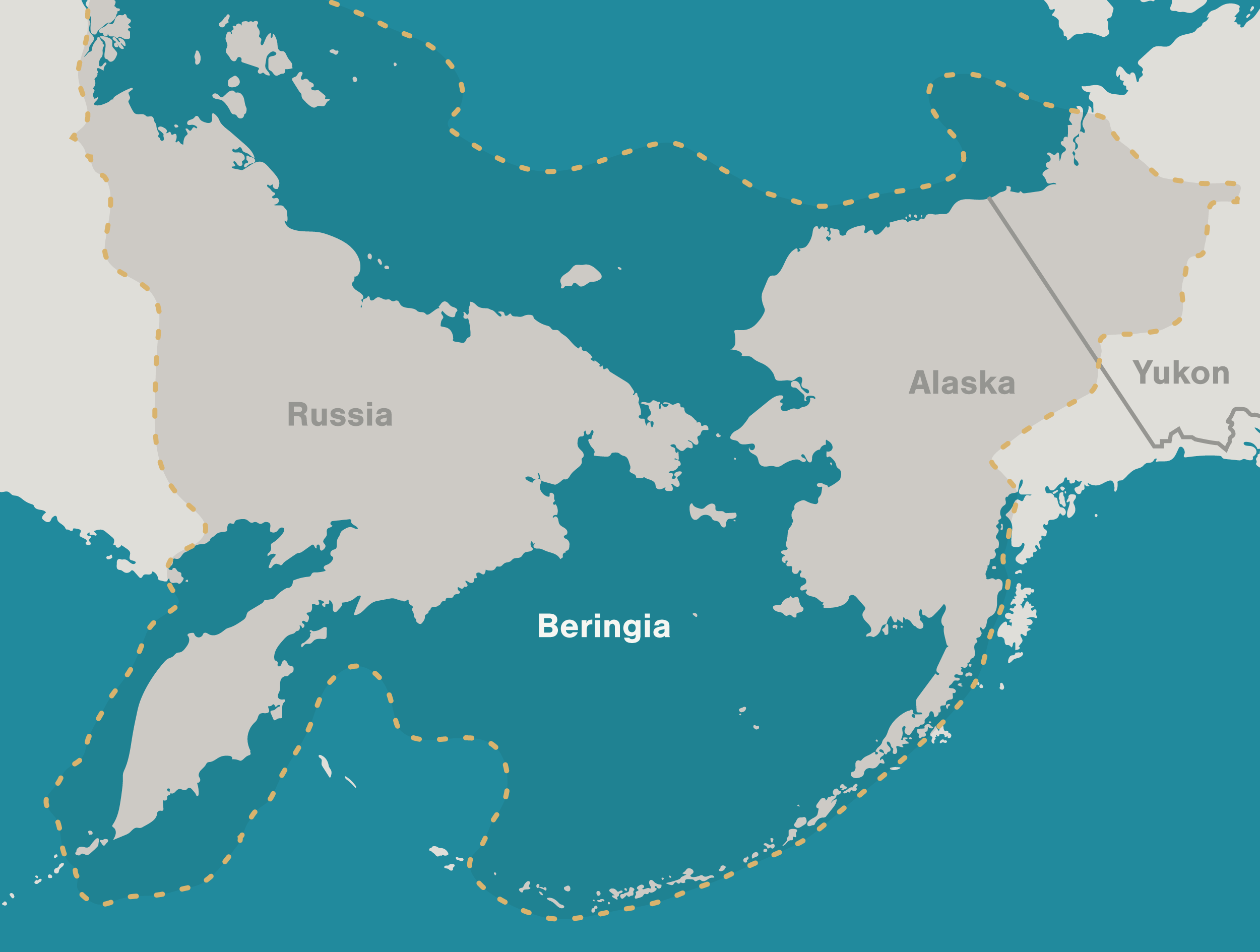
    It may be plausible to extrapolate that same thinking to the "land bridge" and Alaska and Yukon:


    Quote ...the Beringian Standstill Hypothesis.

    Archaeological remains, pollen analysis and climate records show that Beringia was less cold and less bleak than we had previously believed. The area that is now the Bering Sea (north of the Aleutian Islands, south of the Bering Strait) may have had a climate similar to Siberia and Interior Alaska today. Brutally cold in winter, to be sure, but pleasant and full of life in the summer. Glaciers may have dominated what is now Canada, New England and the northern Great Plains, but they never touched low-lying Beringia.

    At that deep level of glaciation something like 30,000 years ago, there is a related population in eastern Europe, Siberia, and North America, non-Denisovan, actually non-Asiatic contrasted to the ancestors of the Koreans, etc. Likewise, it is non-European compared to the westerners who were African.

    The second part is that Indo-Iranians last shared a common ancestor from this branch 10 -12,000 years ago. And these typical names are inadequate, because what came from India is not human stock, but a considerable volume of trade. Biologically, the east is more like Irano-Indians, and the west is more like Irano-Europeans.

    What happens is humans emerge from refugia, most of which are smaller than the Siberian one. There were pockets of survivors in Kandahar, sites on the east and west Caspian shores, Armenia, and perhaps a few others, which were contributors, perhaps responsible for language isolates, but so far nothing else seems comparable to the Siberian traffic.


    We saw something horrible happen recently in Nepal that I thought was the most dreadful thing I had ever witnessed, and this is a phenomenon called a Glacial Lake Outburst Flood that currently threatens about fifteen million Asians, has happened many times in recorded history, and in terms of the Ice Age, happened in cataclysmic proportions that altered geography. One (or a series) is called the Missoula flood that erupted from Montana towards Washington state, or a singular massive Bonneville flood from what is now Great Salt Lake.

    The vast alteration of landscapes means these events are hard to hide, so the instances are fairly limited.

    Now, considering this seems to be where people were living, although the quantities known in recent floods are staggering, the Altai Flood broke a 650m dam with about 600 cubic kilometers of water that rushed out about 300m deep at around 200 km/h, perhaps more than triple what we saw.

    Quote The catastrophic flood(s) occurred between 12000 BC and 9000 BC.

    Most of the water discharge is thought to have occurred during one day...

    Or perhaps up to about 34 hours.


    Quote Giant current ripples, (gravel wave trains, gravel dunes and antidunes) up to 18 meters high and 225 meters in wavelength were created in several locations along the lake bottom.

    Giant bars are found along the lower Chuya and the Katun rivers, rising as much as 300m above modern river levels, with lengths up to five kilometers.

    Ice-rafted boulders up to several meters in diameter exist in the area.

    It's Soviet research from the 80s, which is why it does not sound prominent to us. It may however be the most significant such incident.

    It would have washed into something about twice as big as the Caspian Sea, because the Arctic Ocean was frozen off, it hit Mansi or West Siberia Lake:


    Overall, that thing rose by about 12m, and then flooded its own drainage:


    Quote It is theorized that because drainage to the Arctic Ocean basin (e.g. by the Ob and Yenisei Rivers) was prevented, the lake would eventually overflow to the Mediterranean Sea through a circuitous route that would include the Aral Sea, the Caspian Sea, and the Black Sea. This would have resulted in water from the Selenga River and Lake Baikal draining over a course of some 9,700 kilometres (6,000 mi), considerably longer than any river's course today.

    The underlying thesis is that one massive river went through all those waterways that are mostly separated today, Siberia to this lake and onwards.


    Looking at the map pins the Altai Flood's source to the corner with Kazakhstan and Mongolia.

    It is difficult to imagine that did not annihilate a river's worth of settlements. Probably more, since it is estimated the cascaded flood out of the Siberian lake might have been about 8m. It may have continued to harm the Black Sea and increase the Mediterranean.


    It might be something that would make you want to search for India or otherwise get away from that or those rivers.

    We have to do some hypothesis, but, the event and the Irano-Indian genetics are at about the same time and place.

    Likewise, what is speculated they had, prior to thawing, was not a bridge, but a land mass nearly the size of Australia:


    And, of course, it is nearly impossible to study by scientific means. It's possible some stone artifacts have been found in today's sea. But if we are thinking the ice got really bad 30,000 years ago, Siberian humans (related to Romanians) are detectable at that age, and the inhabitable corridor probably really did go east into North America. In other words, this was a huge, continuous zone, when everyone else was in tiny little isolated bubbles.


    I have posted several times about Haplogroup U4 in the maternal lineage, and, almost all the records say female genetics travels narrowly and in packs; male genetics tend to go much further and drift around. U4 is extremely rare in the modern world; but it is relatively normal in ancient Siberia and "exploded" in the Bronze Age, until slinking back again. The most astonishing preservation is among the Kalash of Citral, 34%.

    It is almost as if the ancient Siberians teleported to modern Pakistan. The group is so pristine, they are statistically equivalent to their own isolated continent.

    The fact is that genetics tell us who people are, which is not the same as a language group or a culture, leaving questions as to why not or how do people move or change. The Kalash speak their own mix of Sanskrit -- Dardic, which is not quite Vedic, but is probably a derivative, such as chaturmasa becomes Kalash chowmas.

    Their oral tradition is wrong, saying they came from the south, which is meaningful to the extent some Indian males mixed into them, but nowhere near the scale of their mitochondrial genetics, which are as old as Beringia.

    But almost no historical tradition is true beyond maybe a couple hundred years.

    They are symbolically unfalsifiable, if you were to say Noah came from an Ice Age Refuge and Shem started agriculture, it makes sense, in a fairly particular setting, but most likely this was done independently around all the refugia.

    In other words, agriculture did not spread from Anatolia single-handedly, and in terms of genetics, the lactose-tolerance gene is simply another marker that came around 2,700 B. C. E., while dairying happens in the earliest agriculture. That gene is just a trigger for the pancreas to digest lactose in the small intestine, which is irrelevant, because people lived on ferments that would digest it in the large intestine. Mongolia still dairies about seven species while only having about a 7% inclusion of this gene.


    The Kalash are a stark facet on how such archaic ancestry moved around, which is like a 20,000 year Ice Age mystery across the inhabitable strip, and some 10,000 years of world-building as we know it.


    U4 seems to have a preferred father, R1. This is the origin of R1a:


    This is where R1a is found in living populations:


    And this is not just my personal conjecture from reading the clues; most of the scientific community sees it the same way:


    Quote Even though R1a occurs as a Y-chromosome haplogroup among speakers of various languages such as Slavic and Indo-Iranian, the question of the origins of R1a1a is relevant to the ongoing debate concerning the urheimat of the Proto-Indo-European people, and may also be relevant to the origins of the Indus Valley civilization. R1a shows a strong correlation with Indo-European languages of Southern and Western Asia, Central and Eastern Europe and to Scandinavia being most prevalent in Eastern Europe, Central Asia, and South Asia.

    Genetics works like a tree, but we do not always have specimens from every stage of its development. So for example when U6 is found in Romania at about 30,000 years old, it's extrapolated the Basal U is probably around 40,000 years old.

    Although genes change, that does not make the original one go away.

    Quote Only one confirmed example of basal R* has been found, in 24,000-year-old remains, known as MA1, found at Mal'ta–Buret' culture near Lake Baikal in Siberia.

    That is to say, he carries the ancestral gene of what is on that map, even if the gene itself is probably 10,000 by his time.

    What is extraordinary is he also carries a sort of Basal U*, except it works a little differently because the U subclades are not the typical derivatives, but are more lateral and simultaneous.

    For instance, U4 and U9 are originally the same, until the U9 variant heightens on the Makran coast, crosses to Arabia, settles in Yemen, and then Ethiopia.

    That means at something like 5,000 B. C. E., west Europeans were dark Africans, some of whom had blue eyes, and Indians and Ethiopians are Siberian white folk, which means something close to Native Americans.

    Mal'ta Buret Boy is a curious retention of a quite primordial father and mother. He also has a collection of crafts and Venus figurines. Significant but still unreadable. But he is readable as the only known representative of the top of these haplogroup trees.


    If I took Puranic Sanskrit at face value, they simply knew Lake Baikal as Uttara Kuru.

    I'm not sure it's that easy, but this kind of Hyperborean hypothesis is the substrate of what we have more findings on, that is, the beginnings of material culture and language which appear to emanate from Ulug Depe in Turkmenistan at the foothills of Kopet Dagh, within the Jeitun Culture prior to 7,000 B. C. E..

    The extreme opposite end is Rakhigarhi in Haryana, with research ongoing and the announcement of 2026 new remains unearthed. It started only in 2019 1/61 successful samples.


    Quote Steppe pastoralist DNA is absent in the ancient Indus Valley individual, suggesting similarities between these nomadic herders and modern populations arose from migrations after the IVC’s decline.

    The successful sample was female in about the 2,500 - 2,300 B. C. E, range, with nothing from Yamnaya Steppe ancestry, or Anatolian -- Iranian Farmer.

    Most Indians are like her, which is primarily Irano-Siberian Hunter - Gatherer with a small admixture of south Indian. Those other ancestries begin to trickle in only after about 1,000 B. C. E..

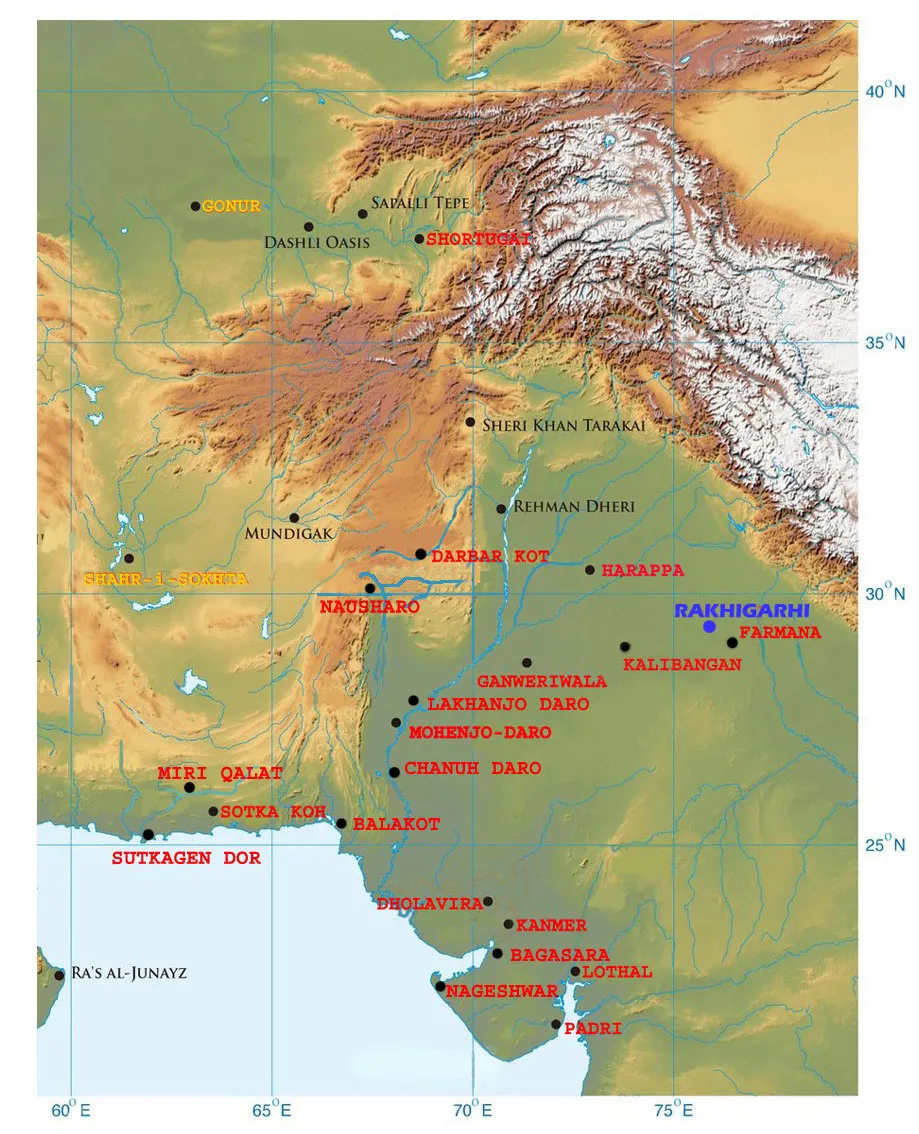
    At the time, her best match was genetic outliers, that is, minorities that represent usually less than 25% of a site's finds, therefor presumed as travelers or migrants. Her nearest relatives are IVC-type people found at the sites labeled yellow:


    Gonur Tepe and Shortugai are among numerous cities that have a lifespan of about 2,300 - 1,800 B. C. E., including Mari and Sintashta. Gonur was the seat of Bactria, an entire kingdom or civilization that rose and fell with it.

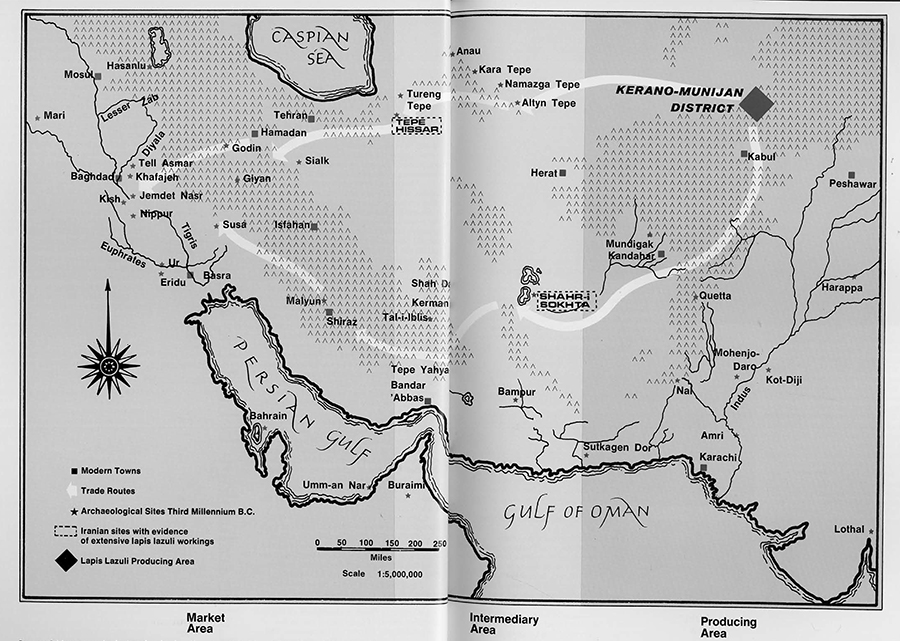
    Shortugai is more like an Indian colony, in the headwaters of the Oxus connected to the Kochka and therefor Badakhshan, the source of lapis lazuli.

    That's probably the most important era. If I could name it for something, Soma culture appears in Gonur and Ulug Depe around 2,300 B. C. E.. It by far is the main theme of IVC seals.

    On the map of sites, it's the central area that appears to have more to do with the beginning of intellectual history, meaning evolved art and writing, Mundigak and Shahr i sokta. What's on the map as Nausharo is a relatively new settlement, near Mehrgarh, which was much older but abandoned; and it is a very narrow route that begins there and leads to Mundigak. It is this which I have written up as the background for a thread examining IVC Seals, which is far better than any individual source because it combines them all.

    For this thread, we might look at exported IVC seals and those of Dilmun and Old Syria.

    Comparatively, gold is not that hard to find, and is easily workable, found as artifacts in Romania at 4,000 B. C. E.; silver is almost never found as its own ore, and has to be extracted by metallurgical processes, with its first known artifacts in Isfahan, central Iran, about 3,300 B. C. E., much closer in time and space to art and writing found in east Iran. This type of evidence pre-dates anything comparable in Sumeria or India.


    The full report on the first Rakhigarhi genome is at the National Institute of Health:


    Quote After building a mitochondrial DNA consensus sequence, we determined that its haplogroup was U2b2, which is absent in data from about 400 ancient Central Asians and today is nearly exclusive to South Asia.


    If you can imagine a triangle from Ulug Depe, which is far enough north it is off the edge of that map, to Rakhigarhi, through Mehrgarh to Shahr i sokta, that appears to have been a trade route staggeringly early at something like 6,000 B. C. E..

    Moreover, one thing appears to have shaped the human intellect far more than anything else, lapis lazuli, which is in the oldest Egyptian and Sumerian writings as the stone of Heaven. It was the most valuable substance for millennia.

    So there was a way to export it to Rakhigarhi and Egypt that pre-existed writing.

    Something worse than a flood happened such that by around 1,000 B. C. E., much of the ancient world and even several of its languages are lost. The hymns of the Rg Veda and Mazda Yasna are intact, though surrounded by later literature.

    The intent in this thread is towards this truly ancient system, and what may have happened to it. Concerning the many wars that took place, they all have the nature of power struggles; that is, we do not see beliefs that any race is inferior or a religion is wrong. There's more of a bridging across different languages.

    That's the key, bridged differences and shared values, along with early definitions of good government such as Hammurabi or Zoroaster.

    The clearest shared value of debt relief is with the Semitic Amorites and the isolate Hurrians, who allow in a Vedic Sanskrit settlement and intermarry with the Egyptian dynasty.

    The intellectual point is continuous through the Parthian syncretic deity, and, after that, just in Asia.

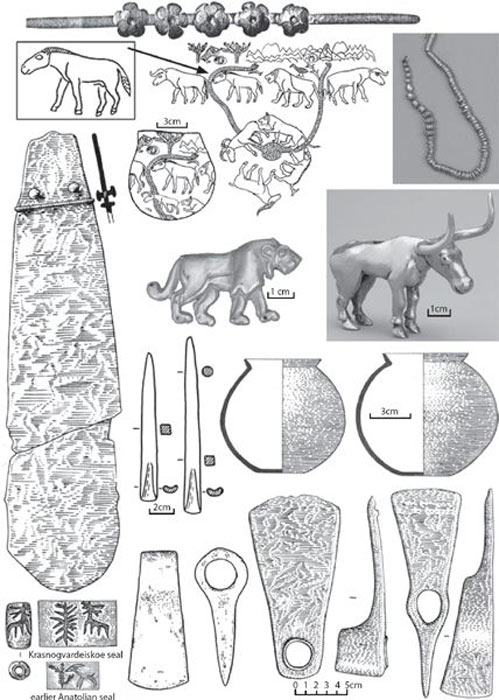
    The main pivot seems to be Sintashta; whereas horses were domestically bred on the steppe, Sintashta in the Urals was like a massive copper workshop, and is credited with invention of the spoked wheel, the fastest and most decisive factor soon appearing in India and in the Hurrian -- Mittani Kingdom. However it has no kind of writing.


    It has many genetic samples, showing it to be related to European Corded Ware but not Yamnaya:


    Quote It's also generally accepted to be the Proto-Indo-Iranian culture, and thus linguistically ancestral to a myriad of present-day peoples of Asia, including Indo-Aryans and Persians. No wonder then, that its origin, and that of its population, have been hotly debated issues.

    Moreover, many ancient and present-day South and Central Asians, particularly those identified with or speaking Indo-Iranian languages, appear to be strongly attracted to the main Sintashta cluster, forming an almost perfect cline between this cluster and the likely Indus Valley diaspora individuals who show no evidence of steppe ancestry.

    It may be "of the culture", which pre-dates its existence. It is the origin of one thing, the spoked wheel, and is otherwise like a small genetic family serving as a massive distribution center.

    Sintashta's Metallurgy is also incompatible with Steppe origins.


    Quote The ancestors of Fatyanovo-Balanovo originated in the South-Eastern Poland Carpathia region (3000 BC Chłopice-Vesele Culture, the ancestors of Proto-Slavic Mierzanowice Culture) where the first R1a-Z93 samples were found. From there next to the Fatyanovo group towards north went the migration of the Corded Ware Culture Baltic group, moving towards the region of Lithuania and Latvia and creating there the Eastern Baltic Corded Ware Culture. On the basis of numerous old Proto-Indo-European words in the Baltic languages it is even possible to assume that this migration happened jointly with the Fatyanovo people (the future inhabitants of India and Persia, the Indo-Iranian Aryans - the creators and users of Sanskrit and Avestan languages) and a long close neighborhood of the Balts with them. It made it easier for the Balts to retain many elements of the Proto-Indo-European vocabulary and culture in common with the Sintashta.

    A proof of the theory above in linguistics is a verb "to swim", which is uniquely the same only in Slavic and Sanskrit languages. Those two branches of Indo-European kept its unchanged form for over 5000 years:

    Sanskrit: प्लवते (plavate)
    Old Church Slavonic: плавати (plavati)
    Slovene: plávati
    Ukrainian: пла́вати (plávaty)
    Russian: пла́вать (plávatʹ)
    Old Polish: pławać, spławiać
    Slovak: plávať

    Again, it is inadequate to assume that Sanskrit was invented in Poland and somehow sent over; but Aryas were probably parallel and linked to these other areas and so there was a common development.

    Dredging for cognates of Arya in European languages is far weaker than "swim". But it is the self-name that distinguishes Indians and Iranians from others, or, really, the followers of Veda and of Zoroaster.


    Physically, if not in the most refined explanation:


    Quote Z93 was not in India before the Bronze Age. Ancient DNA from the Indus Valley Civilisation, including the Rakhigarhi individual, carries Iranian-farmer and indigenous ancestry but no R1a and no steppe ancestry at all. The lineage appears in South Asian remains only after about 2000 to 1500 BCE, exactly when the steppe ancestry arrives.

    It's not Iranian farmer and it's not steppe ancestry. It's in Corded Ware, all males of Fatyonovo, and dominant in Sintashta.


    There was definitely a divergence with R1a splitting in Europe, whose descendants cluster in Pakistan:


    Quote In Europe, Z282 is prevalent particularly while in Asia Z93 dominates.

    Examined males of the Bronze Age Fatyanovo culture belong entirely to R1a, specifically subclade R1a-Z93.

    R1a1a1 (R-M417) is the most widely found subclade, in two variations which are found respectively in Europe (R1a1a1b1 (R-Z282) ([R1a1a1a*] (R-Z282) (Underhill 2014)[2]) and Central and South Asia (R1a1a1b2 (R-Z93) ([R1a1a2*] (R-Z93) Underhill 2014)[2]).

    The oldest known basal R1a1a1 genotype so far published has been dated to c. 5650 BCE, and was recovered from a site at Trestiana, Romania.

    So again we have to be careful about talking about this starting something. It's a change on the heels of R1a --> R1 --> R*.

    That is to say, starting all those languages; Z93 happened in the greater context of much larger R1a ancestry and established routes. The languages already arose; copper was in wide production. R1a-Z93 tracks with the spoked wheel.

    It's not steppe ancestry, it's a close relative of what Indians already were. They happen to be receiving these genetics when Sintashta itself begins to fade away.


    Or you could think of it as Corded Ware is simply a different track from its Yamnaya cousin:


    Quote ...westward migration from the steppes was responsible for the introduction of a component of ancestry referred to as "Ancient North Eurasian" admixture into western Europe. "Ancient North Eurasian" is the name given in genetic literature to a component that represents descent from the people of the Mal'ta-Buret' culture or a population closely related to them. The "Ancient North Eurasian" genetic component is visible in tests of the Yamnaya people as well as modern-day Europeans, but not of Western or Central Europeans predating the Corded Ware culture.

    The majority of CWC-men carried haplogroup R1a-M417, the remaining ones R1b and I2a. Note that, although related to the Corded Ware population, Yamnaya males mainly carried R1b-Z2103, while R1b-bearing Corded Ware males had R1b-L51, suggesting that Corded Ware culture males cannot be directly patrilineally descended from Yamnaya individuals.

    When it meets someone, for instance, by going west, you find things like the following:

    Quote One hundred percent of the Bohemian Corded Ware samples found without steppe-derived ancestry were female, indicating that this genetic diversity was a result of Corded Ware males marrying and assimilating local Globular Amphora females.

    But then we can be sure a paternal lineage from Europe goes east via Sintashta into India, separate from any, probably much later, motion of the Yamnaya.

    Previously, this was all supposed to have been about how horse-riding elites took over and told everyone what to do, but, as we all know, that basically doesn't work. You can't sit on a horse and bash me over the head and force me to learn Sanskrit. If you present it to me as instructions for craftwork and in divine hymns, I become interested. And I just don't think they rode in on that horse and did that stuff, probably, anywhere.


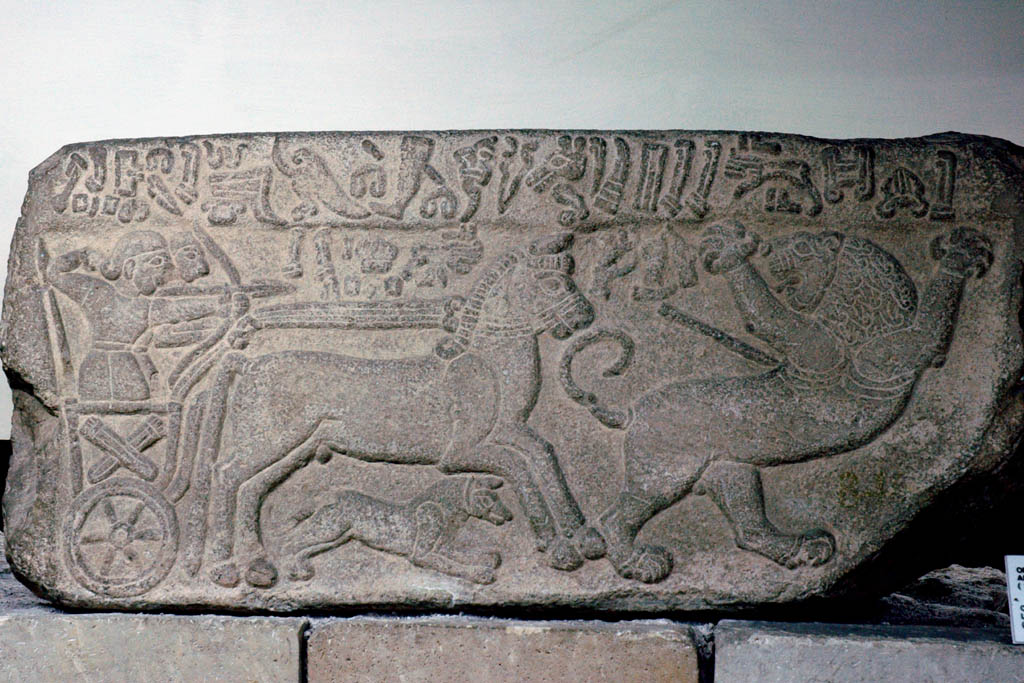
    What we call the Arabian horse (a term coined in 1330) is geographically Syrian:


    Quote It’s thought to be the oldest breed of riding horse, its distinctive dished nose, wide-set eyes, and large, flared nostrils—that once helped these early chariot horses dissipate heat in the desert—the subject of ancient art for centuries. Arabians are found in Saudi Arabian rock carvings dating from 800 BCE to 200 CE, in terracotta figurines from Syria (2300 BCE), and gracing the tombs of the ancient Egyptians (1427-1401 BCE).

    ...by concentrating on the DNA showing the greatest genetic variation (populations further away from the source tend to have smaller gene pools), Dr. Khanshour discovered that the region in and around Syria is most likely the birthplace of the breed.

    So it is actually Nabatean spread by Bedouins, and, if we only find one figurine around 2,300 B. C., E. from Tell Brak, Hasakah, it is quite notable that what is being featured is not really the horse but the details of harness and bridle. However that image is "protected" so you have to look to see it.

    Therefor, the Ukrainian steppe horse may even be subsidiary to this, whether by ancestry or by adaptation of the process to a wild population.


    The dirtier question is if Dravidic and Altaic languages are related as archaic blasted-away bits. That is if India was populated about 8,000 B. C. E. by Dravidians who came from Siberia. The upper bound on Sanskrit or its Prakrits is perhaps about 3,000 B. C. E., which I have suggested was part of the technology and cultural transfer from Mundigak. This was the freaking highway before the Z93 individual was born.

    One can try to guess about a "proto" Irano-European language that may have circulated prior to 3,000 B. C. E., which has no art or writing to support it. Just known contact over long distances. India, so far, seems to be the accumulation of various imported technologies, which may have well brought Irano-Sanskrit as a lingua franca of the artisanal world.

    It certainly wasn't taken over and put into a forced conversion to anything. It was, however, highly selective, like if you go through finished goods, you find almost nothing Mesopotamian. There might be about ten Akkadian-type seals in India, virtually negligible compared to the amount and distance of Indian products.


    If we begin to insinuate the horse was from Tell Brak, it's one of the oldest and largest sites in Upper Mesopotamia, Semitic with a later Hurrian -- Mitanni phase before being destroyed.

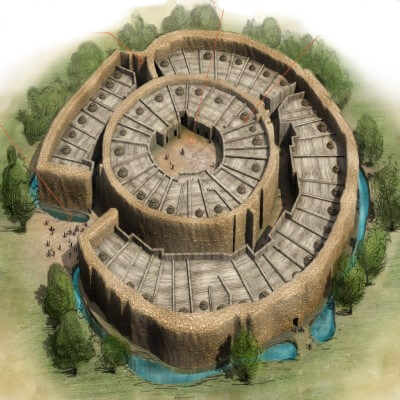
    It has a unique and unidentified Eye Temple that matches nothing in the world:


    Its development was slightly ahead of southern Mesopotamian sites such as Uruk, and it shows transportational phases of donkeys and hybrids prior to horses, wagons and two-wheeled carts prior to chariots. It was famous for acrobats and obsidian.

    IVC iconography is based on the Donkey, and, certainly, Sinauli Chariots is a misnomer because they are solid-wheeled carts.

    Quote According to historian Ruchika Sharma, Jawaharlal Nehru University,

    We should first obtain clarity on why ASI is calling them 'chariots'. It isn't uncommon for a Late Harappan site to have bullock carts. There is already evidence of such terracotta carts [...] ASI has a tendency to colour their discoveries from the lens of Hindutva. They had earlier interpreted female figures as 'mother goddesses', even though there was no evidence to suggest it.

    There is a lack of horse remains in IVC or BMAC, with their earliest substantial finds with Gandhara grave culture at ca. 1,400 B. C. E..


    But that is a simply awful comparison to Vedic practice, which far more strongly matches the ca. 1,900 B. C. E. Cemetery H Cultureand the appearance of rice:


    Quote Some of the designs painted on the Cemetery H funerary urns have been interpreted through the lens of Vedic mythology:

    For instance, peacocks with hollow bodies and a small human form inside, which has been interpreted as the souls of the dead, and a hound that can be seen as the hound of Yama, the god of death. This may indicate the introduction of new religious beliefs during this period, but the archaeological evidence does not support the hypothesis that the Cemetery H people were the destroyers of the Harappan cities.


    Cremation in India is first attested in the Cemetery H culture, a practice previously described in the Vedas. The Rigveda contains a reference to the emerging practice, in RV 10.15.14, where the forefathers "both cremated (agnidagdhá-) and uncremated (ánagnidagdha-)" are invoked.


    Blessings because, there, they actually cite the relevant verse. Proponents of the "Kurgan hypothesis" bandy about the misty phrase "burials similar to Vedic rituals", and I have bothered to excavate what they are talking about, which contradicts the claim. It talks about burial maybe a couple miles outside the village, with a perhaps small, symbolic stone fence placed halfway in between to prevent you from returning.


    Horse burial would not be expected to be a part of that, so, the Vedic textual evidence for horses may well be older than the 1,400 B. C. E. burial evidence; in fact, that's about the same age as Kikkuli's Horse Manual.


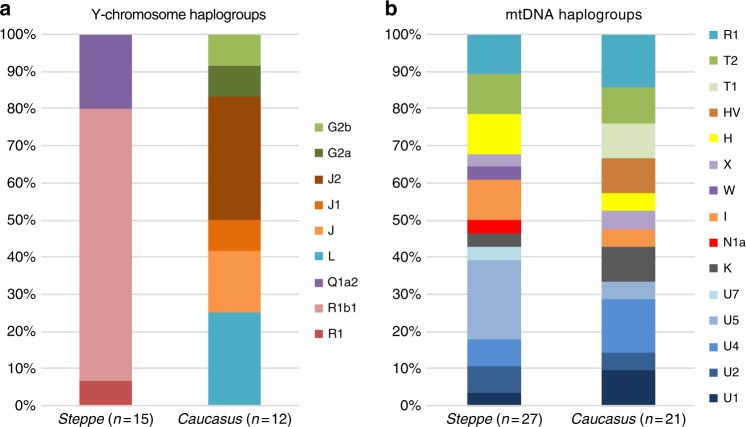
    So there was a Vedic settlement among the Hurrians, who, themselves, are difficult to identify, having their own language family; but culturally are perhaps the most influential group in west Asia. There isn't genetic information on them, but, they are presumed as an offshoot of Kura-Araxes, which is more or less Armenia from about 4,000 B. C. E., which has yielded the masculine and feminine haplogroups:


    Quote R1b1-M415 (xM269)

    U1a1a, U2e, U3a2, U3b1a1, U3b2, U4

    The data indicate a largely stable genetic profile over time, with limited gene flow from Steppe populations, distinguishing them from later Bronze Age groups that incorporated more Yamnaya-related ancestry.
    Those were selected from among others, just to show their presence, in what is probably a melting pot and multi-lingual interface.

    Doubly curious again, the Kalash also have U2e, meaning "European", as contrasted to U2i which is standard in India. Those are not the best terms; U2i is really the group of U2a, U2b, and U2c, and India also has U2e. In fact, U2e is simply found in Europe at about 1%, while it is in India across castes and tribes, Pakistan, Iran, and Central Asia. In the above, we can say, well, those samples are from about 4,000 - 2,000 B. C. E.; the maternal lines are not very European, but the paternal one is (and those were just a selection).


    Kura-Axes introduced a horse to the Caucasus around 3,300 B. C. E.. In transitions, we are not sure if this is a domesticated wild horse, such as the Botai of Kyrgyzstan had, which was a milch animal. It was not specially bred for riding. This Kura-Araxes spread to the Caucasus, Iran, Syria, and Palestine, making it notable that you do see an unmistakably dressed horse in 2,300 B. C. E..

    They were advanced metallurgists who exported to Russia; and also distributed the grape and wine, similarly to Dionysus.

    Their paternal R1b traces to Villabruna, Italy, about 12,000 B. C. E.. And yet he has a descendant among the Botai ca. 5,500 B. C. E.. Otherwise it is very meager in the east, and does not enter India at all.

    The Kalash do not have it; they have R*, R1*, R1a.

    These Armenians have two of the same U-lineages that account for half of the Kalash. Those are ultimately Siberian, but who are the other Kalash mothers?


    R0 (Arabian)

    J2, extremely rare, Arabian, whose closest cousin is the 19% J1 Polish Roma; J2 ranks probably less than a percent in the rest of Pakistan, while it has a high presence of about 2%:

    Quote J2 is more localised around the Mediterranean, Greece, Italy/Sardinia and Spain.

    So the figure of 9% is, for this, extremely high.

    They have altars with horse heads and use wine as a sacred beverage.

    This is "elite", in the sense that two of the rarest mothers in the world have their highest concentrations here.

    It's like a Hurrian -- Nabatean mix speaking Sanskrit.

    Much like the Mitanni. Problematically, they are not chariot warriors, and are thought to be aboriginal, meaning they displaced no one and have not been smashed themselves. And they have strong affinity to the neighboring Kho.

    So we'll look at very ancient things that funneled in to the Mitanni and Kalash, and how things significantly changed after a "Dark Age". The point is to look at it more carefully, since almost everything that has been said (or written) is usually either a pre-conceived notion projected onto the findings, or, a guess that does not bear out.

  2. The Following 8 Users Say Thank You to shaberon For This Post:

    Bill Ryan (8th November 2026), Eddy Fire (Today), Ewan (8th November 2026), Harmony (8th November 2026), Irminsül (8th November 2026), petra (Today), samsdice (8th November 2026), Yoda (12th November 2026)

  3. Link to Post #2
    United States Avalon Member
    Join Date
    1st April 2016
    Posts
    7,133
    Thanks
    36,364
    Thanked 40,814 times in 6,782 posts

    Default Re: Beringia and the Altai Flood into Recorded History

    Today we'll bring in a verbal mystery and a visual one.

    Then my brain is going to explode into thousands of tiny little pieces. Anyone who studies historic trends may get the same result.


    Verbally is a glimpse into the root of Indo-European. I am not a fan of re-constructed "Proto" languages that have no documentation. For instance, if Aramaic appears to be among the oldest forms of Semitic, and, at its origin point, why would you not just consider any older form to be Aramaic? And that's just in a fairly small area. Well, Aramaic as a business language extended to Sogdia, but Semitic languages and their associated lore are in a relatively small spot. Something else accounts for Sanskrit and almost everything spoken in Europe.

    At least in terms of the underlying words. Ideas and knowledge are perhaps different. Trusting what someone says can be worse.


    Something notable about small stand-alone populations like the Munja or Brahui is they have basically nothing in terms of self-legendry; the Brahui were "introduced" to the concept of history in the 1700s. So this type of thing is not an inherent criterion of existence.

    Probably one of the worst rips against mankind knowing much of its own history is found in what may be the "Indo-European center", Armenia.

    That's not their personal name for themselves (Hay).

    What happens is the Orontid Dynasty converted to Zoroastriamism in the Achemenid Period -- and they take the Armenian epynomous founder, Hayk, and merge him with Zoroastrian mythology; we know those stories are not original Zoroastrianism either, but there is a surge of storytelling in this era, and the Armenians take it and say "that's us".

    Later, it was the first kingdom to independently convert to Christianity -- and they re-write it all and re-define themselves and their national hero as associated with Biblical patriarchs -- "that's us".

    What is odd is that it was not all that long from a perfectly fine recording of objective history in the Lake Van Cuneiforms, and this is not a mystery at all, because they have dual-language inscriptions with Neo-Assyrian; and this is in the 900 - 600 B. C. E. range. So, yes, that more or less is textbook for what actually happened, and the Armenians had no clue by one or two hundred years later.

    Armenian itself refers to the language, since the cuneiforms are the sole branch of this isolate family:


    Hurro-Urartian


    The first refers to Hurrian speakers with no state until the Mitanni Kingdom, and, after the Dark Age, this is a state:


    Urartu


    Others have recorded it as Ararat, but after the demise of the state, no one remembered it there.


    For the most part, the Hurrians are known in Greater Armenia, and, the difference is, Urartu includes the Highlands, which have been occupied for millennia, but, apparently, not as a country. It's like IVC is not clearly a country or has any countries. But the Highlanders are definitely "a people":


    Quote Recent studies have shown that Armenians are indigenous to the Armenian highlands and form a distinct genetic isolate in the region. There are signs of considerable genetic admixture in Armenians between 3000 BC and 2000 BC, these mixture dates also coincide with the legendary establishment of Armenia in 2492 BCE, but they subside to insignificant levels since 1200 BC, remaining stable until today.

    Genetic studies explain Armenian diversity by several mixtures of Eurasian populations that occurred between 3000 and 2000 BCE. But genetic signals of population mixture cease after 1200 BCE when Bronze Age civilizations in the Eastern Mediterranean world suddenly and violently collapsed.

    And this is a sponge for a different kind of Bronze Age migration:


    Quote A large genetic study in 2022 showed that many Armenians are "direct patrilineal descendants of the Yamnaya".

    Considering that Urartian began to diverge from Hurrian around 2,000 B. C. E.:


    Quote It must have had long contact with, and been gradually totally replaced by, an early form of Armenian.

    Before that happens, I know something Hurrian when I see it, the deity of Teisebaini ca. 650 B. C. E. in Armenia, fortified to defend against Scythians and Cimmerians:


    Teisheba or Teišeba


    Is that a Unicorn?

    Quote Theispas was often depicted as a man standing on a bull, holding a handful of thunderbolts. His wife was the goddess Huba, counterpart to the Hurrian goddess Ḫepat.

    Theispas is associated with the Assyrian god Adad, the Vedic god Indra, and with Teshub, a god of the Hittites and Hurrians.

    It's Hittite because they also got it from the Hurrians. But Teshub has been considered the major cultural influence in the region since he was first heard of. He must be about two thousand and this is his last hold.

    About 585 B. C. E., the city is thought to have been attacked during the night, as it was burned in such a way that there are people trying to run with gold objects in their hands and human remains are everywhere.


    Until that point, there are states which previously are thought to have expanded towards the highlands, such as Hayasa, which is potentially the source for Hay and Hayk, although Sumerian Ea -- Hayya is another possibility. A Hittite copy of one of its legends curiously includes Canaanite Elkurnisa, which is considered to be related to this verse:


    Vayvarechehu vayomer baruch Avram l'El Elyon koneh shamayim va'aretz


    It's also found in bi-lingual Phoenician -- Luwian. If the equivalency is correct, it comes out as El Possessor/Creator (El koneh from the above), but of course it is really a Baal story. Point being how widely copied it is.

    The first kings of Urartu instead said they were of Nairi, an amorphous confederation having this record:


    Quote An early documented reference to Nairi from the 13th century BCE is a tablet which describes the purchase of 128 horses from the Nairi region.

    It sounds like a Hurrian League after the destruction of Mitanni by the Hittites. You find a Hurrian-derived language and their chief deity coming out of this. It's Greater Armenia with an eye to the mountains. There absolutely is a reason why this should be happening.


    Here's what would make "Van" or Urartu even more significant:


    Quote The Armenian Plateau has been called the "epicenter of the Iron Age", since it appears to be the location of the first appearance of Iron Age metallurgy in the late 2nd millennium BC.

    So they say. But it's practically a mirror of India. In that case, also around 1,200 B. C. E., it seems that iron was really in the hands of "tribes" in the mountains, and new contacts were made and businesses started, and what we call Damascus steel is really Indian; Armenia is certainly closer to where more writings start to re-appear, and Indian steel is top quality. This is paralleled by the older Sanskrit Aya, metal, appearing in new phrases that say red or black, with black metal indicating iron. Therefor there is no conclusive appearance of iron in the Rg Veda.


    It has been known for a long time:


    Quote Assyrian inscriptions of Shalmaneser I (c. 1274 BC) first mention Uruatri as one of the states of Nairi, a loose confederation of smaller kingdoms and tribal states in the Armenian Highlands in the thirteenth to eleventh centuries BC which he conquered. Uruartri itself was in the region around Lake Van.

    Because the Assyrians continually and repeatedly attack it, until it seems to unify or replace the Nairi becoming its own power about 860 B. C. E., until they continue to attack it, are joined by others, enough so that it's not even known who finished it off. By around 500 B. C. E.:


    Quote In the late 6th–early 5th century BC, with the emergence of the Satrapy of Armenia in the region, Urartu (Urashtu in Babylonian) was used as a synonym for Armenia (Old Persian Armina) in the trilingual Behistun Inscription.

    Armenia means you don't remember anything Hurrian, I guess. That sounds like being plundered for six centuries in a row, corresponding to a period of no genetic mixing. The presence of Urartia did not cause any physical changes to the inhabitants, and if its language died, it was probably one of those official languages like Aramaic in Gandhara.


    After the wipeout, it was taken in to the Achemenid Empire around 570 B. C. E..


    Not surprisingly, prior to the Ice Age there was mixing of individuals from north to south Mesopotamia, then, a period of isolation, after it, a population explosion with stability in the maternal line for 8,000 years, and then the Yamnaya and Armenians really have a common ancestor, Caucasus Hunter - Gatherer:


    Quote Caucasus hunter-gatherer (CHG) "genomes significantly contributed to the Yamnaya steppe herders who migrated into Europe ~3,000 BCE, supporting a formative Caucasus influence on this important Early Bronze Age culture. CHG left their imprint on modern populations from the Caucasus and also Central and South Asia possibly correlating with the arrival of Indo-Aryan languages." For example, about 50–70% of Armenian ancestry is derived from CHG, persisting from Neolithic times to the present.

    This early CHG is part eastern, perhaps Siberian, and it is not found in corresponding western Anatolians. The takeaway is that the theoretical language-spreading Yamnaya contributed nothing to Bactria at its zenith, but they do contribute to Armenia, findable as R1b, which is not in the east.

    Its Orontid Dynasty is not until about 400 B. C. E., which is when they re-enter the records and we find they are ripe for Zoroastrian revisionism, because they have forgotten Urartu, which means this Hurrian regime must not have whitewashed their Armenian language. Nevertheless, they have forgotten the cuneiform and whatever may have come before that, and appear to roll with the versions given by two religious conversions.

    The region may have been Gilgamesh's Aratta.

    So, that's curious, they were beside Hurrians, they had a Hurrian state for three centuries, and yet that language evaporated. There aren't loan words or cultural influences, although there are no Armenian records until the 300s, so they are basically silent, apart from external evidence. From that evidence, we conclude they were always there, speaking their language, except the Yamnaya moved in and had kids, which is more of a way to get your language used than a court language or commercial lingua franca. That makes them indistinguishable, until further evidence comes along. That's hard to get, when we presume to be talking about places with no writing whatsoever.


    There is, of course, a visual back story to what we looked at above.

    There is shared symbolism throughout most of the seals and other art forms, in a way you could almost say excludes Egypt but includes India. And throughout all the known writing that accompanies this, one of the most important subjects is Time, in all its aspects, from the involvement of deities to the civil calendar. It so happens that our current year of 365 1/4 days is from Ptolemaic Egypt.

    Because I don't believe humanity passed along a whole lot of specific information over a long period of time, I don't believe they had any clue about the precession of equinoxes and certainly not the Great Year.

    With this, the most likely observation is again from Egypt, since temples were built around Aswan prior to 3,000 B. C. E. in stellar alignment of that time, which would be noticed, because the building remained intact and the Egyptians weren't miscegenated.

    You have nothing scientific without observations. And it probably was true that most people were looking at the sky at night, and they weren't tracking equinoxes, but they were highly interested in Space or Direction. And what anyone would more easily be able to find is the Pole Star quits working. You know, we're talking about a huge amount of maritime activity; some of the reviews I have seen come off as thinking language and knowledge and so forth is based on land routes. Traversing Iran has never been anyone's favorite. There was a lot of activity by sea, so, questions about north are in constant demand.


    In general, there was a script of Animal Hieroglyphs, that we suppose may have had a common international meaning, with regional differences.

    Because of that, I tend to think the Unicorn was a joke about people who never saw a Rhinoceros. In the Bronze Age, it inhabited Pakistan, and IVC has a perfectly well-detailed Rhinoceros. The normal animals it uses, numerically, are minor, small things, like each their own subject, or industry, or something. But the Unicorn occupies 60-80% of it, making it look like Unicorn People with Unicorn Speech. And/or it is Sanskrit itself; it clearly visually is Soma culture, which is also Iranic.

    In most of the rest of the world, there are few unicorns, and you could debate whether Urartia has one or not. If its heritage is Hurrian, it has continuity for over a thousand years, this being the last part of it.


    We'll find a definite unicorn and one you will have to contemplate visually.


    First is something not really worth looking at, and, is not really the earliest sample of writing. We want to emphasize the location. The site of Konar Sandal South occupation has been dated to c. 2880 BC to c. 2200 BC in the Early Bronze Age. However it is considered to be part of the older Jiroft Culture of eastern Iran, which may have the earliest writing or even experimental systems.

    It possibly was known to Sumeria or Akkadia:


    Quote ...they may be the remains of the lost Aratta Kingdom. Other conjectures have connected the site with the obscure city-state of Marhashi.

    There was a known mound site since 1936, but, here is why there are so many newer finds including the Konar Sandal Unicorn:


    Quote ...in 2001 following
    a disastrous flood the Halil river cut its banks, exposing
    thousands of graves full of precious artefacts. Local
    inhabitants and antique dealers immediately started to
    systematically loot these treasures until Iranian security
    forces put an end to the illegal excavations and seized
    some of the artefacts. Thereafter Iranian archaeologists
    have recorded hundreds of archaeological sites dating to
    Chalcolithic, Bronze and Iron Age, and some late
    Neolithic sites have been also found in the northern
    mountain valleys.

    It's literally not until the 2000s that we have realized how old and massive all that is. Enough that it persuaded me they exported technology to India. That would place Iranic Mehrgarh as the radiation point. The suggestion would be they came out of the mountain pass around 6,000 B. C. E. and settled near the mouth of it. And comparatively, it looks like Indian art begins a little after Iranian, using Iranian symbols. I would not hesitate to guess that if someone from India went to visit a developed Mundigak and Jiroft, they would want to imitate it immediately.

    The Konar Sandal find is likewise a locally-produced IVC reproduction.


    It's a particular kind of cylinder seal:


    Quote ...the ‘whitestone group’. The seals of this group, found at
    Konar Sandal South, Tepe Yahya, and Shahdad, but
    also in southern Turkmenistan and eastwards at
    Mohenjo-Daro, have diverse iconographies, but share
    the use of a similar white stone, a carving technology
    employing drills to carve crucial points of the figures,
    and the characteristic of being strongly worn after a
    prolonged use. According to Pittman, this group of
    finds originated in central Iran and marks a wide network
    of Middle-Asian cultural connections.

    We always question continuity; there are certainly much older sites nearby:


    Quote Excavation of the early Chalcolithic levels at
    Mahtoutabad brought to light the remnants of a large
    hut-like structure, fragments of a distinctive polychrome
    pottery, evidence of leaded copper processing
    and manufacturing of different types of semi-precious
    stones, including calcite-alabaster, chlorite, and lapis
    lazuli. A later settlement dating to the last centuries
    of the fourth millennium BC consumed large amounts
    of bevelled rim bowls, flowerpots, nose-lugged jars,
    elongated jars with downwards-flected spouts, and
    other ceramic types closely comparable with the ceramics
    assemblages of Susiana (Susa, Acropolis, level
    XVIIa), Choga Mish, and other sites of the central and
    south-western Iranian Plateau.

    Knowing another particular thing was made here:


    Quote Carved chlorite objects from Marhashi have been found
    from Mari to the Indus Valley, and from the southern
    shores of the Gulf to the interior of Uzbekistan.

    Things that seem to be brought here:


    Quote ...compartmented metal
    seals imported from Bactria and Margiana.

    A bronze stamp seal found on the surface of Konar Sandal South bears a standing caprid or
    antelope with long wavy horns and a gharial (Gavialis
    gangeticus) of indisputable Indus inspiration, if not
    origin.


    This image has only a few relatives:


    Quote The only other unicorn-like
    animal so far discovered in the typical Halil style appear
    on two chlorite carved vessels and a hand-bag weight.
    The creature, always represented standing among palms...

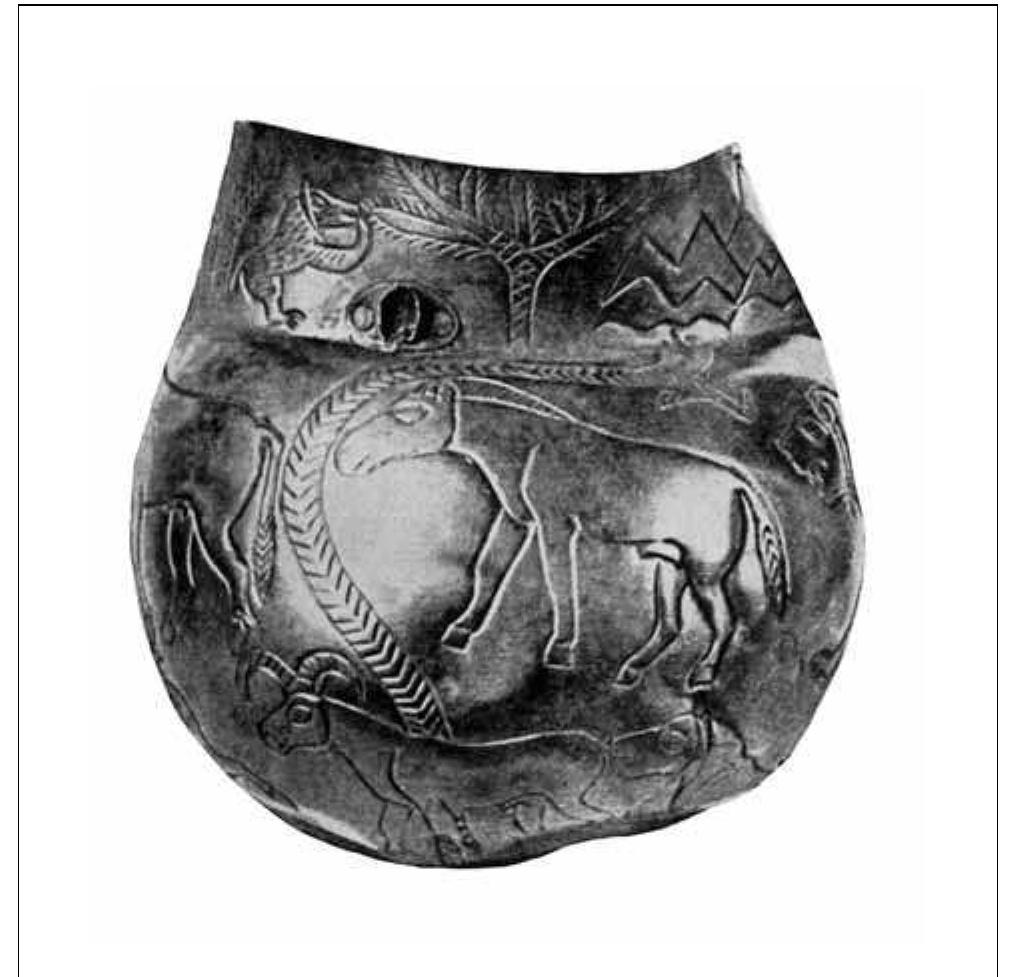
    Again, those are artistic, rather than seals, which we presume have or develop an extensive meaning. We find that same change in other places; an IVC symbol is used, and then it is re-done with the native Tree of Life, the Date Palm. The Unicorn on the white seal however is just among some animals. It was noted they appear to follow "IVC rules", such as facing right, with the Zebu leading. Similarly, the object art unicorns are slightly iconographically different, having:


    Quote ...a long, straight horn covered
    with segments or ridges clearly indicating a spiral-like
    twisting. The horn of the Indus unicorn is instead rarely
    represented with inner hatchings.

    It's good to notice the differences, but, I can tell you, "hatching" has a lot to do with the message in the Indus seals, in fact you can follow an evolution of the IVC Unicorn, visually and in behavior, giving its livery to the Goat, having an impersonator or Fake Unicorn, and other nuances, which are not arbitrary style choices, but follow a scheme.

    In the same trench with the seal were four flakes of Lapis Lazuli that have been run through X-ray diffraction and electron microscopy, to return the answer that they probably are from Badakhshan; there are minor sources in the Pamir and at Lake Baikal. It's a rock that has a large number of minerals that vary from place to place, but it has no sources in Iran, and it has been exported for over a thousand years at this point, including to older parts of Jiroft.

    The seal itself is relatively uninteresting because it is worn out to nearly nothing. You can make it out just enough to tell it resembles a more intact mother-of-pearl Mari Unicorn.


    Quote In the winter of 1933-34, André Parrot excavated the
    Ishtar temple of the city of Mari on the Euphrates in
    northern Mesopotamia. In the courtyard of the temple
    Parrot discovered remains of a mosaic panel that
    consisted of separate carved mother-of-pearl plates
    about 10 cm high. The panel (Figure 7), now in the Musée
    du Louvre in Paris (AO 19820), cannot be quite reliably
    reconstructed because it was completely mutilated and
    dispersed when the city was sacked, but its components
    make it possible to recognize in it a victory parade,
    with dignitaries in military uniform and weapons,
    bundled prisoners (an important component of other
    Mesopotamian victory parades, like that depicted
    on Sargon’s stela from Susa), and most interesting
    in this connection, a unicorn bull carried at the top
    of a stand (Figure 8). The panel is dated to Late Early
    Dynastic Period, around 2500-2400 BC

    It wasn't compared to the IVC motifs Unicorn Parade and Monumental Objects. The stand was in the hands of a standard-bearer, meaning a realistic animal is not being supported; would they use a terra cotta figurine?

    In this montage is an IVC Unicorn being conveyed in the same manner:


    What humans do in that art that is realistic is basically nothing.

    The Mari Procession looks fairly realistic, until you ask what is that thing being carried.

    The problem with calling it a profile is animals don't have forward-projecting horns.

    And 3-D figurines have a single, central horn. So, it is a creature, maybe not a real one, but something intricately Indian that has been found natively over distance. I'm not sure this is a bi-lingual "Rosetta Stone", but the similarity is a little stronger than just maybe the creature. How someone could carry anything like a real bull is somewhat preposterous. Maybe it means a golden one, or a special statue, but it is most similar to these other ones from quite far away.


    We are very curious about what goes from here (Mari) to the Mitanni Kingdom a thousand years later.

    I'm not saying that is definitely an IVC Unicorn. I'm saying those images are the same kind of weird. The Indian one's definitely a unicorn.

    Among raking arguments about the evidence, there is a tendency to re-ify The Mitanni as if they are "a people", whereas it is just the name of a state. There are no "the Mitanni"; there are Hurrians who have osmosed Sanskrit culture.

    A somewhat weak argument from Mari and older establishments is the use of Marya for "horse-riding elite"; it is a Sanskrit word, but it does not have this connotation, "warrior". In fact its most common meaning is "mortal", such as in Dirghatamas I.150.3:


    Quote sa candro vipra martyo maho vrādhantamo divi |

    the mortal (who propitiates you) becomes a moon in heaven, the most eminent of the great

    So by extension, it may derive to "man", and then "young man", corresponding to which the Rg Veda, at least, imputes it with a connotation of lover in a few areas, while if it is used for "warrior" at all, it is very difficult to find. It's a short form, martaya --> marya, and who would want to call a warrior "those whom death affects"? But yes it has this meaning in Semitic. Does that make it a Sanskrit loan word?

    I'm not so sure. But there are several points about the Superstrate of Mitanni that just slip past. One is that it is not "the deities" Mitra and Varuna, it is the duality, Mitravaruna, which has specific Vedic contexts. And some other personal names are not mere words:


    Ṛtadhāman, not a name in the Veda, but Rta or "order" is one of the main tenets

    Indrota, "Indra has helped", possibly Sudas

    Subandhu is actually the target of Resurrection in hymns X.59-61

    Priyamedha is probably the most important, since he is followed by "the Priyamedhas", which are important to the whole thing, possibly indicating the Syrian one derives from this lineage. It's claimed to be only in the "Late Books", but, Books Eight and Ten also contain some of the earliest material, which has simply been included in later development, or, Book Eight of the Kanvas contains almost the entire epoch, minus the very first few generations.

    If I want to be generous, I could say Maraya is the command kill, which is fine, if you do it to the implication that "Marya" is something from the Rg Veda. It's not an order of knighthood. It's a type of linguistic possibility, if there is a good reason Semites would want to to that, despite the horse being native right there.

    The, so far, lack of warlike evidences in IVC, leaves little reason to seek it in pre-Vedic Sanskrit.


    Part of the noise being made is that the Mitanni gives the appearance of an older and more Iranic pronunciation of the names. And so it must have been them who somehow blanketed it across India. Problematically for this, the difference between Mazda Yasna and Veda is that Zoroaster does not seem to like the Aswins, who were here given their alias Nasatyas, "Not Untrue". You would not seem to be honoring this if it was an Iranian settlement. The root term for "horse" is of course prevalent there:


    Quote aśva-sana- "master horse trainer" (Kikkuli himself)

    So for the Aswins to be regarded as a local village deity, is a little unusual, since they are not among the standard cosmological forces Sun, Moon, Rain, which consist of the vast majority of examples; they fit no standard because I am not aware of any other culture that has a true equal.


    na-ša-ti-ya-an-na


    It's the only one to be attributed the suffix -nna, such as is done in selective constructions like Marya-nnu. Nasatya-nna.

    Nasatya and Dasra do not appear to be used as individual names in the Veda; they are a pair, just like "the Aswins". It's all synonymous. That brings us to a terribly specific instance of unexplainable drift.


    Lithuanian Asvieniai have a slightly different form -- it is a pair of horses pulling the sun's chariot, or, a sole charioteer.


    Its Mythology is hashed and battered but here is something bewildering to find:


    Quote Indraja: Jupiter (Vedic Indra)

    It is the same word, although it sounds to me, like the word was used in a generic meaning, until it was applied to a planet. They have all seven planets. But that is the Chaldean system; it's not Indian. In Sanskrit, Indra is arguably not a personal name. but a title, similar to "lord or king", given to someone who is called Maghavan, Vrtrahan, Purandar, and other names. In Buddhism, you might be able to say he is referred to as Indra, and addressed as Sakra. The planet Jupiter is Brhaspati. So here they are using a Sanskrit word, not a Vedic deity.


    This aspect however is usually accepted as equivalent:


    Quote Perkūnas: The dievaitis of thunder (Parjanya/Indra in Vedism)

    The expression for solar chariot:


    Quote saulės ratai

    We just dodged a lot of mud about Ratha as a common Mitanni name, like it is in the Veda, although supposedly only in the late part. And at any rate, you have the sun goddess, with an invention from Sintashta. Maybe it is their name for their own invention. More plausibly, it is an older word for "cart" cognate to Latin rota "to roll; wheel" which makes it unclear if it is a chariot in the Veda. Nevertheless, with the horses, the Lithuanian vocabulary seems constrained to the Vedic period.

    It's cognate to Surya in the way that "l" drifts or splits to "r".

    To sun goddess Saule':


    Quote "mīļā, balte"

    dear white


    It also has the same Venus -- Dawn as Ushas:


    Quote Aušrinė was first mentioned by 16th-century Polish historian Jan Łasicki as Ausca. He described a "goddess of the rays of the sun that descend and rise above the horizon".

    Yes, goddess of rays. In this context, dawn does not refer to the solar orb, but to civil twilight. Venus is usually the last thing visible in that interval.

    They have some kind of tale about her temporarily mating with the Moon, which is similar to the Veda, which actually is exceptionally detailed about this. It would beg the question of why she marries the Moon and then the Aswins.


    The Lithuanian context of the Aswins is broadly similar, having to do with the sun and power of life, but the Veda is far more technically advanced. They have multiple divine episodes and interactions with humanity. Most of that I think is metaphorical, i. e., something like curing of leprosy represents a mental or spiritual problem that was overcome. It's probably being very poetic about this.

    There are a ton of Lithuanian entries, most of which have nothing to do with Sanskrit, except the most basic core deities, such as:


    Quote Vėjopatis: God of the wind and master of Dausos (paradise)

    The suffix -pati changes context, in the sense that "lord of" something can also be "lover of" something. Their Earth goddess is a cognate of Greek Semele, and her spouse may be named in reference to her:


    Quote Žemėpatis ('Earth Spouse') and Žemininkas, male deities associated with cattle, agriculture and the fertility of the land.

    This appears to be not Indic, but Thracian -- Phrygian. And this is exactly where Greek myth will bang into objective history:


    Quote Semele was the youngest daughter of Cadmus and Harmonia, and the mother of Dionysus by Zeus (her own great-grandfather).

    Cadmus is also the father of Illyrius, namesake of the Illyrians.

    He is notably absent from Hesiod's Cosmogony, but Homer knows "the Cadmeans".

    The sense in which something historical must be true here is that he brought the Phoenician alphabet for the Greeks to use. He has only one kind of antecedent:


    Quote The fact that Hermes was worshipped in Samothrace under the name of Cadmus or Cadmilus seems to show that the Theban Cadmus was interpreted as an ancestral Theban hero corresponding to the Samothracians.

    In turn, the origin of Hermes is from Cretan E Ma Ha.

    Under his wing, so to speak, Semele and Cadmus are drifters from slightly outside the Greek mainland, and directly involve their re-invention of writing, which begins with Hesiod. There is no truly archaic source for them, they don't have Sanskrit equivalents, and they correspond to actual events, the new or classical Greek mythology, and the appearance of the Illyrians. That is something that happened around 1,000 - 800 B. C. E.

    The Argives argue that his father was one of them, while Thebans say he had come centuries before the Trojan War, which, compared to the real event, is impossible. So, we think this is the same principle, over-claiming something about a real event.

    I tend to think the Greeks are getting real input from Luwian Apollo and Cretan Hermes and Zeus, after some kind of Trojan War, and if Cadmus is based on some kind of real person associated with a particular pedigree:


    Quote Unsuccessful in his search—or unwilling to go against Zeus—he came to Samothrace, the island sacred to the "Great Gods" or the Kabeiroi, whose mysteries would be celebrated also at Thebes.

    That's a lot like putting Cretan Hermes and the Samothracian Kabiri into Greek writing.
    ,
    It's not necessarily surprising it reached Lithuania, if, the goddess is important enough so that a male is simply called Husband of Zemele.

    They may have the Aswins expressed with the overall heavenly deity Dievas:


    Quote Dievas had two sons (Dievo sūneliai (Lithuanian) or Dieva dēli (Latvian)) known as the Heavenly Twins.

    Cognate to Sanskrit deva and Avestan, having the meaning of light, divine.

    Zeus "Sky Father" is cognate to Sanskrit Dyaus Pitr.

    Those are two different things which sometimes become conflated.

    Most of their language looks Slavic, so, it seems a little unusual that the most important deities are Sanskrit, Aswins, Usas, Parjanya, and although Saule' is considered cognate, it's not a theological equivalent, nor the moon which may have been taken from the word for month.

    Parjanya/Perkunas is the agent of punishment for the Moon for mating with Dawn. So these cognates are all being used together in a really basic way that the Rg Veda is like hundreds of Homers responding to.


    The premise of deity and heaven is close to the same, as is this other thing of importance:


    Quote Auštaras (Auštra): The god of the northeast wind, who stands at the gates of Paradise and lights the way for those going to the afterlife. This function makes him similar to Aušrinė; some consider him to be her cousin.

    Dausos contains trees which bear golden apples. Day in the garden is perpetual but outside its confines lies perpetual night. Master of Dausos is Vėjopatis (Lord of the wind) or Vėjas (Wind) who is also one of the oldest gods in Lithuanian mythology. Vėjas is identical to Vayu of Hinduism. Auštaras and Vėjopatis are the gatekeepers of Dausos (Dausų Vartai). While Auštaras acts as the psychopomp of good souls, Vėjas (Vėjopatis) blows bad souls into oblivion.

    And there is this curious definition:


    Quote mirti (Verb) to die (used only for humans and bees) ; mirtis (Noun) death

    It lacks Agni and I don't think that's Indra in any normal way, and there is no Soma culture. There perhaps was a reason or the introduction of perhaps even the Samothracian Mysteries, to use Semele, which is not Sanskrit, although her husband has the -pati Sanskrit construction.

    It's like the Sanskrit language without any Vedic content whatsoever. Like you find Agni in Hittite, also meaning fire, but it is not Vedic Agni whatsoever, it is a destructive force.

    However it's a shared Sanskrit language within the age of horse and chariot. It has ugnis as an ordinary noun.

    In that concentrated way, it is about like the better half of Avestan is like reading Sanskrit.

    Armenian has nothing of this, except for cow, kov, gov, Lithuanian karvė, galvijai, galvijas.


    Overlooking three theoretical Proto-languages, Sanskrit Haya:


    Quote Cognate with Old Armenian ձի (ji, “horse”).

    Asva and Haya are not normal nouns, but, verbs or adjectives with the connotation "go fast". And in the Rg Veda, you will find a few instances of haya where it just describes rapid motion. There is a single use of it as a noun meaning "horse" by Pratiksatra Atreya, who I would contend is probably in the last generation.

    Vedic horses are called New Wealth as contrasted to the cow being Old Wealth. All three languages have the same cow in slightly different pronunciations, like I just called it a cow, still the same word.

    Asva is the new and going thing written in hundreds of ways, and this is shared with Lithuania in its core mythology?


    If they won't tell us in words, we'll take their teeth. Most genetic research is done on teeth. Here is a good point made on a regional survey of seventy-three Bronze Age individuals:


    Quote Limited evidence suggests successive waves and local continuity rather than a single population replacement; the millennium-long span (2100 BCE–1625 CE) sampled here includes cultural transitions that archaeology records as shifts in burial practice, settlement pattern and material style. Where the DNA and material culture diverge, it highlights the complexity of identity: people could adopt new practices without wholesale genetic turnover.

    Comparatively, an older migration with Anatolian Farmer entered Sweden around 4,000 B. C. E. and established Megaliths around 3,300 B. C. E..

    Lithuania and environs was considerably later to begin agriculture as well as its Bronze Age was not until 1,200 B. C. E..

    So, physical and technological changes do not mean one people was replaced by another, or even mixed. It is possible different populations can dwell near each other with very little mixing, i. e., farmers and gatherers remain nearby but mostly separate. Perhaps nobles and knights don't usually mix with peasants.

    Here, there definitely is an eastern contribution:


    Quote R dominates (R lineages ~78%), consistent with widespread Steppe‑associated paternal ancestry in Bronze Age Eurasia. Haplogroup N (~13%) is present and likely reflects later or regionally specific connections tied to Uralic‑language‑associated group.

    U (~37%) and H (~32%), mitochondrial clades common across northern and central Europe and often associated respectively with Mesolithic hunter‑gatherer continuity (U) and Neolithic farmer expansions (H).

    Rather than an older Anatolian Farmer, it was Corded Ware that mostly contributed to Lithuania; and we know that it was a certain stripe distinguishable from Yamnaya. And then Lithuania is probably receiving a backflow from both Sintashta and Yamnaya.

    Drawing from Prehistory of the Baltic:


    Quote The presence of ancestry from the Pontic-Caspian Steppe among Baltic CWC individuals without the genetic component from north-western Anatolian Neolithic farmers must be due to a direct migration of steppe pastoralists that did not pick up this ancestry in Central Europe. It suggests import of the new economy by an incoming steppe-like population independent of the agricultural societies that were already established to the south and west of the Baltic Sea. The presence of direct contacts to the steppe could lend support to a linguistic model that sees an early branching of Balto-Slavic from a Proto-Indo-European language, for which the west Eurasian steppe was proposed as a homeland. However, as farmer ancestry is found in later Eastern Baltic individuals, it is likely that considerable individual mobility and a network of contact throughout the range of the CWC facilitated its spread eastward, possibly through exogamous marriage practices. Conversely, the appearance of mitochondrial haplogroup U4 in the Central European Late Neolithic after millennia of absence could indicate female gene-flow from the Eastern Baltic, where this haplogroup was present at high frequency.
    It seems to have been. That's familiar. Judging by the data, it is R1a-dominant over R1b, and it has the Kalash subclade from one individual:


    Quote Kivisaare3 4730–4540 calBCE Baltic EMN Narva Kivisaare, Estonia M 176533 0.186 U4a1

    Currently, although it is somewhat present (1-2%) on the European cusp, it is next strongest in the Siberian Ket (29%) and moderately present in the Volga-Ural region (6-26%).

    Archaically, it was Corded Ware.

    Most likely it tells us these groups shared a common ancestor with the Kalash about 12,000 years ago, and seems to confirm that eastern circulation is largely its own entity.


    Eastern Hunter-Gatherers:


    Quote ...derived part of their ancestry, referred to as Ancient North Eurasian (ANE) ancestry, from a population related to the Upper Palaeolithic Mal’ta boy found in Siberia (MA1).

    And it turns out to be here that you find an interface of otherwise highly-distinct eastern and western peoples:


    Quote Our results suggest continued admixture between groups in the south of the Eastern Baltic region, who are more closely related to WHG, and northern or eastern groups, more closely related to EHG.

    That tells me why Greek and Slavic transfer to Lithuanian, but we are still a bit out there on why the Lithuanian deities are not so much cognates, but simply are Sanskrit. It's transparent. At least to that extent, it is identical, while Kalash is vague and fuzzy and probably more like the suppressed Nuristani, in other words, entirely local. Culturally, they fit as a fringe community that has kept to itself, so much so that you could say they are no kind of separate migration, but then why are they filled out with Arabian ancestry. Is this an expansion of something Iranic, from the south, say, Dorah Pass and Mehrgarh.

    On the other hand, if U9 is a split from U4,, then U4 is already the mother of a large migration across Arabia. Similar to Armenia, I believe this means before 1,200 B. C. E., and the historicity of the Queen of Saba is afterwards.

    It sounds a bit like extensive commerce between Pakistan and Dilmun for at least a few centuries. The Kalash potentially embody women moving in both directions, which is a bit against the idea of a "closed" society, although there could be a reason for it.

    As just a medical fact, they are incredibly highly related to the R1a + U4 track that appears most strongly in Sintashta, Lithuania, and Corded Ware, but they also have mothers anywhere from Nabathea to Yemen. Their language and culture would probably just be regionally normal prior to Islamicization.

    These Lithuanian relatives, however, manifest the Asvieniai to this day, such as on this rooftop:


    Horses did not come from here; they are somewhat modern on this scale of things. They came from the Steppe, which has a different R1b line that went to Armenia, which is I guess an Indo-European language, but, so far, from the view of Sanskrit, has nothing like the above.

    It's not an old name for a wild horse, donkey, ass, onager, or any of that, but it is the main term used in the Veda and by Zoroaster.

    When it is said to be related to equus and hippos, you see how much of a bend that is, compared to the fact that it is instantaneously recognizable.

    The Lithuanian response is that their deity in pagan terms is the same deity now also expressed in Christian terms.

    It almost places Sanskrit as the Eastern Hunter-Gatherer language, or, if you want to call it Irano-Indian or something, and the horse could have come with this name already given to it. If one were to see the Veda as a specifically-Indian reaction to a broader Sanskrit ethos, Lithuania fits that perfectly. It's very simple, and it shows Greek characteristics, e. g. the sun entering a boat to pass the night on the ocean, which is not apparent in the Rg Veda, because it is about other things.

    Anticipating Lithuania to be a late receiver, we find the standard for humans was Cremation at the first signs of horse burial in its Early Metal Age. This is a bit misleading, because it is late to metal work, and it just uses what look to be parts of leftover horse remains; in a couple of cases, two teeth are being called a "burial". These are more like luck pieces. A bit later on, you find the whole horse, buried like a person, near a group of people. In a later phase, it finally becomes a horse buried with a person, which they persisted in doing until 1386.

    Older remains of horses have been found, but it is unclear if they are anything other than wild or milch animals, or if, indeed, there was any particular human relationship to them. And, it seems to be later than most other places when they become used for draught or anything else. The linked article believes they are responding to regional shifts in horses and burial practices that started around 2,000 B. C. E.; the time they are receiving this is probably post-Kikkuli.

    That may be the best explanation for horse-related deities, but it doesn't answer why they already had Sanskrit with the Sun and so on so that Asvieniai could be its offspring. Otherwise you'd have to say the Indo-Aryans took over Lithuania, not India.


    DD Mishra brings up Medus for "honey".

    Parpola digs into Vatsa -- Year and reminds us this is significant for cire perdu or lost wax casting technique:


    Quote *mete-śišta ‘beeswax

    madhu-śiṣṭa

    Well, it turns out the Rg Veda is more popular in Lithuania than in India. You know, I'm focusing the fact that the main pantheon is identical, and it is worth noting where groups of related words travel together, in which case the ones for brother, daughter, etc., are the same. Sveta and syama, light and dark.

    And I'm calling it Sanskrit which I know, but there is in fact a Lithuanian -- Hindi Lexicon, because Hindi is a much larger living language with zillions of terms for all the tiny details in the world. And, guess what...it is thousands of details where Lithiuanian is identical to Hindi, leaving Sanskrit as a sub-set.

    Finally we don't have to have a third party like Parpola cherry-pick something to fit his pre-conceived claim that this was spontaneously delivered to India by authors of the Rg Veda who invaded from the north around 1,300 B. C. E.. Here's Lithuania just telling us what they find that is Hindi:


    kraujas - hi. kravya (cremation fire)

    širdis - hi. hriday (heart)

    vilkas - hi. vrik (wolf, although most animals are not equivalents, aside from kurma -- turtle)

    amalas - hi. amla (gooseberry)

    bebras, bebrus (plg. dar bėras) - hi. babhru (brown, attested in Mitanni)

    kukurbezdalis, kukurdvelkis - hi. kukurmutta m. "grybas". Skr. atitikmens (oyster mushroom)

    garas - hi. gham (heat or ghee offering)

    laukas - hi. lok (I saw this in the deity lists but did not want to be the one to say it was the same)

    mėnuo - hi. mahlna (which, as I did say, is masa -- mas, "month")

    rasa - hi. rasa (taste)

    srautas - hi. srot (hearing)

    tamsa - hi. tamas (heavy or dark)

    ugnis - hi. ag (Agni, fire, unknown in Avestan where it is called Atar)

    ašis - hi. aksa (eyes)

    duona - hi. dhan (to give)

    durys - hi. dvar (door)

    jungas - hi. yug (yuga or age)

    siūlas - hi. sūt (Sutra)

    tinklas - hi. tantu (Tantra)

    žambas, žambis (Jambhala)

    baimė - hi. bhay (fear)

    giesmė - hi. git (song)

    rauda -hi.rudan (Rodas)

    sapnas - hi. sapna (sleep)

    raudonas - hi. rudhir

    sausas - hi. sūkha


    What the heck? It's not "Sanskrit, imposed by the roaming elite", it's freaking "Hindi, common everyday" to an abruptly disconcerting level of detail.

    Unlike Armenia, this was the last Christianized place.

    It sounds like a Greek form of Pali. Not in its entirety, not by looking at the Lithuanian that is in that article because it is unintelligible, but by combing the vocabulary there are a significant number of what I, at least, would be willing to take as equals. This is severe.

    It's above and beyond most concepts of drift and borrowing; it can't prove its primacy, but has every reason to appear late and perceived. Like I have been thinking IVC represents the voluntary adaption of Sanskrit, which includes Dravidian in the Rg Veda, this looks like the same thing happening again. At any rate, it is near-identity throughout...everything...in a way that is not rivaled by anything between the two places. Uralic is an entirely different family, so if Sintashta had Sanskrit, it may have been an un-cemented official language.

    Lithuania has caused an uproar, and, as you see, the work is buried except by Lithuanian specialists.


    Ca. 1912 Saule' and her daughters:


  4. The Following 4 Users Say Thank You to shaberon For This Post:

    Bill Ryan (12th November 2026), Harmony (13th November 2026), petra (Today), Yoda (12th November 2026)

  5. Link to Post #3
    United States Avalon Member
    Join Date
    1st April 2016
    Posts
    7,133
    Thanks
    36,364
    Thanked 40,814 times in 6,782 posts

    Default Re: Beringia and the Altai Flood into Recorded History

    This is one of those days that re-arranges puzzle pieces.


    It's what geneticists dismiss as story-telling. And in a lot of cases, that's what goes on, even with respect to new research. Our thesis is that practically every culture or language takes its sacred hymns and a few true facts, and embellishes it with a much grander and majestic back story.

    So this thread is more of an attempt to distill the development of thought. Like if we ask when a certain theological idea came in, and what happened. It's a train of ideas that may be better or worse. There is such a thing as humans that have no ideas, in the sense of looking at you like livestock; one day you quit moving and there is no such thing any more. This is a kind of non-belief that was held, for example, by Tibetans. A philosophy that life is more than an animated body was new to them in the 600s.

    This post will add some gravity to a conclusion that does not resemble most published information. Or, we will reason it has been presented exactly backwards.


    I was not aware of this decades ago, but, the impulse of this line of questioning is simply the field of linguistics, which was started in the late 1700s as a sole question:


    Is the Book of Genesis a historical document?


    In other words, anything that ever led me to questioning a type of one-book dark age that led to institutionalized persecutions of each other, started from here.


    That being the motivation, the ready answer was no, it's not, and, instead, it was suggested that Zoroaster and the Upanishads were probably very interesting sources of wisdom, which became the leitmotif of Schopenhauer. This premise was still widely-held in academics in the early 1900s.

    Unavoidably The Secret Doctrine was the most influential book in the world for almost fifty years. I'm not quite sure anything has done that since. One of the things that is quite extensive in there is Zoroastrianism. And it perhaps was the most influential thing in the world throughout multiple Persian Empires. And I noticed at one point, she says, the real key to the Tarot would probably be found in the Babylonian cylinder seals.

    I'm not quite sure that's correct. Probably not one to one for the Tarot as we have it. We can look at the seals and see what we find. It's based on Animal Hieroglyphs that certainly are found in other areas previously. Chances are it could be broadly classed as Agricultural Magic.

    The details of what she said are sometimes useful, sometimes not, and it's very educational to figure out the problems with some of her lines. The main point of her work was the assertion of an Ancient Wisdom Religion, which, by being called esoteric, means a spoken tradition, that you never see written down fully. This is unfalsifiable. What turns out to be true is Zoroastrianism calls itself Mazda Yasna, Wisdom Religion. Well, we can narrow this down one of two ways, it was either the cause of, or, upheld the practice of, changes in burial customs found around the origin of Balkh about 1,500 B. C. E.. Seen this way, the origin of Zoroaster is self-explanatory, reduced to those possibilities, and I at least think he was upholding something already being done. There is hard to have a more specific religious practice than Air Burial.

    That is a relatively late time on the scale of writing.

    Very early writings also have something other than myth. Currently, we have identified the entire genre as Wisdom Literature, starting from the Sumerian Instructions of Shuruppak around 3,300 B. C. E., being the longest-lived and most influential, reflected in the Ten Commandments and the Book of Proverbs. Those are moral maxims.

    Egyptian literature is notable as being focused on the afterlife.

    This is seen in Pyramid Texts ca. 2,400 B. C. E., developing to Coffin Texts and the Book of the Dead, which is not a book, but a style of compilation. The Coffin Texts also use a scene that is a map of the underworld, which is their first known map.

    What you see in Egypt begins possibly as narrowly as believing only the king had a divine relationship, and might be able to enter Heaven. It seems to take a few centuries to transition through those texts for it to become a personal affair. Then you can say it is about our, my, the afterlife.

    The difficulty with Akkadia is it has never been found. The capital, Agade, is thought to be near Baghdad, but it has not been discovered. Presumably, it would have troves of records that would be a huge patch in understanding it. The consensus is Sargon invented state-based warfare as we know it. Every power ever after sought to be him. We have to take this as a running sidebar, while the empire is, of course, highly relevant to Astronomy and so on. The next thing about it is his son Rimush invented genocide. A state may be one thing, but this seems to have been remorseless unnecessary slaughter.

    That's why I think a point is being made by his successor Naram-Sin, the first one to clearly deify himself, meaning, previously it had been seen as the king being consecrated by the deity, that is, receiving a blessing, and Naram-Sin turned it into a personal union. He's taken on divine identity in exchange for which is a tremendous responsibility. At that point, he "invents a divine dynasty", which goes as far back as Sargon. Nothing outrageous. It is a small family tree of those having this divine grace. It excludes Rimush,


    I take that as a fairly lovely idea, which is born out in further detail by Vedic hymns. You can tell, repeatedly, that this nationalistic divine welcome, is not automatically inherited. Friends and family members that commit grievous deeds are no longer to be tolerated. It sounds to me like there is a common value in the Rg Veda and the Akkadia of Naram-Sin.

    If we had to guess, the closest comparison to the Veda may have been the Druids, because they take a twenty-year apprenticeship, and their closest surviving cousins are the Bards. They may have a few Gaulish fragments. Otherwise nothing can be reliably said about them, except Caesar was highly impressed. So you're talking about something at 55 B. C. E. and lingering remnants in Gaul or Bibractis until about 200.

    Indian Rishis were opposed to writing because it is a substitute or crutch. And the result was incomparable to anything in the world. The Rg Veda is the same from Gujarat to Assam, from Kashmir to Kanyakumari. Whereas no two Mahabharatas are alike. Veda either took twenty-four years' training, or, in its self-analysis, that is the first group worth mentioning. It's not just that they memorized hymns, every single line was memorized in sixteen perturbations of its syllables. The result is that it worked like a tape recorder.

    However the one that should really be considered explanatory, or the philosophy of it, would be Atharva Veda. Not by its contents, but because Atharvan was the founder of the whole system.

    Similar terms such as Manu and Yama are probably all referring to the same person.

    The problem is ascertaining its absolute chronology. Anywhere else in the world, like where we see "Late IVC" occupies the same time and space that is expected for the Rishis, they would say oh, these are the same people. So we'll carry a sort of artificial separation until we can nail it down.

    This is the corresponding timeline of archeological finds. IVC or "Late Harappan" is obviously not going all down the Indus River. Cemetery H at about 1,900 B. C. E. is "new burial customs" that would match the Vedic ethos. Copper Hoard is well established by IVC industry, these being new artifacts possibly representing new sources (different traders or tribes). Painted Grey Ware is in the Iron Age from about 1,200 B. C. E., which has several dozen fortified towns, but not yet to the degree that will be seen in heavily fortified cities about 600 B. C. E..


    I would tend to say India lagged considerably behind west Asia in terms of warfare.

    Everyone in those layers is pretty much just Indian.

    Culture is not equivalent to physicality such as around Greece:


    Quote Despite marked differences in burial customs, architecture, and art, the Minoan civilization in Crete, the Helladic civilization in mainland Greece and the Cycladic civilization in the Cycladic islands in the middle of the Aegean Sea, were genetically similar during the Early Bronze age (5000 years ago).

    It's not asking if that testifies to Ice Age land bridges, and, there's nothing Minoan, it's just Crete, which, according to this, is the same people as early Greek pastoralists.

    They weren't wiped out, and, there is a recognizable main influence around 2,600 B. C. E.:


    Quote The findings are important because it suggests that critical innovations such as the development of urban centres, metal use and intensive trade made during the transition from the Neolithic to the Bronze Age were not just due to mass immigration from east of the Aegean as previously thought, but also from the cultural continuity of local Neolithic groups.

    The study also finds that by the Middle Bronze Age (4000-4,600 years ago), individuals from the northern Aegean were considerably different compared to those in the Early Bronze Age. These individuals shared half their ancestry with people from the Pontic-Caspian steppe, a large geographic region stretching between the Danube and the Ural rivers and north of the Black Sea, and were highly similar to present-day Greeks.


    Similar pattern in Canaan by or before 2,500 B. C. E.:


    Quote From the viewpoint of archaeology and history of the Ancient Near East, the team was surprised to see the strength of the Caucasus/Zagros component in the population of the Bronze Age, and that migration from this area continued as late as the second millennium BCE. According to archaeological findings, the Bronze Age Southern Levant was divided into city-states, which present similar material culture. Now it can be concluded that similarity between these populations extends also to genetics, showing that it is a case of cultural unity associated with shared ancestry.

    That sounds a bit like a Hurrian diaspora defrayed into the local communities and losing its language. They say it continued "through the Bronze Age", presumably around 1,200 B. C. E..


    Original Bactria was mostly local, with some Steppe admixture towards its end. The local population was most strongly related to those in Iran. And, there is analysis from Ulug Depe:


    Quote ...the ULG75 genome can be modeled with as much as 24% of its ancestry derived from Indus Periphery. Thus, the small amount of South-Asian ancestry found in the modern Turan population may be explained by an ancient, low, continuous, gene-flow.

    Curiously, Bactria begins to show some people becoming mixed with a northern ancestor, and some being mixed with Indians. This is of course Bronze Age, not the origin point. Physically, Turanians and Iranians are pretty much the same people. Then, the region around Bactria becomes the north-south meeting point.


    There is some Indian mixing to its north and west. We might have to think very differently about Dilmun. This quite possibly changed from U4 in Uttar Pradesh and represents IVC outflow from North India to Ethiopia:


    Quote Unlike major European or Steppe expansions that dominate Bronze Age genetics (such as R1b/R1a Y-DNA or large-scale H/U5 mtDNA shifts), U9 is not a signature marker of a massive demographic replacement.

    Its presence in southern Arabia and adjacent regions reflects deep, localized maternal continuity and Holocene-era or ancient maritime and trade connections across the Red Sea and the Gulf of Aden rather than large-scale inward migrations.

    ...geneticists associate U9 with Holocene-era coastal gene flow and maritime trade networks across the Red Sea, Gulf of Aden, and Arabian Sea—corridors that peaked during the Bronze Age (such as trade between Dilmun, Magan, and the Indus Valley).

    On the other hand, although most of India is free from inflow until the Iron Age, that's not true in terms of the Kalash. That is, they have the reverse of the above, R0 is like a primordial Arabian matriarch, however this also happens to be accompanied by something that seems highly selective:


    Quote In Pakistan, where West Eurasian lineages occur at frequencies of up to 50% in some ethno-linguistic groups, the incidence of J1 averages around 5%, while J2 is very rare. However, J2 is found amongst 9% of the Kalash minority of north-west Pakistan.

    Neither one of those have easy references in Bronze Age India.

    Like the Kalash, multiple groups in Southwest India who have quaint beliefs like being descended from Alexander the Great's army, or other European or African sources, have no basis in fact. They are basically the same as other Indians.

    If the Kalash were only Siberian, they would seem to be part of the same Iranian strand that started all of India; but they are also very strongly something that seems like it should not be there.

    And so, putting everything together so far, now it is possible to look at Mitochondrial or maternal groups of different kinds, that track with what may broadly be true and join archeogenetics with linguistics. The line of R1b and Yamna is strongly associated with Centum languages, and R1a and Corded Ware more strongly with Satem languages.

    I would like to be able to refute that for entertainment purposes, but, I think it is statistically overwhelming with nothing to gainsay it. It's at least a reasonable starting point. Despite the physical movement though, there's a good chance Satem was eastern and flowed west.

    That's almost to say, East Iranian flowed to the Caucasus and Armenia and the Centum group split off from it there.

    It's counter-intuitive, since you don't quite see a mechanism for it. But the general movement of people and technology simply seems to be too late to explain Iranian at all, especially in the east. Physically, we might guess there was a later eastward dissipation of Sintashta, since the local remaining Uralic language is not related:


    Quote Isolated Indo-European settlements in Asia, such as the Tarim basin in north-western China, the Altai region in southern Siberia, or Bactria and Margiana in southern Central Asia, provide unique opportunities to find European mtDNA in regions that are otherwise genetically Asian. Since there wasn't any other major European settlement of these regions historically, if we exclude white Russians from the sampled populations, the European mtDNA found in these regions would necessarily correlate with Bronze and Iron Age Indo-Europeans, i.e. haplogroups R1a and R1b.
    Mostly so, and those tend to be separate stripes.

    Found with R1a are the European mothers of the Kalash:


    U2e, U4

    Even those are not necessarily European in origin, but they are in Bronze Age settlements coupled with a most likely European male. All they were doing was bouncing away from other European populations and heading back through where their own archaic ancestors were.


    Quote The oldest mtDNA sample from the presumed homeland of R1a men is a 30,000-year-old early modern human from the Kostenki 14 site on the Don River in southern Russia, who belonged to haplogroup U2. This haplogroup is found at low frequencies (1-2%) throughout Europe today and is most common in Russia. Only two U2 subclades are found in Europe: U2d (rare) and U2e (the most common). All other U2 subclades are typically found in South Asia, where they can exceed 20% of the population in some regions, particularly in Pakistan and northern India where paternal haplogroups R1a and R2 are dominant. U2 is found as far as Southeast Asia, where Y-haplogroup R1a and R1b are absent, but R2 is present. All these elements combined support the hypothesis that U2 was one of the original lineages of basal Y-haplogroup R, and that U2 was spread alongside R1a, R1b and R2. Note that the 24,000-year-old Mal'ta boy belonged to mt-haplogroup U and Y-haplogroup R*.

    Haplogroups U4 and W are the two lineages most typical of Balto-Slavic countries. Along with U5 and V, these were probably native Paleolithic European lineages linked to Y-DNA haplogroup I that were assimilated by the R1a mammoth hunters from North Asia.
    That's the whole Ice Age that already has direct relatives from Romania to Siberia.

    A handful of U mothers are in all of it.

    Through them is a significant eastward flow from Europe starting around 3,000 B. C. E.:

    Quote Central Asian populations with elevated percentages of R1a are very useful to identify R1a's equivalent maternal lineages from the mass of other European haplogroups. For example mt-haplogroup J2b1a, a typically European subclade of J, has been found among the Kalash of northern Pakistan, alongside H2a1, U2e and U4. J2b1a hasn't been found elsewhere east of Iran. The Kalash have 20% of R1a, but no R1b. Similarly, the subclades K1b1b and K1c2 were found in Tajikistan, a country that has 30% of R1a and only 3% of R1b.

    Ok, yes, although the J2 represents an Arabian descent towards Greece. We don't see any kind of Mitochondrial R in the traveling companions of R1a. Two Kalash mothers who appear Arabian remain more difficult to explain. By "European" mothers, we would expect the continuancy of the northern track described above.

    Lithuania is strongly (around 40%) R1a, but does not have Z93.

    The Srubnaya layer contains one R1a-Z93, which starts with the origin of the wheel around 3,000 B. C. E., moves east, and winds up in India. It is probably slightly after 2,000 B. C. E. in the Urals in this general group:


    Quote Six males from two sites ascribed to the Srubnaya culture were analysed, and were all found to possess haplogroup R1a1a1. However Cimmerian, Sarmatian and Scythian males were found to carry mostly haplogroup R1b1a1a2, although one Sarmatian male carried haplogroup R1a1a1.

    Saying Srubnaya had the Iranian language because of later-applied hydronyms is wrong. Nevertheless it may have had a prior form of it.


    This is the picture that forms:


    Quote ...following westward movement of eastern European populations and mixture with local European agriculturalists, there was an eastward reflux back beyond the Urals.


    It's comfortable to talk about it on a scope of thousands of years, thinking of U4 as just some ancient Siberian genome and there is plenty of time for related languages to somehow evolve. And then we found Lithuanian is the sister language of Sanskrit. Again this is somewhat comfortable with a fossil from 4,000 B. C. E., but with it using Horse and Chariot, this would seem to be even later for Lithuania than most places. It doesn't have the main migration arc. It's like a Mitanni shadow. Except it is still currently their language. It's not Vedic. It has Ugnis as a household or hearth fire, but, there is no indication it is particularly deified. It has Surya, in the correspondingly opposite way, a woman, Saule', which oddly is like U4 mothers being Lithuanian relatives, and a male, or Surya, traveling far away.


    There is almost a whole book on one page, Varas and Dragonslayers, which takes the same issues seriously and has somewhat of a thesis like out-of-India in terms of language and possibly religious ideas. First of all, "he" did not go straight into India:


    Quote In Iron Age Swat Valley, the gateway to India, there are only two samples with R1a, I12457 (970 BCE) and I12450 (800 BCE), and two samples with a peculiar I2a dating to 900 BCE with most of the steppe ancestry being mediated by females.

    Siberian mothers were there, but hardly any kind of European father before historical records when Central Asia became the clashing ground of several invasive forces.


    Burial changes are not consistent with any kurgan hypothesis:


    Quote ...cremation was pretty common in 2000 BCE Balochistan (Penano Ghundai II, Mughal Ghundai III, Dabar Kot, Mehi, Sutkagen-dor) but very rare in Central Asia: “If anything, on present evidence, cremations appear to have originated in the Indo-Iranian Borderlands and spread northwest (and southeast) thence, against the grain of postulated movements of Indo-Aryan speakers”.

    The Vedic requirement would be when this burial custom meets that Gangetic rice offering. It doesn't say cremation is the law; it spreads a custom. So cremation and rice are ordinary background subjects to its audience. That begins to make sense slightly after 2,000 B. C. E..


    They begin to look at Mazda Yasna as-it-is:


    Quote ...grasping at straws, and on closer inspection, some interpretations are just plain wrong, especially those dealing with the Avesta due to the lack of knowledge of the Sassanian and Achaemenid interpolations.
    Such as:

    Quote in the Younger Avesta the warriors are called “rathaeshtar”, ie. charioteers but in the Gathas, they were called “nar”, man and the enemy warriors in the Younger Avesta mairyo ie. marya of the Rigveda and Mitanni.

    The idea is Indra was given to Sumeria:


    Quote “The name Indar relates to the Gutian theophoric Inda-ššu, similar to the Kassite Indaš and the Sanskrit term indrasūnu “son of Indra”. Indaššu was the name of an Ensi of Zabshali recorded in a tablet dated to the Ur III period”.

    Indar, a minor god in the Gudea inscription...

    The complete Indo-Aryanization of the hydronyms in the entirety of South Central Asia when the Rigveda was composed.
    In Sanskrit, if you delete the "r", then Ind- would be used for the Moon. But, maybe, those are transmitted names.


    This is true:


    Quote As for the Rigveda, it is a book composed for the elite by the elites, ie. those who know. Most of the stories and descriptions in the Rigveda are vague and metaphorical because the intended audience already knows them. Unfortunately, that is not taken into account...

    Similar to Vedic Tugra:


    Quote ...in the third millennium, the Near Eastern texts mention a land to the east of Gutium rich in lapis lazuli and gold called Tukrish,

    Another truth:


    Quote His constant contradictory statements and shifting goalposts are a result of a flawed methodology based on preconceived notions. Under strong rulers, 200 years is enough to modify or erase the collective memory.

    So, yes, the kurgans are nuts, because it's not exactly burial but decarnation is in east Iran about 2,000 B. C. E., and then Zoroaster condemns cremation. It may be a repercussion of closing the Dilmun necropolis (or an alternative if it was still being used).

    After two hundred years of fragmentary Vedic lore, then, yes, there probably is two hundred years of building a large system including what probably equates to a medical college, which is where a doctor from Balkh speaks. It is probably a script, similar to a play, not an actual person, where "a doctor from Balkh" would be an everyday expression.


    What is good is the reviewer is aware that the Donkey -- Rasabha is the steed of the Aswins in multiple areas.

    Hiranyastupa Angiras

    Dirghatamas

    Krsna

    Kaksivan says it overcame a thousand.


    It's very metaphorical since there are three-wheeled chariots and so on. Except, without further knowledge, it's presumably a cart.

    Moreover, Dirghatamas and Kaksivan are the exegetes, I think, in terms of the Aswins.


    Hiranyastupa Angiras makes a present-tense reference to Samyu Bharadvaja, which is how you begin to tell the order these Rishis really came in has nothing to do with the Books,

    The cited example says "When will the Vajin -- Steed Rasabha be yoked, so you will come to the Yajna -- Offering, Nasatyas?"


    Quote kadā yogo vājino rāsabhasya yena yajñaṃ nāsatyopayāthaḥ ||

    He has slipped an Angiras secret in there, that they travel three times day and night. Three daily times are simply the normal pattern to make Offerings. However, the Angiras priests' specialty is just what he said, nocturnal rites. The hymn makes several references to the normal three times a day.

    After she marries the Moon:


    Quote The daughter of the sun has ascended your three-wheeled car.

    It uses the categories Three Worlds and Three Elements, and even says the three times when you come in your car from infinity, come as the Life Wind (Vata) into the person:


    Quote tisro nāsatyā rathyā parāvata ātmeva vātaḥ svasarāṇi gacchatam ||

    It's not a normal Donkey Cart.

    There, you see a normal horse-related expression, Vajin, is something other than a horse.

    That reviewer also found they have an agricultural role in Kaksivan I.117. He didn't notice this is where they are addressed as Dasras, followed by the grand purpose I mentioned above:


    Quote Ploughing and sowing barley, O ye Asvins, milking out food for men, ye Wonder-Workers,
    Blasting away the Dasyu with your trumpet, ye gave far-spreading light unto the Arya.

    Ye brought the horse's head, Asvins, and gave it unto Dadhyac the offspring of Atharvan.
    True, he revealed to you, O Wonder-Workers, sweet Soma, Tvastar's secret, as your girdle.

    So, yes, the Rg Veda per se is like a partial reflection of the knowledge of the audience, while the actual inner meaning or spiritual aspect is Atharvanic and it is that line right there.

    It does not actually say "soma", and, instead, Tvastr is doing a verb form of Rta, rtaya:


    Quote ātharvaṇāyāśvinā dadhīce 'śvyaṃ śiraḥ praty airayatam | sa vām madhu pra vocad ṛtāyan tvāṣṭraṃ yad dasrāv apikakṣyaṃ vām ||

    It's elided, but, yes, it is asva sirah, Horse Head Rite. Unless it was a donkey that became a horse later. That would not affect the teaching much. It may be a horse to Kaksivan but not to Atharvan. Same thing.


    I'm not sure the referenced line is agriculture, although it may be Agricultural Magic.

    In the mundane sense, "far-spreading" is based on the other term for wheel, "cakra", which is also Iranian, and equivalent to Greek kuklos which comes to us as cycle.


    jyótiš cakrathur ā́ryāya


    Here you have yava -- barley and vapanta -- sowing, done by the Aswins fused to a wolf, a tooth-or-claw plough, that is to say antlers and other things had been used by people to hand-plough before draught animals being used:


    Quote yavaṃ vṛkeṇāśvinā vapanteṣaṃ

    They had drawn ploughs by this point in time, so, "wolf" is a bit poetic and intentional.

    The violent line is not quite right.

    Disingenuously, "trumpet" is a gloss for Bakura, which has only one other instance by Madhuchhandas Vaisvamitra:


    Quote tam īṃ hinvanty agruvo dhamanti bākuraṃ dṛtim | tridhātu vāraṇam madhu ||

    “The fingers press the Soma, they squeeze it glittering like a water-skin; its juice becomes threefold, enemy-averting.”

    It's an unknown word, also translated as "thunderbolt". But this part is from Book Nine, it's totally about Soma, and the Bakura is some forgotten agent of soma pressing.

    That's actually the same phrase as Kaksivan:


    Quote bakureṇā dhamantoru

    Like raising a barley crop, turning the soma pressing towards the Dasyus brings them in to the Arya wheel of light. That seems to be the kind of agriculture going on here.

    It's quite possibly the meaning of subjugate seen so frequently in the translations.


    If I wanted it to make sense, I would think, the bulk of the corpus of traceable Rishis begins perhaps four to six generations after Atharvan. That is why it is missing a sort of early apostolic transmission, and, there are people and events that subsequently become used as the basis for hymns. It's a sort of gummy, webby, evolution-by-implication, that's sort of variable depending on how long you think a Rishi generation is. It would seem to amount to one to two hundred years overall, and then you have stability and continuity because it is a Vedic kingdom, which, itself, probably lasts six or seven generations, and meets an unknown ending which is why the actual things it was based on are not known in later literature, which is full of presumptions.

    It is dead silent on endings and transitions, and it never said Visvamitra did anything wrong.

    The article was correct that the Rg Veda does not deal with anything north of the Oxus, while the Atharva Veda knows of Balkh.


    Statistical modeling for linguistics combined with genetics estimates that Sanskrit split from Iranian around 3,000 B. C. E.; this I think is a bit like saying "entered India", and is around the time that art and technology perhaps came in from Iran. Then in turn India has superior numbers. The population of IVC was perhaps a million. At least two sites have a stadium twice as large as anything found in Rome. Then there is the creation of Shortugai and Indian genetics span into Ulug Depe. That's probably because the Oxus River provided the ideal maritime trading route.

    In my line of reasoning, it is not necessary India had any kind of Iranian language, Proto or not, it more than likely was Dravidian and Munda, and the increase in activity is the reason for bringing a new language.


    I don't think it's genetic or a migration of people that did it. Like you would probably say more Bactrian culture is radiated towards Russia, which only has stuff.


    Sintashta is in the purple connected to the Caspian, while the Oxus goes to the Aral Sea:


    For the Ural Civilization:


    Quote Trade of the prestigious bronze artifacts from Lake Baikal to the Mycenaean world in the West via Ural waterways correlated with the development of the Southern Ural proto-urban civilization from Arkaim via Sintashta to Andronovo culture.

    Flat-bottomed, well smoothed pottery decorated with geometric patterns. Intensive copper and bronze metallurgy with distinctive curved bronze knives and twisted earrings.

    By the second millennium BCE Ural had become a source for resources in North Asia. In the Southern Ural the Andronovo culture and Srubna culture were succeeded by the Scythians and Sarmatians.

    A study on DNA variation among ancient Europeans found that, of the six samples extracted from Srubna culture sites for whom a Y-DNA haplogroup could be tested, all belonged to haplogroup R1a, and four of them to subclade R1a-Z93, which is common among modern-day Indo-Iranians.

    It needs to be hammered into shape, since Mycenaea did not exist until after Sintashta was gone, but, there is something to east-to-west trade on the northern track.


    This is the region according to Parpola:


    Quote Srednij Stog chiefs apparently took over the
    rule in the Tripolye culture, which became the most
    populous agricultural community of the Copper Age
    world. Wheeled vehicles (ox-drawn heavy wagons and carts)
    were invented around 3600 BCE in the Late Tripolye
    culture, which needed transport for its agriculture and
    logistics for its mega-settlements, villages of up to
    400 hectares and up to 15,000 inhabitants. The inventors must have spoken Late (or Core)
    PIE, because the PIE language had about a dozen native terms related to wheeled
    vehicles (if new inventions are borrowed, the relevant terms are usually borrowed
    too). A steady increase of steppe-type pottery in the Late Tripolye culture (phase
    C1, 4050–3000 BCE) – from 10% of the total ceramics to dominant type – suggests
    constant infiltration of the Tripolye culture by pastoralists from the Pontic steppe, and
    language shift from non-IE to Late PIE.


    He's talking about Carpathia and Romania which was very early urbanized by 4,000 B. C. E.. It has several genetic components, but you can find the Sintashta mothers:


    R0 and U4a1


    Is there a reason for what he says, about being taken over, no, it's R1a dominant and non-Anatolian. Yamnaya on the other hand, is Anatolian and Levantine. Theories are this is why Hittite is a bit different.

    Arabian ancestry that is typically just found in south Europe now, appears in Romania in a conspicuous way.


    This is what he calls the invention of the wheel:


    That fails to prove a real ox cart by so many miles; none have been found.

    It's what I call "disingenuous". That's when you say a toy proves something. Or, really, to accept anything as proof and re-publish it as fact.

    Now, of course, I would tend to agree that if you invented a wheel, and showed it to me, I would take your word for it. I know how to make square wheels. but, let's keep that aside. It makes sense to say that "wheel" as a shared word word be incredibly relevant and follow the pattern of its spread.

    Tapping the "central" language, Armenian, results in:

    dzi (horse)

    aniv (wheel)


    The first etymologically derives to "hi" and so hi-ya, Sanskrit Haya. As for the second, no clue. Yet there is a very wide similarity from rotas --> ratha.

    Being named for something that rolls, the oldest functional wheel was horizontal:


    Quote ...a potter's wheel found in western Ukraine, of the Cucuteni–Trypillia culture, dates to the middle of the 5th millennium BCE which predates the earliest use of the potter's wheel in Mesopotamia.

    Vertically, a drawing of a cart is in Poland at around 3,500 B. C. E., with the oldest known functional wheel including axle and lubricant from Slovenia ca. 3,150 B. C. E..

    Quote Latin rota, Irish rath, Welsh rhōd, Lithuanian rãtas, Latvian rats and German rad (amongst others), all of them meaning “wheel” in the sense of a wagon, as well as Albanian rreth, meaning “circle”, and Old Indic rátha, meaning “chariot”.
    It sounds important but the axle was the main technology to it:

    Quote Old Indian ákṣa-, Latin axis, Irish ais, Welsh echel, German achse, Lithuanian ašìs, Russian ось (osi) and Old Greek άξονας (axonas).


    Likewise, the horse is earlier known in north Mesopotamia, and can hardly be attested in the south until around 2,000 B. C. E.. And so Sumerian would of necessity import their corresponding words.

    Rather than using a term for "speed", it is a common noun, "donkey of the mountains":


    Quote anše.kur.ra

    Even after their introduction, horses remained exceedingly rare and expensive compared to native donkeys. One Ur III agricultural ledger records just 38 horses alongside 2,204 donkeys.

    It has a couple other ways of expressing the same thing:


    Quote ANŠE.ZI.ZI

    anše-ḫi-a


    Those are all modified donkeys, while Akkadian makes a clear distinction:


    imērum (donkey)

    sīsû (horse)


    Well for draught, the Mesopotamians initially used a hybrid which actually looks an incredibly lot like a horse, a Kunga. You would easily accept you had gotten a modified one of these.

    Hittitie only attests the Sumerogram Anse.kur.ra, which is supposedly pronounced Ekkus.


    It translates something, which I might say is from another language:


    Quote Cuneiform Luvian azzuwas, Hieroglyphic Luvian á-zú-wa-

    Lycian esbe

    Tocharian B yakwe


    Those are the same as Sanskrit, Avestan. One word in different dialects, which Hittite does not seem to be among. Of course, regionally, it is going to be super important for the horse, which is why it looks like Latin.

    So:

    Armenian êš ‘donkey’.

    could plausibly be an ancient root that is modified into a "fast" form in the asva vein.

    Note that Lithuanian only has the divine mythological use of it, whereas their terms for a normal horse are completely something else.


    As, I think, an awkward way to mix it in, there is a type of Sumerian to Reconstruction lexicon, which in turn adds examples from actual languages:


    Quote Hittite hul- 'to encircle, surround', hulhuliya- 'entwine, embrace', hulali 'spindle', hulukanni 'chariot', hurki 'wheel', Arm. hol 'spinning top', holel 'turn'

    From the view of Sanskrit, Hittite would be incomprehensible. However, the discussion also refers to Hurrian ashu:


    Quote aššuššanne
    ‘horse-trainer’ combines the Hurrian suffix -anne with an Indo-Aryan-sounding root aššušš

    Except that's actually Sanskrit being rendered locally.

    This is not a true lexicon, but, an attempt to show that Sumerian was a receiver of Indo-European. Not to a large degree, but at least about thirty terms. However they plainly failed to receive any word for a horse.

    So it's kind of cluttered and almost pointless, but I was unaware of this type of construction:


    Quote Sum. di 'to shine', PIE *diH/daiH/diw- 'to shine, glitter; day, Sun; god', Skr. dī- 'to shine, be bright', dina 'day', Armenian tiw 'day', Luwian Tiwat- 'Sun god', Palaic tiyaz, Hittite sius, Lycian ziw 'god', Latin dius 'celestial, bright', Greek dios 'shining, divine', Albanian diell 'Sun', Lith. dienà 'day', Old Irish dïa/dïe 'day'.

    Sum. diĝir (dingir) 'deity, god, goddess; sky', the cuneiform symbol, like a star, was also read an, meaning 'sky' in Sumerian, so the word seems to come from another language.

    Sumeria received solar light from the Indo-Europeans?

    Which ones?

    We relegated their deities to a dependence on lapis lazuli.

    Quote The Sumerian cuneiform sign by itself was originally an ideogram for the Sumerian word an ('sky' or 'heaven'); its use was then extended to a logogram for the word diĝir ('god' or 'goddess') and the supreme deity of the Sumerian pantheon Anu, and a phonogram for the syllable /an/. Akkadian cuneiform took over all these uses and added to them a logographic reading for the native ilum and from that a syllabic reading of /il/. In Hittite orthography, the syllabic value of the sign was again only an.

    Sumerian Di has other meanings that are entirely unrelated. I'm not sure Dingir is constructed. Dimer is a pronunciation used in a certain area.


    Quote Emesal is used exclusively by female characters in some literary texts. In addition, it is dominant in certain genres of cult songs such as the hymns sung by Gala priests. It has been argued that it might have been a female language variety of the kind that exists or has existed in some cultures, such as among the Chukchis and the Garifuna. Alternatively, it has been contended that it must have been originally a regional dialect, since instances of apparent Emesal-like forms are attested in the area of late 3rd millennium Lagash, and some loanwords into Akkadian appear to come from Emesal rather than Emegir. Apart from such isolated glosses, Emesal is first attested in writing in the early Old Babylonian period. It is typically written with syllable signs rather than logograms. A text is often not written consistently in Emesal, but contains apparent Emegir forms as well.

    There, Eme- is "tongue, language", with "gir" being "native". I don't know how these constructions work, but Sumerian Din is "to live".

    It sounds like syncretism, i. e. "our" An to Akkadians is El.

    I'm not sure what would make Sumerian so focused by the Hittites. It faded as a common language around 2,000 B. C. E.. It remained as a scribal language; Dingir remains valid into Assyrian. It is the revered object on this Mitanni seal:


    It has spread through The Sumerian World.


    Quote The high priestess, dam-dingir, at Ebla

    eresˇ-digˆi

    Early Dynastic texts do not mention an en-priestess, but eresˇ-dingir-priestesses
    are mentioned in Lagash.


    A document dating to the Ur III period lists expenditures for the funeral of
    Geme2–dLama3, a high priestess (NIN-dingir) of Baba .

    They might add that a scribal school was becoming standard in a similar manner.


    We can extract the Sumerian theological level of thought, that is, this sounds like the Pharaoh of 3,000 B. C. E.:


    Quote Textual documentation from the Early Dynastic period is insufficient to allow us
    to draw conclusions concerning conceptions of the afterlife or of the journey of the
    dead into the netherworld. The earliest description of a journey to the netherworld can
    be found in a poem about death of king Urnamma (2112–2095 BC), the founder of the
    Third Dynasty of Ur (Flückiger-Hawker 1999: 93–182). It should be noted that all the
    manuscripts for this text date to the following Old Babylonian period (c.1800 BC), thus
    far there is no manuscript from the Ur III period itself. The powerful narrative of this
    poem offers only one detail about the funeral of Urnamma: we learn from this text that
    he was buried together with his “donkeys,” here interpreted to mean a donkey together
    with a cart (lines 70–71). Traveling by cart, Urnamma embarks on his long and difficult
    journey to the netherworld (lines 72–75). Upon arrival he gives presents to the seven
    gatekeepers of the netherworld. When the king reaches the center of the netherworld,
    the dead welcome him enthusiastically. Urnamma then slaughters numerous oxen and
    sheep and holds a banquet for the “famous kings,” including isˇib and lumah˘ priests and
    NIN-dingir priestesses (lines 76–82). The composition describes this event with the
    following words: “(For) the food of the netherworld is bitter and drink of the netherworld
    is salty” (Flückiger-Hawker 1999: 116, line 83). Afterwards, Urnamma offers substantial
    animal sacrifices to the netherworld and makes offerings to the gods of the netherworld
    in their “palaces.”

    These passages have sometimes been used to interpret objects found in the Royal
    Tombs as sacrifices to the netherworld (for example, Tinney 1998: 28; Meyer 2000),
    although no one has suggested that this also be applied to interpret “private graves.”
    Thus, even those scholars who have used the composition “The Death of Urnamma” to
    interpret the finds from the Royal Tombs have not suggested that there was a single
    notion of how the dead behaved in the netherworld.

    You have a sort of ritualized transition, with no subjective corollary of what does this mean, for me, personally. The Rg Veda is about that. It so to speak opens the gates for all of its adherents. Here, we have another donkey cart that is not normal. There is a similarity of use around 1,800 B. C. E. when a horse had not quite entered the symbolism yet.


    Dingir can be doubly Akkadianized as Il and Samu (Sky).


    That construction is identical to Lithuanian:


    Quote Dangaus Dievas

    Which is like saying Zeus Dios or Dyaus Deva. I'm not sure either one of those exists, but the words and similar meaning is the same.


    I didn't want to be the one to say anything about the term "Worldly", but, this is what I meant earlier, because I generally refer to Hindu cosmological deities as Laukika Devas:


    Quote Laukų dvasios, spirits who run through the fields. When crops waved in the wind, people saw it as the work of spirits. Laukų dvasios include Nuogalis, Kiškis (hare), Meška (bear), Lapė (fox), Katinas (tomcat), Bubis, Bubas, Bubė, Baubas, Babaužis, Bobas, Maumas (bugaboo), Raudongalvis (red-headed), Raudongerklis (red-throated), Žaliaakis (green-eyed), Paplėštakis, Guda, Dizikas, Smauglys (boa), Ruginis (spirit of rye), Papiokė, Pypalas, Žebris, Arklys (horse), Vilkas (wolf).

    So, yes, I would easily call it the Sisters or Ksetrapalas, I would easily say it would seem to directly meld in the way I use it.

    I could go further, and say, you have a nuclear family of Those Who Go in the Sky, Sun, Moon, Wind, and there we just referred to Those Who Go on the Surface. Not many of the details resemble Sanskrit. Vrka -- Wolf is in the episodes of Usas. It potentially is symbolic of a plough being named for a tooth or claw, or, Russian warrior bands.


    Quote dvasia
    spirit, soul, mind, breath, heart, ghost

    They also have terms for thought or wisdom that seem related to Manas. Vedic Manas is the mind of a person living or dead, i. e., is not differentiated from the soul.

    Just by saying they were on the receiving end of technology, does not mean they were unknown:


    Quote Baltic amber has been traded since the Neolithic period in Europe, with Baltic amber being found as trade goods from 3634–3363 BC in Spain.


    Armenia however had a long period of heavy mixing. Here's something that must be important.

    Armenian silver ca. 2,100 B. C. E.:


    There's nothing like that in IVC. This is a re-made Armor ca. 1,400 B. C. E.:


    What is notable there, is not so much the Swastika design, particularly because it's not free standing. It's not "that shape". It's like a box divided into four L-shaped pieces. That is in IVC. Swastika-in-a-box definitely means something in Unicorn Speech, and, it seems, to me, at least, those pieces come out and get fashioned into other things, like playing with blocks, pixels, or bricks.

    Such a symbol became resident in India.

    Vedic period art isn't, that is, it looks like a descent of IVC elaboration back to simple designs. I don't recall finding any clues.

    I would say, however, it became too much of a system. Once you have some two hundred years of myth and events, you have a knowledge base to perpetuate, and continue to increase. It would get too big for anyone to know. Its structure required a unit of sixteen priests; it would become cumbersome to keep re-building. So you reach a point where the status of Rishi is no longer available. That is, no one could contribute official knowledge into the scripture, and it becomes self-contained, maxed out.

    Although that was a bit unwieldy, the other correspondences may have ran it to sheer demise. Both Egypt and Sumeria institutionalized temples for ritual dedicated to a single passed royal:


    Quote The archive also mentions the place at which these rituals of the dead occurred: it
    was designated as the “drinking place” (ki-a-nag˘), commonly translated as “libation
    place.” In some cases the texts mention “libation places” of a specific city (NINA/Sirara
    and Lagash). Unfortunately, it is impossible to locate these places with any degree of
    certainty. The “drinking place” in Lagash is called the ki-a-nag˘ lugal lagasˇki, the
    “drinking place of the ruler of Lagash.” Offerings to the dead were also made at a certain
    “place at the riverbanks” (ki gú), and one text mentions a “riverbank of Gilgamesh”
    (gú dgilgamesˇ) specifically.


    The annual festivals of the goddess Baba and
    of the underworld deities dlugal-iri-bar(-ra) and dlugal-IRIxKÁR(ki) saw the most
    substantial offerings for the dead in the city-state of Lagash.

    So then you have a burdensome system of perpetuating these monuments.

    How long would you continue to pay staff for a mausoleum that's been running for five hundred years, that's not used for anything or a source of value, but a reflection of the belief that the dead need continued input for support?


    India, comparatively, seems to have offered a toast to your memory. The Pitrs are to be remembered as those who entered Heaven, minus the fact that someone does not automatically gain entrance because they are your ancestor. That is a false notion. So it should not strictly be "ancestor worship", but "memory of the good". The tradition has never faded.

    It's clear enough that the wheel, horse, and human genetics, went east and entered India. However we are still suggesting the language was East Iranian, because the Bactrian sphere of interaction was into Iran and India, and had been for all urbanization phases, this was almost certainly its own unit, which more likely radiated language outward. There is continuous, low-level female migration within it, and you might be able to ask if this represents the marrying off of princesses.

    The polite suggestion is exogamy. And by studying the rare sub-clades, the Kalash appear to most closely represent urbanized Romania ca. 4,000 B. C. E..

    The Lithuanians are related, primarily by mothers, but they have the use of Sanskrit and Hindi. It's not Vedic but it has the same Vedic vocabulary challenge, since the Aswins are specifically said to use a Donkey. At what point can you be utterly sure asva changes to the meaning of "horse". Because the term is also used by Luwians, it could be that it reached Thracian Semele and they went to Lithuania as a package.

    But, this will not bear out. Lycian is a late language from about 500 B. C. E., meaning ancient Luwian died out after 700 B. C. E. and was found in various daughter languages such as this.


    Quote Similarity of words: Luwian māssan(i)-, Lycian māhān(i) 'god'.

    Luwian has a hugely different influence:


    Quote The known Luwian vocabulary consists mostly of words inherited from Proto-Indo-European. Loan words for various technical and religious concepts derive mainly from Hurrian...

    ...annotations on Urartian pots, written in the Urartian language using the hieroglyphic Luwian script. The sign , which had hitherto been read as ī was shown to be being used to indicate the sound za, which triggered a chain reaction resulting in an entirely new system of readings.

    Their myths are not Sanskrit, it is Hurrian Teshub and Hepat. They are thought of as syncretic, picking up things from Babylon and Syria. However they are non-Hittite and they don't carry Sumerian stuff in the same way.

    Although the Hittites had their moment of destructive savagery, since probably before 2,000 B. C. E. the Luwian culture was Dominant:


    Quote The collated data confirms the existence of an independent Luwian culture between Mycenaean Greece in the west and the Hittite kingdom in Central Asia Minor in the east. The Luwian culture even covered a larger area and endured much longer than its better-studied neighbors.

    Greece as we know it is a re-telling of Luwian Troy.

    Not necessarily with true historical events, but, overall.

    So despite having an asva, it can't explain Lithuania, there aren't Indic deities.

    A brief Glossary confirms a large non-alikeness for Sanskrit, but intriguingly they attest both Maddu and Mellit, Lithuanian Medus.

    The root language is almost entirely Hittite, with only a few counter examples:


    Quote palahša- (a shield) [Sanskrit phalakam]

    That's not the vector.

    It's as if they were Hittite speakers, who, in adopting Hurrian influence, distinguished themselves from the Hittites.

    Tiwat for "sun" is similar to Sanskrit divi terms. You might be able to say this one reference preserves their native belief, which was then Hurrianized.

    That does not tell me why a slab of Hindi is in Lithuania with Sanskrit deities.

    Thracian: esvas

    Luwian Plural: azzuinzi (which also influenced loanwords in neighboring Semitic languages like Ugaritic and Hebrew).

    As we said, "Aswins" and its two synonyms seem to only mean a pair.

    Luwian has no verifiable word for "wheel", only a glyph.

    Quote Unlike Hittite Tarḫunna and Hurrian Teššub, his chariot was pulled by horses, not bulls.

    No word for that, either, only a compound symbol.

    One of the most important cultures has failed to yield the most important traveling words.


    Luwian Hieroglyphic Lion Hunt ca. 800 B. C. E.:


    Apparently being a major source for Hittite incantations, they are believed to use Merism to express "external (or) internal evil". When you see one aspect of fluidic thinking, there's probably more. Of course, they probably crushed the Mycenaean frontiers and became the "Sea People" who raided Egypt. That's entirely possible since Luwia was much larger than its obscurity suggests.


    The very old "horse riding elite" of west Asia have a name that is neutral and generic in the Veda, but look where it causes some excitement:


    Quote ...mairyas originally referred to bands of young Bronze Age warriors who used chariots and weapons to raid pastoral settlements. These groups were often associated with ecstatic rituals, wolf imagery (vəhrka), and lawlessness.''

    In the Young Avestan Hymn to Mithra (Yasht 10), the word mairyō is explicitly paired with miθrō-druxš ("one who is false to a contract") to describe a malicious rogue who brings ruin upon the land.

    They're similar to Rimush and the Hittites, and to the Vedic foes, paired with the Druj.

    Zoroaster being much later than Mari and Ebla does not quite confirm the same word being used for the same people. However it has a connotation while Sanskrit really does not.


    Lithuania of course is what begs most examination of all.

    Quote Dantis(Lithuanian)=Dantas(Sanskrit) meaning ‘teeth’
    Naktis(Lithuanian)=Naktis(Sanskrit) meaning ‘night’


    Interestingly, although Ugnis is a fire used for sacred offerings, it's feminine, like the sun. As you can see, that's extremely non-Iranic; and that would be a hell of a hundredth monkey to suggest it independently arose from an unknown root language to make these stylistic changes that only appear in Sanskrit.


    I am behind the times on this. The Indian government has long established a study center in Lithuania, reciprocated by opening Baltic Studies in Haridwar 2016.


    What's a little more surprising is the word of Lokesh Chandra 2011.


    Quote “The same year I was born, 1927, my father went to London to get a degree in Lithuanian language. He spoke the language fluently, but he never visited Lithuania,” tells the elderly professor, still with his Kashmir coat and cap on despite the outside temperature of close to 30 Celsius.

    I soon learn that the professor’s knowledge about the connections between Old Sanskrit and Lithuanian language and ancient cultural ties between India and Lithuania is nothing but amazing. He confirms that there since ancient times have been unique ties between India and Lithuania, not only with regards to language. Also the songs, the medieval cultures and more were extraordinary closely connected to each other.

    Here is what he tells me this early morning at his New Delhi office: “The very mention of Lithuanian opens up an image, a vision that gives a people their identity through language. It shows how the darkness of dreams becomes the new embodied hope. My father was stimulated and strengthened in his work on the development of Hindi by the history of Lithuanian language. It has been the eternal continuity of these people; - it rustles something deep in their being. My father felt that we in India share with our distant Lithuanian brothers the silent geography of lost frontiers. Political freedom is inseparable from language.”

    And the professor continues with his amazing story: “My father would relate how grandmas in the remote villages narrated folk-tales to eager grandchildren in their Lithuanian language which was despised by the Slavised nobility and punished by the Czarist regime. My father also told me how the Lithuanian daina (songs) were abandoned by the courts, but still continued to live on in the villages, faithfully preserved by the poorest people of Lithuania, guarded by the mothers of the families even during the darkest periods of Lithuania’s history.”

    “Such was my first contact with Lithuania, in 1937, at an age of ten,” smiles Professor Chandra.

    SHEEP: Sanskrit avis - Lithuanian avis

    MAN: Sanskrit viras - Lithuanian vyras

    SMOKE: Sanskrit dhumas - Lithuanian dumas

    These Lithuanian words have not changed their forms for the last five thousand years.

    The relationship between Sanskrit and Lithuanian goes even deeper. Take, for example, the Lithuanian word 'daina' that usually is translated as 'song'. The word actually comes from an Indo-European root, meaning ‘to think, to remember, to ponder over’. This root is found in Sanskrit as dhi and dhya. The word also occurs in the Rigveda (ancient Indian sacred collection of Vedic Sanskrit hymns) in the sense of ‘speech reflecting the inner thoughts of man’.

    Apart from its Indo-European background as word and term, the ‘daina’ incorporates the idea of the Sun-Goddess who was married to the Moon-God, reminiscent of goddess Surya in the Rigveda.

    Very kind of him. That's Avestan Den.

    Or spelled out as Daena:


    Quote Daena/Daæná is related to Lithuanian diena, Old Church Slavonic dini, Polish dzien, Russian den; literally “to shine; to see, to see through.” In ancient times it was believed that the eyes emitted a beam of light. This light would allow one to SEE and perceive. Daäná/ Daæná is the “visionary power” which enables the worldly being (gätik) to be coupled with his or her spiritual (menök) reality.

    The earliest reference to the close connection between úrvaan “soul” “the power to choose, try, venture” and daena/daæná “ability to see” goes back to the poetic gathas of the prophet, (See Yasna 45.2, 5th rhymed verse line.)

    According to the poetic gathas and the Avesta, the status of a soul hereafter is linked to its daena/daæná or “ability to see/perceive beauty.” (See Yasna 49.4, 2nd rhymed verse line).

    Also a ship sunk by the United States.

    Quote The term comes from the Avestan root meaning "that which is seen or observed" or "vision/insight," and is cognate with Sanskrit dhena (thought/speech) and dharma.

    That's amazing, if they have Dhi, that's philosophy, meaning rituals and so forth are not just superstitions. And, yes, it is the main concept of the Veda.

    That's interesting, in the sense that preserved writings about rulership refer to Rta or Order in Mitanni, and, here, this spoken language conservative tradition seems to be based in Dhi. For my personal purposes in the use of language, I need these two fundamentals. I have used Chandra's work for years and did not know this about him. I found it because of genetic research that was done after that interview.

    Unlike the Veda, Gatha Zoroastrianism really is structured like a teaching, a subjective one, about spiritual forces and the afterlife. The stuff the Veda assumes you to know. However Zoroaster appears to be contending against droves of disbelievers. India was aware of them; he is facing stiff resistance.


    Lithuanian and Sanskrit Cases are nearly identical systems. The deity is not a plain noun, Asva, it is a Case, Aśvin, literally "possessors of horses". And, before we give up, asva or esva is attested as obsolete, so, it was Lithuanian. On the other hand, there is the claim Asvieniai is imputed, because the horse heads are just called Little Horses by a different term with no connection, and, the Divine Twins are only called Sons of Dievas in the folk songs.

    The word, itself, may be false:


    Quote ...the ethnologist Libertas Klimka, describing the twin horses who draw the Sun’s chariot, glosses the word with the Sanskrit Asvin in the same breath. The beings are old. The label is a scholar’s handshake across the whole width of the Indo-European family tree.

    While the tale of the Twins remains common with Greece and India:


    Quote Across all three the twins are tied to horses, they rescue a woman of the dawn or the sun from danger, and they shine as a pair of stars at the edges of the night. It is one of the most secure pieces of inherited Indo-European myth. The Baltic songs, collected in the nineteenth and twentieth centuries, preserve it with startling fidelity.

    That's dreadful. You can't put words in the hymns. You can suggest that "Aswins" are a Vedic take on that myth, but, I think their function is a bit different, the chariot of Surya is his own, and there are no Lithuanian Aswins. But, before we erase it, and just say "arklys" is "horse", it is correct there was an "asva", similar to Luwian.

    No Aswins, yes asva in Old Lithuanian.


    Compared to the honorary symbol:


    Quote ...though horses are often referred to in Hittite documents, the scribes never spell the word out (!); instead they use a logogram (word-sign), one of many adopted as part of the cunei­form writing system, which is usually transliterated with the Sumerian phrase ANŠE.KUR.RA ‘donkey of the mountains’. All the actually attested Anatolian words for ‘horse’ are from languages of the Luvian subgroup; and in that subgroup the initial vow­els of all the relevant words are etymologically ambiguous!

    There is a very solid report that the Hurrians ambiguously picked up Essi as a loan word.


    The Hittites however seem to have replaced a town called Madhu with Mellitu.


    Honey is a form of sedentary agriculture appearing in Indian Rock Art from 10,000 B. C. E., so it's not a revolutionary practice. It would be expected in any "root language", and then for Lithuania to only allow an *mr- type of death for humans and bees indicates a specialness that I am not aware of in India.

    Well, we can be pretty certain there was a Sanskrit establishment in Mitanni probably prior to 1,500 B. C. E.; although the only evidence is royal names, this makes little sense unless it was already a court language that we have only discovered a few additional uses of. There was an exclave. They were definitely there.

    If they could do that there, why could they also not do it in Lithuania?

    If we trivialize it to the most basic "for instance", if Lithuania began metal work late around 1,200 B. C. E., that could have been due to Indian assistance.

    It's not like the other Baltic countries and languages. Projecting myths from Latvia may not be accurate. Lithuania is physically more of a "crossroads" that sits south of the other Baltics.

    It's very weird.


    Considering it sparsely inhabited by hunter-gatherers until about 3,000 B. C. E.:


    Quote ...large-scale migration was responsible for the introduction of both the GAC and CWC peoples as well as animal husbandry into the eastern Baltic.

    That's dairy.

    What is missing is not so much the fact this is a little late, but it utterly lacks its normal traveling companion, agriculture.

    Around 1,500 B. C. E., there are no signs of any more new settlements. Only then is the first evidence of farming found:


    Quote Charred barley grains were dated to ca. 1300–1250 cal BC in western Lithuania.

    Finding another cultural shift:


    Quote 10 cremation burials (within ceramic urns or separately in pits) were discovered that most likely belonged to a flat cemetery. Of the 10 cremation burials, one was radiocarbon dated to 728–388 cal BC (Poz-86016, 2375 ± 35 BP) demonstrating that the cemetery succeeded the earlier habitation layer, the latter of which was dated by typology and radiocarbon dating to ca. 1300–900 cal BC.

    It is only this 1300s layer that started using Bronze:


    Quote Local societies started to cast bronze artefacts after or contemporaneously with the emergence of sedentary agrarian subsistence, circa 1400-1200cal BC.


    It's local, but it is not in Lithuania whatsoever.

    It doesn't have the resources. Everything would have to be gained by trade.

    That's what they were doing in Lithuania, was Amber:


    Quote Large deposits of Neolithic artifacts made of amber (beads, buttons, pendants, rings, and plaquette figurines) have been found at the Juodkrante and Palanga sites in Lithuania, both dated between 2500 and 1800 BC, and both of which are near Baltic amber mines.

    You'd live like this:


    And what you'd have is something with a shared status to IVC lapis and carnelian. But those are different networks.

    Lithuania was blank "hunter-gatherer" space and then Corded Ware:


    I'm not prepared to say Indian survivors of Mitanni fled to Lithuania and installed Sanskrit, which then slipped under the rubric of "Baltic languages".

    The difficulty is overcome if something that was ancestral to Corded Ware supplied it.

    The weakness of looking at Haplogroups is that it makes single-parent lines; you are basically looking at your father's father's father and so on. In this way, we can find individuals in Corded Ware Germany that closely match the Kalash. However, by a method that is a better reflector of total ancestry, Corded Ware has an unusually high component from Gedrosia.

    Not South Asia (practically zero). Gedrosia.

    More than double the Caucasian. It's consistently the third-highest factor, although it is probably the smallest origin point.

    The microscopic amount of J present in their potential European mates does not account for it.

    Curiously, over time, Corded Ware male lineages reduce from five to one, or, at least one very dominant.

    More difficultly, that points us to the time and place where Sanskrit is expected to have differentiated from Iranian. It's like saying the Kalash are ancestral to the Estonians. Not originally, through Corded Ware.

    It's one of those forbidden questions that was never asked.

    For one thing, European burial customs do not change like there was a founder and radiation point; they are ubiquitous. Also, the timing does not match the spread of "steppe ancestry".


    More cracks in the package are the source of copper:


    Quote ..one of the clues pointing to the actual Proto-Indo-European homeland somewhere south of the Caspian Sea, the region where both Sumer and Maikop acquired their copper from. The semantic trajectory from denoting a color to denoting a metal strengthens the likelihood of an Indo-European origin.

    The only Corded Ware-derived culture with advanced metallurgy techniques was Sintashta, due to BMAC influence:

    “Finally, the technique of lost-wax metal casting first appeared in the north during the Sintashta period, in metal objects of Seima-Turbino type (described in more detail below). Lost-wax casting was familiar to BMAC metalsmiths. Southern decorative motifs (stepped pyramids), raw materials (lead and lapis lazuli), one mirror, and metal-working techniques (lost-wax casting) appeared in the north just when northern pottery, chariot-driving cheekpieces, bit wear, and horse bones appeared in the south.” (Anthony 2007)

    That's basically Srini Kalyanaraman's Out-of-India hypothesis, which is far more clear in that he specifies the Tin Road, which is far more important. But undermined by his pure spam presentation of rebuses, unrelated details, and personal conclusions. But when we think of the above in terms of the "Smith god" prominent of many of these languages, it may be from an eastern language spread by metallurgy. By that, we primarily mean alloys, since gold and copper are easy to find, easy to work, and not very good for much.


    Other considerations:


    Quote “if early Indo-European languages were introduced alongside Corded Ware or Yamnaya influences during the early third millennium BC, why do we not see archaeological evidence for the material culture associated with early Indo-European vocabulary around 2800 BC?”

    “Baltic also contributes to a set of cognates for fortified settlement (Lith. pilis ‘fort, castle’, Latv. pils ‘fort, castle’ < *pelH-), and it is only in the Early Bronze Age (c. 2000–1100 BC) that Baltic hillfort settlements begin to appear. Irrespective of where one wishes to locate the IE homeland, it is unlikely that we can speak of the full Indo-Europeanization of the Baltic region until 2000 BC, although IE speakers may well have begun to enter the east Baltic a millennium earlier. The geochronological position of Baltic also illustrates why the concept of assigning the IE homeland to the Baltic region is rather implausible, i.e., it requires IE expansions from an area that itself could only have become IE-speaking when we already begin to find differentiated IE stocks such as Anatolian or can confidently presume their existence such as Indo-Iranian.”

    ...fortifications appear to have been rare even in later Corded Ware-related cultures. Out of more than 200 Abashevo settlements, only two show evidence of fortifications (Anthony 2007).

    The earliest actual forts used by populations related to the Corded Ware horizon were those of Sintashta and Arkaim.

    “Both settlements also remind of the circular and rectangular fortifications of the BMAC culture (Parpola 1987, 1998). But note the alleged occurrence of bricks, something unusual in the steppe region. Indeed, Hiebert and Shishlina (1998), conversely, regard BMAC influence as possible.”

    Most likely through Maykop (Greek Colchis):


    Quote Yamnaya metallurgy borrowed from the Maikop culture two-sided molds, tanged daggers, cast shaft hole axes with a single blade, and arsenical copper. Wheeled vehicles might have entered the steppes through Maikop.

    Mariya Ivanova argues for this:


    Quote This archaeological culture named after the great Maykop kurgan showed innovations in all areas which have no local archetypes and which cannot be assigned to the tradition of the Balkan-Anatolian Copper Age. The favoured theory of Russian researchers is a migration from the south originating in the Syro-Anatolian area, which is often mentioned in connection with the so-called “Uruk expansion”. However, serious doubts have arisen about a connection between Maykop and the Syro-Anatolian region. The foreign objects in the North Caucasus reveal no connection to the upper reaches of the Euphrates and Tigris or to the floodplains of Mesopotamia, but rather seem to have ties to the Iranian plateau and to South Central Asia. Recent excavations in the Southwest Caspian Sea region are enabling a new perspective about the interactions between the “Orient” and Continental Europe. On the one hand, it is becoming gradually apparent that a gigantic area of interaction evolved already in the early 4th millennium BC which extended far beyond Mesopotamia; on the other hand, these findings relativise the traditional importance given to Mesopotamia, because innovations originating in Iran and Central Asia obviously spread throughout the Syro-Anatolian region independently thereof.

    Recalling the Chalkydri of 2 Enoch:


    Quote χαλκύδραι khalkýdrai, compound of χαλκός khalkós "brass, copper" + ὕδρα hýdra "hydra", "water-serpent" — lit. "brazen hydras", "copper serpents"

    So you see Colchis/Kalkos, and note a Greek settlement made there about 600 B. C. E. in an already thriving region; this is "east", or the destination of the Argonauts, etc., or what seems to be their primary mythic layer. The kind that obfuscates the fact they were not there until a late time by referring to grand events. It was Maykop.

    That seems most expeditious.

    You can forget Sumeria, Upper Mesopotamia, or Syria, and look at Iranian influence beside the Caspian into the Caucasus before 3,000 B. C. E.., and it just kind of bypasses all of the major civilizations.

    I'm not saying the Romanian one wasn't fascinating, but, it had no writing or "readable" art, whereas Maykop has animal styles and hieroglyphs.

    Romania seems to have shared the Iranian idea of "temporary settlements" and burned a village after about 60-80 years.


    My thinking is that language spread with Iranian metallurgy into IVC and Maykop simultaneously as one huge enterprise. Sintashta was a huge enterprise. It may have spread into that. Russia had supplied the people, which could be due to Oxus inspiration. It would have made Sanskrit pincers around the whole Caspian that extended into Luwian and Lithuanian.

    I have considerable difficulty with the "sudden event" explanations assumed about kings or warrior castes that all previous research uses, while over-valuing the cultures with writing and monuments, which kind of spits in the face of "most people". Continuous low-level exchange probably gives more solid results, such as apparently-related "language families" whose simplest name would be Iranian. By this, we mean Bactria or Turania as much as the area of modern Iran.

    It doesn't fully explain why Lithuanian is that much like Sanskrit, but it is a better scenario for that to happen.

    It moved into the Caucasus prior to 3,000 B. C. E., and the Corded Ware re-migration intersected it. As an early genetic wave, it did not have metallurgy.

    That satisfies the requirements; all that need be allowed is that someone was listening to the artisans for whom the Bronze Age is named.


    The Varas and Dragonslayers site reaches pretty much the same conclusion I did, but, while I was doing it to explain IVC, this is being done to explain Indo-European:


    Quote To trace the movement of Proto-Indo-Iranians the Namazga culture has to be looked at, since BMAC itself derives from the earlier Namazga culture with an extra Mundigak influence (Lyonnet and Dubova, 2020). Either PIE was native to Namazga and developed into Proto-Indo-Iranian or was brought up by migrants to Namazga. The 4th millennium Uruk and “Proto-Elamite” expansions can be excluded as there is no direct evidence of their influence in northeastern Iran and Kopet Dagh, but trade cannot be excluded.

    The most impactful migration is related to that of the Iranian Grey Ware people, who a long time ago were believed to be invaders from the steppes 3000 BCE. The origin of this grey ware was in Tepe Pardis, just to the south of the Alborz mountains in the 6th millennium BCE. The grey ware spread gradually in the 4th millennium among the elites of northern and northeastern Iran and western Turkmenistan (Bonora & Vidale, 2013).

    This all relates to evidence of a migration from Northeastern Iran to Ashgabat (Kircho, 2020). While grey ware is present in Turkmenistan (3200-2800 BCE) it is still not the dominant pottery in every site, unlike in Namazga IV where the period is characterized by a grey ware pottery variant. It was in this period that a migration from Turkmenistan related to Geoksyur/Namazga III to Shahr-i Sohkta, Mundigak and Mehrgarh.

    ...the formation of the IVC would also be associated with this network.

    The most likely prestige language and lingua franca of this network is Proto-Indo-Iranian.

    ...if BMAC was not Proto-Indo-Aryan, likely, the origin of some of the rituals and beliefs of the Deva based religion of the Rigveda should be sought there. In this case, Mundigak (I predict it to be very similar to the IVCp samples) would be where Proto-Indo-Aryan split and entered India.


    The ware seemed to be an elite or prestige object. After numerous compositional analyses provenanced to Balochistan ca. 3300 - 2900 B. C. E.:


    Quote this
    ware was traded across Iranian Baluchestan, KechMakran (Southwestern Pakistan), the Halilrud
    cultural sphere of southern Iran, Iranian Sistan,
    and the Helmand region of southern Afghanistan.
    Circulation of this grey ware is a clear indication
    of dynamic intraregional interactions in the IndoIranian Borderlands at the dawn of early urbanization
    in this part of Southwest Asia.


    But especially in Iran, it is truly a mosaic of numerous regional parts, some of which are inhospitable, so it is more like a nexus with varying types of social chieftaincy. and so what is spreading, is more like economic structure and craft itself, without so much of it being human migrations:


    Quote ...archaeological and radiocarbon evidence from Narges Tepe and Phase F of Tepe Hissar confirms its presence between ca. 3900 and 3700 BCE. The strategic position of Tepe Hissar—situated between the Central Plateau, the Gorgan Plain, and eastern Iran—facilitated extensive cultural interaction and exchange.

    Evidence from Tepe Hissar indicates that during the Hissar II period, the site functioned as a major industrial center, with a substantial portion of its population engaged in copper metallurgy and lapis lazuli processing.

    Gray ware, therefore, should be understood not as an ethnic or migratory marker, but as a material expression of socio-economic reorganization and early urbanization in northeastern Iran.

    Understood as a low-level minority, yes, they constantly moved around. Only in isolated cases is this anything like a decisive battle or population replacement.

    We don't have to say Shortugai was built by south Indians. It's simply made the way things are distinctly done in India at that time.

    It is strongly reminiscent of Romania; the difference is, Tepe Hissar in the 3,500 - 3,000 B. C. E. layer was processing alabaster and lapis, as well as copper alloys and leaded silver. It sits near the southeastern corner of the Caspian, perhaps slightly closer to the Caucasus than it is to IVC. It even has three "symbols" and what look like blank writing tablets.

    It's a bit more convincing to think of language as spread, not by finished goods, but essentially by the system of apprenticeship it would have taken to get into metallurgical alloys.

    Finding "bracelets with multiple coils" there is the same as IVC. I see no reason there shouldn't be a similar influence headed to Urmia --> Armenia --> Caucasus.

  6. The Following User Says Thank You to shaberon For This Post:

    Bill Ryan (19th November 2026)

  7. Link to Post #4
    United States Avalon Member
    Join Date
    1st April 2016
    Posts
    7,133
    Thanks
    36,364
    Thanked 40,814 times in 6,782 posts

    Default Re: Beringia and the Altai Flood into Recorded History

    I found a few visual cues that are flagship standards, except they're not, because we're only just bringing this up now.

    You have to pick through it, because unrelated things are sometimes shown together.

    There is an aggregate called the Maykop Treasure, which is a false lead because it is mostly Scythian era.


    We are looking at how it was around 3,000 B. C. E., how there could have been an "Indo-European" language that began to branch, with Sanskrit peculiarly similar to Greek and especially to Lithuanian.

    It turns out that Corded Ware genetics, the wheel, and the horse cannot quite represent it.

    Metallurgy is much closer, although the use of Tin is going to be too late to be relevant to root-level development. Places like Maykop mostly used local resources of arsenicated copper. It's a natural bronze that poses health risks when working it, and the product is not a very good quality compared to a tin alloy. But that's how it started in the relevant time frame.

    So, if I suggest writing is a derivative of objects, I primarily mean from the Golden Bull:


    It's inseparable from the ancient Mesopotamian writings, but, those are co-eval and simultaneous with a much broader reality despite lack of writings in these other places.

    It's irrespective of languages and geographical distance. Point being, it is foundational to, not developed by, anything written.

    The original lore may have run into some difficulty with changing Equinoxes and Pole Stars. Once any of them had made any system of astronomy, Draco would appear to crawl across the dome cap. To that extent, something about astral deities would become invalid, and you would have to change or add myths somewhere after about 2,000 B. C. E..

    Until then:


    Quote The Age of Taurus is an astrological age that lasted approximately from 4300 BCE to 2150 BCE (or about 4400 BCE to 2200 BCE, depending on the calculation system).

    The Sumerian constellation:


    Quote Gud-an-na or Guanna

    Bull of Heaven is based on that alignment to the seasons. This however is not apparent in India, or, constellations are not apparent other than the asterisms in the Mansions of the Moon. Beyond that, from the Veda, you do not get any system of planets or Zodiacs, whereas it can be later found there were probably a few native signs when Chaldean astronomy began seeping in. It's a different Horology, a sidereal system. So, almost certainly, while there is of course a Sanskrit Bull of Heaven, it is not the sign, Taurus. It is also not a Bos taurus because it is a Zebu.

    The name "Taurus" is said to be a calque of the Sumerian with derivatives in Aramaic and Arabic.

    There technically is a Sanskrit cognate Sthaurin:


    a pack-horse, beast of burden, draught-ox


    which is found in dictionaries; it's not in the Veda, or, any text for that matter. It's an approximate synonym based on a root about being powerful versus weight; describes an ability, not a creature, like "asva". So unused I never heard of it before. Vedic equivalent is Uktha, probably in the etymology of "ox".


    Luwian hieroglyph Bos:


    Despite being mostly Hittite, Luwian has Sanskrit cows and horses.

    At least the word. They probably specifically mean taurus in all its connotations.

    Although we found that Luwian should be considered the dominant culture over the Hittites and Greeks, we have to move Maykop back like a thousand years before this and probably without Babylonian astronomy.


    The period-appropriate treasure trove of the Maykop Chieftain's Grave will bring us some familiar graphics:


    Quote The lion, bull, necklace, and diadem are gold; the cup with engraved design is silver; the two pots are ceramic; and the other objects are arsenical bronze. The bronze blade with silver rivets is 47 cm (18.5 inches) long and had sharp edges.


    This silver vessel implies a Maykop Unicorn probably really is a bull profile:


    Since 2019:

    Quote Hansen, who, in his attempt to dismantle the grand narrative that all pre-historical technological advancements originated in Egypt and Mesopotamia, pointed to the Maykop as an important intermediary site for the formulation and spread of new ideas.

    His new approach argued that Egyptian and Mesopotamian success was down to their adaptation of techniques produced in peripheral areas, like the North Caucuses where the Maykop resided.

    Before, early theorists had recognized a strong Mesopotamian bent to Maykop objects, but usually attributed it to direct Mesopotamian influence on the Maykop.

    Using later radio-carbon dating of the Chieftain’s Grave, Hansen showed that the crypt was built around 3700-3500 BC, a thousand years older than previous estimates, implying that it was the Maykops that influenced the Mesopotamians.

    It revealed that the Chieftain’s Grave represented the oldest evidence for metal vessels and the earliest use of lion iconography in the heraldry of a ruler, showing that tentative steps towards state formation were already being made by the Maykop in the first half of the 4th millennium.

    About the same as saying Jiroft influenced Mesopotamia, minus the royal grave.

    I think that is a huge point, because, although credited with writing, Sumeria and Egypt have practically no influence on the world. The Egyptian language pretty obviously died in place without the Egyptians having abandoned the territory. Inevitably, they must have pioneered urban systems, dependent on imports, such as Romania had to import 60-100,000 kg of salt annually to stay alive.

    Maykop was an early exporter.

    Evidence of its reach:


    Quote To add to this, similar copper tools found in the Chieftain’s Grave have also been found in Mesopotamia and as far as the island of Crete. The relatedness of the knives, swords, and axes in Maykop, Mesopotamia, and Crete, advocated the Maykop as an important middle-man in the spread of technology during the 4th millennium BC.

    Maykop influence has been found even further afield than Crete. In an astounding discovery, Maykop weapons, bows, and quivers were found in Göhlitzsch, Germany, identical to similar armaments from a site in Novosvobodnaya near Maykop.

    Thus, the Maykops had an impact on the development and distribution of technologies during the 4th millennium BC, being a major player in a system of innovation that incorporated the East, Caucuses, and Central Europe. No doubt the richness of the Caucuses region in ores, pastures, and timber proved extremely attractive to the evolving urban centers that the Maykop became inextricably linked too.

    Acting as an intermediary between East and West, they were also an integral part of the technological revolutions of the 4th millennium BC, which included the wheel, wagon, the domestication of donkeys, sheep, and horses, and the cultivation of olives and wine. Several innovations in metallurgical and wool have been attributed to the Maykop, who were not only effective transferrers of knowledge but trailblazers in their own right.

    There are gold and silver vessels and notably the invention of Cauldrons:


    Quote These often-ostentatious containers are at once familiar and enigmatic, connoting instability, mixing and magic, creation, destruction, and rebirth...the earliest known metal cauldrons in Europe, associated with the funerary mounds of the Maykop culture (ca. 3700–2900 BCE) in the northern piedmont of the Greater Caucasus Mountains and the southern edge of the Eurasian steppe.

    The Sumerians had writing, and, what happens, is, the Ur civilization spread towards northern Mesopotamia, until, right around 3,000 B. C. E., its growth reverses.

    The sphere of influence was then occupied by the southern Caucasus Kura-Araxes to Urmia and beyond:


    Quote I suggest that it was the transformative impact of the centralised Uruk model over the societies and the economies of the Iranian highlands that activated a synergy between Uruk pastoralists and northern Kura‑Araxes communities in the fourth millennium BC, and it was this that was the structural prerequisite for the expansion of the Kura‑Araxes culture in the Kangavar Valley during the early‑third millennium BC.

    This paper will present two case‑studies to highlight the structural premises that may have favored the Kura‑Araxes “expansion” in Iran and Anatolia: Godin Tepe and Arslantepe. Between the late‑fourth and the early‑third millennium, these two sites recorded a strikingly similar cultural sequence consisting of the construction of large, possibly public, buildings characterized by a Uruk‑related material culture that were replaced by an occupation of flimsy wattle and daub huts featuring a Kura‑Araxes related material-culture. A thorough comparison of the developments illustrated by these two case‑studies can suggest a new explanatory model for the Kura‑Araxes expansion in the regions formerly involved in the Uruk “world”.

    There lie plausible branches for Luwian and core Iranian languages. Kura-Axes is merely a southern Caucasian, different material culture from Maykop, but effectively the same people.

    It's a long way to India, which would most certainly be by a near-Caspian route if not over water. The handshake near Tehran remains unclear, but everything east of there functioned in a big triangle.

    Varas and Dragonslayers was not written from a Sanskrit view, but, is willing to suggest the same idea I got from looking within India:


    Quote Namazga III culture expanded all the way south to Shahr-e Sukhteh, Mundigak, and Mehrgarh. This is followed by a regionalization period (2800-2600 BCE) and by the end of it Indo-Iranian should have split 2500 BCE at the latest. Indo-Aryan languages should have entered India around that period by the end of the Kot Diji phase. Indo-Aryan languages would diversify in that region and Sanskrit and the Indra cult spread amongst the elites first with most Indo-Aryan languages that are spoken today descend from different dialects. Iranian most likely is the older split as proposed by Hamp as it is the more culturally and religiously diverse group. Already in the late Rigveda Iranian names are pretty diverse...

    That's like Ulug Depe increasing its influence to the south at an early stage, and then, Bactria--Margiana was more like a northern irrigation project somewhat after 2,500 B. C. E.. IVC is already populous, probably has contacted Mehrgarh since the beginning of agriculture, but in terms of its distinctive seal-using period, it sounds like it comes from this east Iranian crescendo. Like the Caucasus, it probably had a human border north of the Kopet Dagh range, until a later steppe-like expansion.

    One tell-tale sign is the spread of wheat, which is found to come in from the west and be used in Pakistan, temporarily, and its advance halts. This Iranian agriculture is forced to yield to Gangetic rice which enters Nepal after 3,000 B. C. E. and Haryana about 2,300 B. C. E.. This is like own-culture meets root language. Wheat is relegated to a fringe product until its progress resumes after 1,500 B. C. E..

    The Age of Taurus was almost shaped like an "H" with Maykop and Ulug Depe at the head of each limb, but, was there really a waist?


    If we skip using arbitrary names for people that at least knew each other, then, almost certainly from about 3,000 B. C. E., there is an expansion from the East Caspian, and, an expansion from the West Caspian.

    And, yes, the highest source of value is as according to Tosi 1974:


    Quote Tosi reconstructs the third-millennium B.C. lapis lazuli trade across the Iranian plateau in light of archaeological discoveries that had transformed the older picture of Iran as merely an empty corridor between Mesopotamia and Central Asia. He accepts Badakhshan in northeastern Afghanistan, particularly the Kokcha Valley mining region, as the principal ancient source of lapis lazuli, but argues that its movement westward depended upon a network of populous and economically developed intermediary centers across Iran. He distinguishes changing northern, southern, and maritime routes rather than a single permanent “lapis road.” At the beginning of the third millennium, he considers the southern route the more important: lapis moved from Badakhshan through the Hilmand system to Sistan, then around the southern margin of the Dasht-i Lut toward Kerman, with routes continuing toward Elam and Mesopotamia. Shahr-i Sokhta was especially important, since excavations yielded large quantities of lapis lazuli, carnelian, and turquoise together with tools for cutting and drilling them; more than 90% of the stone fragments were workshop waste. Tosi consequently interprets Shahr-i Sokhta not simply as a transit point but as a major processing and bead-manufacturing center that added value to raw materials before their onward shipment. Tepe Yahya, Siyalk, Hissar, southern Turkmenia, Mundigak, and other urban centers similarly demonstrate the economic and cultural integration of the plateau.

    Tosi uses the fluctuating quantities of lapis found in Mesopotamia to examine changes in control of the trade, including its near disappearance during Early Dynastic I and revival during Early Dynastic II–III. He relates this interruption to the Sumerian tale of Enmerkar and the Lord of Aratta, interpreting the story as preserving the memory of a commercial blockade involving lapis lazuli, and tentatively explores whether Aratta might be associated with Sistan, while acknowledging the considerable geographical difficulties with that identification. By the middle of the third millennium the northern route through the Gorgan-Damghan region and what later became the Great Khurasan Road had become more important, while after about 2500 B.C. maritime commerce through the Persian Gulf increasingly bypassed inland intermediaries. In this later system Magan and Meluhha, identified respectively with the Oman–Iranian Gulf region and the Indus civilization, became important links in supplying Mesopotamia. Tosi thus treats lapis lazuli not merely as a luxury stone but as an archaeological tracer for reconstructing long-distance commerce, urbanization, craft specialization, political relationships, and cultural exchange linking Badakhshan, Afghanistan, Iran, Central Asia, the Indus Valley, the Persian Gulf, Elam, Mesopotamia, Syria, and Egypt during the third millennium B.C.

    Yes, of course, these are donkey caravans. You had something like a cluster of bubbles where an individual merchant runs a route of maybe two hundred miles. Nobody really knew the origin of their stuff.


    In terms of metal, east and west did not need each other's stuff:


    Quote Hissar maintained large-scale copper smelting and metalworking workshops during the 4th and 3rd millennia BCE. Meanwhile, the Urmia basin and adjacent Zagros/Caucasus mountains had independent access to rich copper and arsenic ore deposits, fostering parallel metallurgical traditions rather than reliance on Hissar's output.

    But they may have shared knowledge, i. e. a guild.

    There is something curious about the Caucasus. On the material level, around 3,000 B. C. E., Maykop is succeeded by a European Megalith or Dolmen Culture. These are not real megaliths, but mausoleums.


    You might have a guy starting a village send out word for six smith apprentices, who could have come from a distant province. It would be like a permanent transfer. By contrast, if you did stonework -- such as those dolmens or "dwarf houses" are all highly crafted, they are not rough menhirs as sometimes used for the purpose -- there are like three thousand of them. Masons would usually travel, to distant lands, to work on temporary projects. So you got a few handshakes or whatever that were beyond language, like an Iranian could tell a Maykop boss what level he was and be given a proper assignment that they did not need to talk about in detail. If these were the same, then, the principal applies later as masonry began to be done elsewhere.


    It baffles me that this does not enter the thoughts of those who review archeological buildups, but it's not mud bricks. It's not lapis that you had to break out of a lithic crust. It's not a mound with a few decorative stones. It's a lot of work.


    That is, of course, why the east is ignored, it does not have the temples and monuments of Egypt, etc., although the dolmens are a very different concept than the Pharaonic. India's entry to the Megalith culture is late, perhaps the last, likewise they do not have that type of stonework to such a degree until noticeably later than the west.


    If there was some type of thoroughfare connection east to west, meaning towards the direction of Maykop, it would come in around Tepe Hissar.

    Ceramic studies show the most original and key motifs at Tepe Hissar are date palm and wild goat. This is effectively permanent and stable.

    It has primarily been studied at U-Penn 1931.


    Munja lapis network:


    Quote As the Sumerians had no political control over either the production centers or the in­termediate Iranian plateau, for a good half of the 3rd millennium B.C. these more or less constant supplies were guaranteed by inde­pendent centers situated on the plateau, which acted as middlemen in the trade. In any case, all commercial transactions are charac­terized by one or more intermediaries. The exchange value of the commodities is proof that they were no longer exchanged on the basis of a direct and strictly temporary evalu­ation but as a function of the usefulness of the exchange in itself. The merchant thus be­came a full-time worker who in turn might stimulate new productive and manufacturing activities in his community as a function of the exchange of goods, most of which may have been in transit.

    Scholars realized the importance of these mediating centers as research work pro­gressed in eastern Iran—this large, semi-arid region which, however, was not lacking in favorable environmental conditions and large concentrations of population.

    Okay. While they are doing that, their cultural symbol undergoes a metamorphosis. Tepe Hissar has seals with rotating animals and two-headed ram figurines. They have alabaster stemmed plates, strongly reminiscent of IVC Monumental Objects, as a similar shape may also be seen among Copper Magic Wands:


    A goat-headed person is found at Tell Brak 3800 - 3600 B. C. E..


    There, you go into the deep, weird language that is in some of these seals.

    A goat, or most typically Iranian Ibex as seen on Rock Art, means rain, whereas a Snake is summer, because snakes come out when it's warm. That's why there is a "battle". And in the cases where we find a Storm God defeating a seven-headed serpent, that's because the two seasons, wet and dry, were not equal; summer lasted seven months according to older Babylonian and Zoroastrian texts. This definition may not have lasted long, but it would have originally defined an Iranic climate zone distinct from India or Egypt on the Nile.

    IVC art takes this and begins to differentiate itself only around 2,600 B. C. E..

    On a close look at it, though similar cultures, Tepe Hissar and Shahr i sokta show different forms of organization. Tepe Hissar had taken a closer hold to northeastern or Gonur Tepe influence, and had numerous small workshops all over the place, kind of like Sintashta. Shahr i sokta ran something more like a big industrial center. The two places did the same work using two different kinds of drill bits. It's not a blanket identity. But they could probably speak to each other.


    What Maykop means, is, originally the North Caucasus was practically uninhabited.

    It was South Caucasians with Asiatic ancestry who occupied it, as found in the study of Nalchik Man ca. 5000 - 4800 B. C. E.
    .


    These have nothing to do with the Volga-Don or Steppe people; it is the arising of agriculture, including from Iran:


    Quote In the end of the fifth millennium BC—beginning of the fourth millennium BC, this wave was followed by another one (Chaff-face ware complex) which is linked finally to the emergence of the Maykop culture in the Northern Caucasus. From the archaeological point of view, the latest Darkveti-Meshoko sites are linked to the Maykop culture in the Northern Caucasus and the late sites of the Sioni type in the Southern Caucasus...

    They "survived", apparently by undergoing cultural fusion:


    Quote ...at the beginning of the third millennium BC when the Maykop culture ceased to exist, in the Western Caucasus both the Maykop culture (Novosvobodnaya variant) and Darkveti-Meshoko sites were succeeded by the Dolmen culture, while in the Northern Caucasus, it was succeeded by a new population...


    That was based on the oldest find and just two similar specimens.

    By the looks of things, Maykop probably was a foreign elite because that culture and language did not transform the entire Caucasus.


    It says from the first measurable point at 5,000 B. C. E., "Caucasian" including the region out through the northern foothills has been settled by people from the south who are of mixed ancestry, which basically ends there, like a border.

    That's very definitive in terms of these things.

    For a bigger picture, there is a comparison of Caucasus to Steppe over a 3,000-year epoch:


    Quote Archaeogenetic studies have described the formation of Eurasian ‘steppe ancestry’ as a mixture of Eastern and Caucasus hunter-gatherers. However, it remains unclear when and where this ancestry arose and whether it was related to a horizon of cultural innovations in the 4th millennium BCE that subsequently facilitated the advance of pastoral societies in Eurasia. Here we generated genome-wide SNP data from 45 prehistoric individuals along a 3000-year temporal transect in the North Caucasus. We observe a genetic separation between the groups of the Caucasus and those of the adjacent steppe. The northern Caucasus groups are genetically similar to contemporaneous populations south of it, suggesting human movement across the mountain range during the Bronze Age. The steppe groups from Yamnaya and subsequent pastoralist cultures show evidence for previously undetected farmer-related ancestry from different contact zones, while Steppe Maykop individuals harbour additional Upper Palaeolithic Siberian and Native American related ancestry.

    There is a type of inner Iranian ring around the Caspian divergent from the well-studied regions:


    Quote The near East and Anatolia have long-been seen as the regions from which European farming and animal husbandry emerged. In the Mesolithic and Early Neolithic, these regions harboured three divergent populations, with Anatolian and Levantine ancestry in the west, and a group with a distinct ancestry in the east. The latter was first described in Upper Pleistocene individuals from Georgia (Caucasus hunter-gatherers; CHG) and then in Mesolithic and Neolithic individuals from Iran.

    An admixture chart gives away the R1 lineages.

    Quote While autosomal and mitochondrial DNA data appear relatively homogeneous across the entire Caucasus, the Y-chromosome diversity reveals a deeper genetic structure attesting to several male founder effects, with striking correspondence to geography, ethnic and linguistic groups, and historical events.


    Quote Four individuals from mounds in the grass steppe zone, archaeologically associated with the ‘Steppe Maykop’ cultural complex (Supplementary Notes 1 and 2), lack the Anatolian farmer-related (AF) component when compared to contemporaneous Maykop individuals from the foothills. Instead they carry a third and fourth ancestry component that is linked deeply to Upper Paleolithic Siberians (maximized in the individual Afontova Gora 3 (AG3) and Native Americans).

    That is a Kalash-esque rare preservation of ancient Siberia, meaning these Europeans are far more strongly related to Native Americans than they are to any Europeans west of Odessa.


    Although the Maykop culture changes, the population really doesn't:


    Quote These individuals closely resemble the preceding Eneolithic Caucasus individuals and present a continuation of the local genetic profile. This ancestry persists in the following centuries at least until ~3100 yBP (1100 calBCE), as revealed by individuals from Kura-Araxes from both the northeast (Velikent, Dagestan) and the South Caucasus (Kaps, Armenia), as well as MBA/LBA individuals (e.g. Kudachurt, Marchenkova Gora) from the north. Overall, this Caucasus ancestry profile falls among the ‘Armenian and Iranian Chalcolithic’ individuals and is indistinguishable from other Kura-Araxes individuals (Armenian EBA) on the PCA plot (Fig. 2), suggesting a dual origin involving Anatolian/Levantine and Iran Neolithic/CHG ancestry, with only minimal EHG/WHG contribution...

    Eventually, its refresh rate drops under the other influences after the Dark Age or post-Mycenaean era.

    For a while, its only contender seems to have been Yamnaya to Anatolia.

    Caucasians are only part Caucasian. It's a Hunter-Gatherer. But they are part Iranian starting about 5,000 B. C. E.. They are not Russian or Ukrainian; in fact, they get more Iranian:


    Quote ...no strong influence for admixture from the adjacent steppe to the north. We also found no direct evidence of EHG or WHG ancestry in Caucasus groups (Supplementary Table 9), but observed that Kura-Araxes and Maykop-Novosvobodnaya individuals had likely received additional Iran Chalcolithic-related ancestry (24.9% and 37.4%, respectively).


    ...our results suggest an increased assimilation of Chalcolithic individuals from Iran, Anatolia, and Armenia and those of the Eneolithic Caucasus during 6000–4000 calBCE, and thus likely also intensified cultural connections. It is possible that the cultural and genetic basis of Maykop were formed within this sphere of interaction.

    ...our data show that the northern flanks were consistently linked to the Near East and had received multiple streams of gene flow from the south during the Maykop, Kura-Araxes, and late phase of the North Caucasus culture. Interestingly, this renewed appearance of the southern genetic make-up in the foothills corresponds to a period of climatic deterioration (known as 4.2 ky event) in the steppe zone, that put a halt to the exploitation of the steppe zone for several hundred years.

    Interjection: be careful of "event" and "civilizations collapse".

    First of all, the Siberian waterway was much more connected at the Holocene Climatic Optimum 6500 B. C. E.:


    Quote During the HCO, precipitation was enough generous to ensure the spread of oak and pistacia forests from the Mediterranean Sea to the Himalayas. Higher precipitation in Pamir, through Syr Darya and Amu Darya rivers, provided more water in the Aral Sea basin which was larger and connected with the Caspian Sea with the Uzboyriver, a distributory of Amu Darya.

    Within the cycle of the precession of the Earth’s axis, lasting about 26,000 years, called Platonic year, it coincided with the greatest inclination of the Earth’s axis to the Sun, which took place 8700 years ago. In the post glacial era the global temperature has never been higher than at that time. It was called the Atlantic period of the Holocene. The sea level raised, causing, among others, separation of Britain from the European continent and the emergence of the Persian Gulf, which was then larger than today, extending to present lower reaches of the Tigris and Euphrates, which only in later millennia became covered with sediments brought in by these rivers. High temperature was accompanied by heavier than today rainfall in areas north of the Tropic of Cancer, which contributed to the development of vegetation. At these latitudes and at this warmest period the first human civilizations developed on all continents of the northern hemisphere.

    If that was the maximum, all it can do is less.

    That's the closest thing to a universal flood is a fractal of independent burgeonings.

    It is difficult not to presume they were all language isolates, the plausible exemption being intra-Siberian. Everyone was talking junk like Sumerian and Hurrian and Uralic and Kartvelian which nobody knows what it is. Pig gibberish. One day it is entirely possible that Maykop linked Prussia to India for perhaps a thousand years.


    The Meghalayan Age is a type of measurement and it's not really that dramatic.

    It was not a global drought, but regionally patchy affected areas, with the most affected ones perhaps being Yamna and Akkadia:


    Quote In the 2nd millennium BC, widespread aridification occurred in the Eurasian steppes...

    It has been claimed that the collapse of the state was influenced by a wide-ranging, centuries-long drought. Archaeological evidence documents widespread abandonment of the agricultural plains of northern Mesopotamia and dramatic influxes of refugees into southern Mesopotamia, around 2170 BC, which may have weakened the Akkadian state. A 180-km-long wall, the "Repeller of the Amorites", was built across central Mesopotamia to stem nomadic incursions to the south. Around 2150 BC, the Gutian people, who originally inhabited the Zagros Mountains, defeated the demoralised Akkadian army, took Akkad and destroyed it around 2115 BC. Widespread agricultural change in the Near East is visible at the end of the 3rd millennium BC. Weiss suggests a figure of 300,000 displaced from the zone of uncertainty, while Burke suggests no less than 126,400 (99,000 displaced from Upper Mesopotamia; 17,400 from Middle Euphrates and approximately 10,000 from territories from northeast to southeast of Ebla). Resettlement of the northern plains by smaller sedentary populations occurred near 1900 BC, three centuries after the collapse.

    India's Thar Desert expanded, but there is no sign of disaster. Rather, when the Veda handles Drought as the prime enemy it defeated, this makes sense somewhere around 1,800 B. C. E..


    We're trying to consider the North Caucasus as having Iranian people and influence from a quite early point. Slightly after the genetic influx, you can see something nascent across multiple cultures. With a similarity of relics reaching at least to the Baltic frontier, it looks reasonably like a tentacle of language:


    Quote This overlap of symbols implies a late 4th millennium BCE communication and interaction network that operated across the Black Sea area involving the Caucasus, and later also early Globular Amphora groups in the Carpathians...

    That's someone else's visual impression of something in common from Maykop going in and through the land of the wheel.

    This sounds like echoes of Siberia's relative immunity to the Ice Age:


    Quote A surprising discovery was that Steppe Maykop individuals from the eastern desert steppes harboured a distinctive ancestry component that relates them to Upper Palaeolithic Siberians (AG3, MA1) and Native Americans. This is exemplified by the more commonly East Asian features such as the derived EDAR allele (Supplementary Note 7), which has also been observed in HG from Karelia and Scandinavia. The additional affinity to East Asians suggests that this ancestry is not derived directly from ANE but from a yet-to-be-identified ancestral population in north-central Eurasia with a wide distribution between the Caucasus, the Ural Mountains and the Pacific coast, of which we have discovered the so far southwestern-most and also youngest genetic representatives.

    The influx is quite possibly bringing the root language:


    Quote This also opens up the possibility of a homeland of PIE south of the Caucasus, and could offer a parsimonious explanation for an early branching off of Anatolian languages, as shown on many PIE tree topologies. Geographically conceivable are also Armenian and Greek, for which genetic data support an eastern influence from Anatolia or the southern Caucasus, and an Indo-Iranian offshoot to the east. However, latest ancient DNA results from South Asia suggest an LMBA spread via the steppe belt. Irrespective of the early branching pattern, the spread of some or all of the PIE branches would have been possible via the North Pontic/Caucasus region and from there, along with pastoralist expansions, to the heart of Europe.

    Yes, it's not genetic. The language went to India educationally. Then, yes, it probably followed the western Amber Road:


    Quote From at least the 16th century BC, amber was moved from Northern Europe to the Mediterranean area. The breast ornament of the Egyptian Pharaoh Tutankhamen (c. 1333–1324 BC) contains large Baltic amber beads. Schliemann found Baltic amber beads at Mycenae, as shown by spectroscopic investigation. The quantity of amber in the Royal Hypogeum of Qatna, in Syria, is unparalleled among known second millennium BC sites in the Levant and the Ancient Near East. Amber was sent from the North Sea to the Temple of Apollo at Delphi as an offering. From the Black Sea, trade could continue to Asia along the Silk Road, another ancient trade route.

    The Old Prussian towns of Kaup and Truso on the Baltic were the starting points of the route to the south.

    That, of course, was not the major product by weight, which involved furs and other goods. Originally, amber had come from Sicily, but, it did not last all that long, while Baltic Amber is insanely profuse, still used today.

    So that's a nickname for the route, which was important for migrations at 3,000 B. C. E..

    It's soon also used for Tin:


    Quote It is possible that as early as 2500 BC, the Ore Mountains had begun exporting tin, using the well established Baltic amber trade route to supply Scandinavia as well as the Mediterranean with tin.

    Yes, since the Swedes were a very early Anatolian wave, from this point you can find a western push of R1a from the Baltics to Norway.

    Now the implications are that language is not confined to the art of metallurgy. Iranian ancestry spanned to the north foothills of the Caucasus at 5,000 B. C. E. and continued to fill it; Armenia being simply a piece of it. The language is in the art of agriculture. Iranian and Hurrian contribute some genetics, but not enough to strongly impact the language, in Semitic-speaking regions.

    Conceivably, it has formed a shoestring along Europe's eastern frontier, which proceeds wave-like to its west. For some reason the tip of it outside Old Prussia is very accurate and extremely conservative. This was of course the last place to be Christianized in 1389 because it was very resistant.

    If we suspend disbelief, and assume independent derivation from a common core into Lithuanian and Sanskrit, here is a Lithuanian suggestion:


    Quote Sanskrit:

    Kas tvam asi? Asmi svapnas tava tamase nakte. Agniṃ dadau te śradi tada viśpatir devas tvam asi.

    Lithuanian:

    Kas tu esi? Esmi sapnas tavo tamsioje naktyje. Ugnį daviau tau širdy, tada viešpatis dievas tu esi.

    English:

    Who are you? A dream in your dark night. I gave you the fire in your heart, so you are god our lord.

    Sanskrit:
    Kas tava sūnus?
    Lithuanian:
    Kas tavo sūnus?
    English:
    Who is your son?

    So if you try to trace these to a hypothetical root language, you run out of wiggle room, because it can hardly be considered as reaching Lithuania prior to 3,000 B. C. E., and, we do not think it is in India before this, either. It spontaneously descended in two extremes at once?

    Or, if it literally accompanied agriculture, it did not arrive in Lithuania until after 1,500 B. C. E..

    In the example given, as we mentioned, this is not an Avestan term for fire.

    They all have the same horse.

    I suppose you have a westward-drifting language that is not necessarily part of the original Corded Ware genetic family until it appears Sintashta must be characterized by Bactrian or Caucasian metallurgy.

    There are limited possibilities here. The root language was that of Lithuanian hunter-gatherers that erupted to this worldly influence. It came with a large migration of dairy herders in 3,000 B. C. E.. It came with agriculture and metallurgy after 1,500 B. C. E.. It came with cremation after 1,000 B. C. E..

    If agriculture and metallurgy are the strongest proponents, we would have to wonder why is this about the same time as the Mitanni Kingdom.

    Why would that be able to, so to speak, re-name the kings when Hurrian was not just the population but the major influence beyond those borders?

    It's not as reducible to chance cognates, if for no other reasons than the "Aswins" -- which might make sense in root language -- instead have the Vedic name Nasatyas, "Not Untrue". You could argue that Indra is a king in Sumeria, and Jupiter in Lithuanian, but it has dual Mitravaruna and Nastya-nnu, so of course it is Indra of the Veda.

    They were used twice as witnesses to a covenant.


    But that is how all things were done when people developed writing. And, it has a Varuna-like enforcer, an Ugaritic deity Lord of the Covenant, Baal Berith:


    Quote Judges is the only Biblical book that mentions Baʿal Berith and El Berith in Judges 8 and 9. It is not clear whether they are actually one god, nor whether they are separate forms of Baʿal and El. Scholars suppose that he or they may have been worshipped for connections to fertility and vegetation, based on Judges 9:27. Also unclear is what covenant or covenants are referred to by the name Berith.

    According to Yehezkel Kaufmann, "Baal-berith and El-berith of Judges 9:4,46 is presumably YHWH", as "ba'al was an epithet of YHWH in earlier times".

    It's unclear because it is the covenant, any covenant. Like being the judge of the process wherever. It's one of the strongest Baal-to-El affinities there is. And, a genre of literature will be formed based on only a single covenant taken on Sinai by means of a burning bush. So, the meaning has been totally changed, from anyone's agreement with anyone, to only this.

    It is a bit odd that the loss of the Mitanni Kingdom and regional traces of Sanskrit is timed to the appearance of agriculture in Lithuania.

    Although it comes with the wave of metallurgy into the Baltics, those sites are not in Lithuania, itself; it may not be solely responsible. This gets more weighted to being an agricultural language, more common, which is perhaps why it is more like Hindi rather than using the Vedic pantheon.


    I wouldn't say the bull profile changes anything about the Unicorn joke, which is based on a rhinoceros. It may however mean the Mari procession is based on this western style.


    Hansen's Gold and Silver shows us more to the Maykop goblet:


    This is very recent and barely examined.

    Is it a map of the Caucasus with Tigris and Euphrates?


    A carousel of the afterlife when seen with four animals rotating around the output at the Persian Gulf?

    I see IVC motifs such as Sky Fish over Horse.

    Usually I think "all are true", it is simultaneously a map, calendar, and the afterlife.

    The more accurate diagram includes unexplained labeling.

    To an extent, it is useful for identification such as "2c = reed basket". Thankfully it clarifies the super-position here:


    Quote Bear (baggy skin) eating dates, chestnuts, or honey


    The lower ring is two kinds of goat, a boar, and a lioness, contrasted to the lion of the upper register.

    Because of curvature, it would be a Bb2 Caucasian Wisent bull (right) facing a cow (left).

    Why would it select two animal couples and the others are individuals?


    The artifact corresponds to the ca. 3,300 B. C. E. Isfahan silver work.

    The normally-dominant Iranian Ibex has been subordinated to a Bear, which, makes sense in that the Caucasus is not the same climate zone.

    If this is the world, where is its Axis Mundi?


    Quote Axial centre; Unmarked as usual.

    If this was a drinking vessel, there are corresponding gold and silver tubes about three feet long used as straws. This, of course, matches the Dilmun seals a thousand years later. We may have just seen the same thing with wands and cups. There are phallic wands such as bone rods with a knob.


    So far:


    Quote The Maykop silver cup (dated to the mid-to-late 4th millennium BC) features the oldest known clear depiction of a post-glacial horse in human art.

    It's just the horse itself was unclear. There are older blotchy horse shapes and stick figure art. They milked them and ate them. Then it was probably pack and draught. Directly riding on it was probably the last stage. During this time it was not genetically identical to the modern horse, more like random breeding of what they could get from the wild. Botai horses are not an isolated event, but, this same process. If a Sanskrit speaker met these people, they would be aswini, possessors of horses.

    If you began with this concept at 3,000 B. C. E., and considered it new wealth, you would begin making a lot of attempts to gain them and it would be a huge deal from a very distant land.

    And, yes, the wheel from Globular Amphora shows up in some of the 3,000s Maykop burials. It made it this far rather quickly. It would have been the first and most direct step for domesticated horse trading, which can be done at the border with no need for mixing human genetics.


    We are looking at what is being considered the source of Indo-European languages, and I see something that looks directly readable in IVC.

    Akkadian, Dilmun, and Syrian seals definitely become more intricate, whereas IVC typically remains plainer and virtually identical to the thing above. The only actually-matching characters are the Goats, Bird, Fish, Trees. The other ones are probably regionally-different substitutes for similar roles or purposes. Like those Mountains become IVC glyphs.

    There is perhaps a reason the bison--bull with at least a piece of foliage, and, the bear with some inscrutable object, face oppositely the others.

    It's amazingly parallel to Jiroft and these seem to be most closely followed by IVC.

    If that cup, so to speak, refers to Indo-European languages flowing out of it, then, visually, it also represents IVC flowing off of it.

    I think this first clear horse is the first clear codex of intellectual history.

    I don't know what it says, but, it seems to be structured rather than random.

    It's helpful to know the subject is probably a Bison that has been hunted to near extinction, and, it is also correct there is Lion hunt imagery beginning in these works that persists at least through Urartu and now it is completely gone.

    But, as we know, that kingdom was already forgotten by its successors, who then obviously have nothing to say about some prior non-state migration zone.


    If I took aswini literally, it would have to mean Maykop until something else could become more appropriate. The primacy would appear to pass to the Hurrians and Mitanni. It would seem to be forced to lose its literal meaning which then makes sense to deify it, as obviously the spirit lives in India by that point. In any case, we hit another issue with it over two thousand years later.

    The redeeming value of later Zoroastrianism is Parthian syncretism. Otherwise, it is a bit headstrong. There is an untidy grain of language when the Aswins retreat from Syria.

    The Zoroastrian Vendidad would have the translation "Against the Devas", and, it is like a gathering of Avestan lore by someone who was not able to compose well in the language. When it comes to Zoroastrian accretion:


    Quote If there is a common strand binding all the disparate material, it is maintenance of righteous living in pursuit of happiness in a world constantly threatened by pollution and chaos from the demonic powers.

    As for the denouncement, generally, it comes to be applied to Persian divs, thought of as similar to ifrit. In the Sassanian era, this blows up to Ahriman + legions against everything good. In the Gathas, it is obscure, not a focus. It becomes a subject in "Young Avestan", and then a full-on war for the planet and your soul. And so the way they excoriate the term Daeva is unclear, but they are startlingly clear about Sanskrit:


    Quote In Vendidad 10.9 and 19.43, three divinities of the Vedic pantheon follow Ahriman in a list of demons: Completely adapted to Iranian phonology, these are Indra (Vedic Indra), Sarva (Vedic Sarva, i.e. Rudra), and Nanghaithya (Vedic Nasatya). The process by which these three came to appear in the Avesta is uncertain. Together with three other divs, Tauru, Zairi and Nasu, that do not have Vedic equivalents, the six oppose the six Amesha Spentas.

    Two of those are Bull and Golden. Zarat'ustra = Golden Camel.

    Sarva is an epithet of Puranic Shiva. It's not meaningful as a "Vedic deity". However, those two still are. It continues to negate "Aswins" as an externally-known myth, but, is using their most famous synonym, Nasatyas. So again this isn't quite a stray Indra. It is a little strange, since this lore is not apparent until well after what we might call the "Vedic Period". It could be some north Indians uncomfortably close, which, at this point, would be like punching a hole in the tissue of a major institution. It's understandable as a purge to get rid of anything different.

    India will seem to get rid of Indra and the Aswins on its own.

    If we take it from the Vedic founder, it does appear to have something to do with holding external forces at bay.

    Indian Aryas as followers of Manu have adversaries in Bharadvaja Barhaspatya VI.21, in an area where he makes himself sound like about the fifth generation:


    Quote ye agnijihvā ṛtasāpa āsur ye manuṃ cakrur uparaṃ dasāya ||


    ...together with all the adorable (divinities); they who, with the tongue of Agni, are partakers of the sacrifice, who rendered Manu (victorious) over his adversaries.”

    Who visit sacred rites, whose tongue is Agni, Gods who made Manu stronger than the Dasyu.
    This "god" is Asur doing an act of Rta.

    It's not "Dasyu"; it is, if anything, Dasa, having one similar use by Anga Aurva X.138:


    Quote ví sū́ryo mádhye amucad ráthaṃ divó vidád dāsā́ya pratimā́nam ā́ryaḥ

    In the mid-way of heaven the Sun unyoked his car: the Arya found a match to meet his Dam foe.

    It's not that, either, it's "Dasa" as something to be overturned by Manu and Arya.

    Almost every other instance of that word is a transitive, something to or for, Divodasa. Here, likewise, it is something to or for Dasa. There are some detailed explanations about what constitutes a criminal or a reprobate; and some about particular people or tribes that seem to be in the west. And it definitely starts the theme of uniting five of them. Some of it has what could only be taken as a mundane meaning. But quite far from a narration of anything.


    Part of Anga Aurva's complaint is the lack of Deva:


    Quote nidhī́m̆r ádevām̆ amṛṇad ayā́syaḥ

    unwearied he destroyed the godless treasure-stores.

    There's a very unusual line which becomes highly elaborated in other hymns:


    Quote Bright Usas was afraid of Indra's slaughtering bolt: she went upon her way and left her chariot there.

    The year has been arranged, possibly by rain:


    Quote Thou in the heavens hast set the ordering of the Moons: the Father bears the felly portioned out by thee.

    What happened was, it went from the type of society that composed these hymns, to a minority whose task was to memorize them. So what is transmitted is perfect knowledge of what the hymns actually are. Just that. The bulk of the lore behind it vanished rather quickly. Some exceptions are Pururavas and Urvashi, and Dadhyan and the Aswins, who are known of, but not practiced in any way like the Veda's favoritism recommends.

    The Rg Veda has a single use of a metal goblet where a clay or earthen vessel would be expected. Although this is in the Book of Atri, it is, properly, the Ratri sages, Babhru Ratreya V. 30:


    Quote gharmaś cit taptaḥ pravṛje ya āsīd ayasmayas tam v ādāma viprāḥ ||

    It's a gift, which is not unusual, just what kind it is.

    It's one of the only specific areas where the term raja for king can be found. It's given by the king of the Rusamas. But this is neither a name nor a word used in Sanskrit. Where is this Rusama country? The only other attestations are that here, where it is presently being done, it is known in past tense to Medhyatithi and Devatithi Kanva.


    The king has a more precise personal name:


    rṇañcaya


    Similar to:


    Quote Ṛṇāntaka (ऋणान्तक).—m.

    (-kaḥ) The planet Mars. E. ṛṇa, anta end, and ka affix of agency: being the patron of debtors.

    Ṛṇāntaka (ऋणान्तक):—[from ṛṇa > ṛṇ] m. ‘terminator of debts’, Name of the planet Mars

    In a balanced way, the Veda deals with two kinds of debts. The ordinary one is like being dead according to Kurma Gartsamada II.28:


    Quote “Discharge, Varuṇa, the debts (contracted), by my progenitors, and those now (contracted) by me; and may I not, royal Varuṇa, be dependent (on the debts contracted) by another; many are the mornings that have, as it were, indeed not dawned; make us, Varuṇa, alive in them.”

    Also, due to the bounties of nature, there is a debt to the Devas, which is paid by the Yajnas or rites, as reflected in Bharadvaja VI.61 where she destroys a Pani:


    Quote “She gave to the donor of the oblations, Vadhryaśva, a son Divodāsa endowed with speed, and acquitting the debt (due to gods and progenitors), she who destroyed the churlish niggard, (thinking) only of himself, such are your bounties, Sarasvatī.”

    This dynasty is started by the son of Impotent Horse.

    We lost a whole country of unknowns, but, the individual, King Rnancaya, has a meaning of rapidly abolishing debt, which is probably not someone's birth name. Like Divodasa is probably an awarded name.


    Maghavan, Lord of Hosts:


    Quote maghavā sarvasenaḥ ||

    He brings back the waters, who had been brides of the Dasa:


    Quote apo ajayad dāsapatnīḥ ||

    That is a cue for the Rivers Hymn, which we think is more of a symbolic quest than a battle plan.

    As to the fate of the Dasa Un-liberator:


    Quote Verily you have made me, Indra, your associate when grinding the head of the slave Namuci...

    Former combats and victories appear to translate into steps of soma pressing.

    The things for Indra to destroy are whatever would cause it to fail.

    So it keeps being done over and over again.


    We're given an equivalent in the Mitanni region probably near Carchemish, and a murky picture outside of the areas with writing.


    Well, after the pivotal Maykop, we should see how ephemeral it is. The Caucasus Bronze Age is nearly blank. The native Kartvelian languages are isolates. There isn't any kind of continuity. The opposite effect happens. Yamnaya roll over it from the north.

    South Caucasian Kura-Axes lasting somewhat longer:


    Quote ...a complex cult system was excavated—a room with a rectangular plan, designed specifically for ritual ceremonies, inside which a clay altar decorated with relief ornaments on its front was uncovered. A statue of an idol was affixed into the altar and goblets for libation were placed in front of the heart. To the right from the stairs, leading to the semi-subterranean room of the shrine, two clay–packed basins were found, in which the ashes from sacred fires were kept. A phallic pendant-idol was found in the shrine, which was the identifying symbol of the priestess. The adjacent room of the complex reflects household activities of the time. A similar cultic complex was found at the ancient site of Pulur (Sakyol). At the inside of the religious structures, terracotta cult hearths unique to the Shengavit culture were located in the altars front. They had diameters of up to a meter, with the edges of the inner space resembling a ship bow divided into three, the upper platforms red-painted and decorated with geometric figures. Statuettes of women and men and worshiped animals like horses, bulls, and rams were found near these hearths.

    There may be silver vessels, but there are not that many ornate scenes on them. The first or earliest pictured today has to do with Iranians covering the Caucasus to the north, and the Armenian from the previous post has to do with the Ukrainians covering the Caucasus to the south.

    That heavily damages the theoretical gateway to Lithuania; is there anything that perhaps resembles this old basic style going towards the direction of Iran?

    Nakchivan Azeri:


    Then as usual it's a dark age.

    The Median archeological layer comes in and its language is unknown, but, considered the precursor of neighboring modern languages.

    Until we can translate seals, there isn't any Iranian text prior to Avestan, which is called "western", although we do not see how this can be so.

    They generally won't allow Avestan to be older than 1,000 B. C. E., since nothing is written, at which time it and all Iranian languages tumbled out of a Proto language that has no writings either. Such is the conventional thinking. We just have to work around this limitation.

    I am one of those who can get a lot from numbers to ten, as seen in several examples of Western Iranian, including Tajik, which, as soon as you get accustomed to the shifts, any of those is basically a form of Sanskrit.

    We can see reasons it did not stick in the Caucasus. Let's see what's said about Caspian:


    Quote Although not spoken in the Caspian region today, according to the long-standing theories the Zaza, Balochi, and Gurani languages originated in the Caspian region and Zazas, Balochis and Gurans migrated from the Caspian region to their present-day settlements.

    So this west Iranian influence is found as widely as Anatolia to Tajikstan, and, the only way to explain the Balochis must be migration. Of whom? The actual answer turns out to be Corded Ware:


    Quote For most Balochs, haplogroup R1a is the most common paternal clade. The majority of Balochs belong to R1a, with a frequency of 34–36%.

    But, surely, we would think this is a contribution made long after the era under scrutiny.

    Pretty much everywhere has huge changes through the Iron Age, while genetic ancestry is much cleaner with smaller populations of distinct origin. We think there is a Baloch to Caspian link, around 3,000 B. C. E.. Networking the interior of Iran is an achievement on its own. Iranians overlapping Caucasian Hunter-Gatherers is "unsurprising".

    Just to make sure they don't miss anything, there might be a relation of Avestan to East Iranian:


    Quote Western Iranian is thought to have separated from Proto-Iranian in the course of the later 2nd millennium BC not long after Avestan, possibly occurring in the Yaz culture.

    West Iranian came from Yaz.

    I mean, I think that is stretching it, but Zoroastrianism is probably Yaz.

    This side of things is not really as smooth, changes are more significant and it takes more effort to pick up on it. But these are all essentially modern forms of these languages, since it was a dark age during the time when Iranian-speaking peoples wrapped back around the north, interfacing with Andronovo:


    If that represents bands like the Scythians and Cimmerians, who were reduced, the region again reverts to Volga-Uralic speakers. Ossetian is the remnant of this eastern wrap-around, not of any Iranian having persisted in the Caucasus.

    But then you are left with the current extent of Iranian languages:


    If it can be accepted that such a large Iranian zone got whisked away, then, it is not a difficulty to suggest there was a similar temporary outcropping in the Caucasus.

    The language remaining in Van--Urmia is Kurdish.


    For those who are adept at reading micro-climates, there is such a thing as a3,000 B. C. E. Kura-Araxes Pine Forest expansion when Anatolia and Dagestan became dry and the Caspian fell:


    Quote The turn of the fourth millennium BC saw the development of various cultural traditions in south-east Anatolia, north-east Syria and north-west Iran; on the northern fringe, these traditions manifested themselves through the Maykop culture. Perhaps it is no coincidence that the first high-status burials containing gold and gemstone jewellery (including carnelian, turquoise and lapis lazuli) appear in these northern, rather than southern, centres in the first quarter of 4000 BC.

    These deep-rooted Near East traditions of ritualization of the production and use of jewellery pieces made of gold, silver and gemstones in the Maykop culture, on the one hand, maintained familiar canons of ritual behaviour and, on the other, made perception of sophisticated symbolism of gemstones more difficult for neighbouring cultures with different living standards, levels of social development and value systems to understand. The jewellery traditions of the Maykop culture had no successors in the Caucasus or the adjacent steppes. In the third millennium BC, the goldsmiths of Europe and Asia had to reinvent the technique of making thin-walled jointless gold beads from scratch...

    Here's a couple of things. I didn't want to take too much from the 1931 Tepe Hissar pictures, there are a lot of bead necklaces, and I want to say these are from Mari and IVC in 2,300 B. C. E.. Maykop is the same.

    So, we're definitely suggesting out-of-Iran metallurgy, except I was looking at semi-precious stones.

    The string of thin-walled jointless gold beads, silver and carnelian beads from the dolmen in kurgan 2 at Tsarskaya, Western Caucasus (1898):


    The finds look like a frontier to me.

    Their copper objects go up the Volga, into Europe, and over to Crete, But not this. Shot was taken from original research from Russia 2017 focusing the gold beads and an attempt to mimic their manufacture. These were found strung on a "red plaited cord" which coated them with Cinnabar.

    I can't say that proves it was held in the same sacred regard as it later comes to be. I can say that's what it looks like.

    Because that's a better view of it, this would be a corresponding specimen at Tepe Hissar, East Iran:


    I am sure it is like IVC work, a thousand years later; I have no idea how comparable it is in other places.

    In most respects, that seems like a better suggestion, that a root language was spread from the Caucasus into Europe, and, the connection broke somewhere after 3,000 B. C. E.. The Yamnaya probably had to do with the Hittites who exceeded the Mitanni by the use of iron, and then, their language also goes extinct. That sounds like the shape of things. It's not satisfying about Lithuanian. The implication would be that Sanskrit is the root language, not Iranian. That hardly seems possible.

    Then again, the root language could have been spreading by the 3,000 B. C. E. pastoralists. The wheel spread rapidly. When it did, it could have been a Sanskrit wheel, which is why the Latin is the same. We can be pretty sure this is when Lithuania got a southern ancestor, two thousand years after the phenomenon in the Caucasus.


    When we find multiple kinds of burial practices, it's rather interesting. It sounds powerful.

    To try to be precise, South Caucasus originally used Jar Burial, and then Maykop is kurgans, at least for the finds of something like over 7,000 gold objects the amount of which is incomparable elsewhere.

    The Dolmen Culture is the West Caucasus of Georgia and Abkhazia from about 4,000 - 2,000 B. C. E., which, though basically unstudied, is incomparable. Lots of Europe already had menhir dolmens. But this stuff is not replicated in Eurasia:


    Anything of value was looted by the Scythians.

    Its lowlands become Colchis, i. e. origin of Greek term for copper.

    The Maykop goblet would itself be a late representation of the root language that perhaps affected Europe rather strongly, including the large Romanian culture, which on a genetic level, surprisingly matches the Kalash.

    That, potentially, was in place at the beginning of the Age of Taurus.
    Last edited by shaberon; Today at 06:47.

  8. The Following User Says Thank You to shaberon For This Post:

    Bill Ryan (Today)

+ Reply to Thread

Posting Permissions

  • You may not post new threads
  • You may not post replies
  • You may not post attachments
  • You may not edit your posts