Page 7 of 10 FirstFirst 1 7 10 LastLast
Results 121 to 140 of 187

Thread: How to reduce the human population ???

  1. Link to Post #121
    Avalon Retired Member
    Join Date
    9th February 2011
    Posts
    618
    Thanks
    3,490
    Thanked 3,380 times in 561 posts

    Default Re: How to reduce the human population ???

    Quote Posted by Rocky_Shorz (here)
    actually, this planet going completely green will allow it to grow to 50 billion people...
    My personal estimate for equilibrium was at 20 billion, but Rocky's 50 billion people must be closer to the truth. Thanks Rocky to put things into perspective.


  2. The Following 4 Users Say Thank You to skippy For This Post:

    Agape (15th December 2013), Eram (15th December 2013), gripreaper (15th December 2013), Rocky_Shorz (16th December 2013)

  3. Link to Post #122
    United States Avalon Member Robin's Avatar
    Join Date
    17th September 2013
    Location
    The Shire, Middle-earth
    Age
    35
    Posts
    1,291
    Thanks
    3,342
    Thanked 8,593 times in 1,240 posts

    Default Re: How to reduce the human population ???

    Quote Posted by Kindred (here)
    First off... all this talk about 'overpopulation', is just so much programming by the 'controllers'.

    It's getting very tiresome to read the comments of proponents of 'depopulation', as it does Not address, much less, acknowledge what you are truly suggesting... i.e; Mass Murder.
    Quote Posted by Rocky_Shorz (here)
    actually, this planet going completely green will allow it to grow to 50 billion people...
    Quote Posted by skippy (here)
    My personal estimate for equilibrium was at 20 billion, but Rocky's 50 billion people must be closer to the truth. Thanks Rocky to put things into perspective.

    Hey guys,

    I know that this is a frustrating and touchy topic, but please try and see the bigger picture of the human population's influence on planet Earth.

    Honestly, I am trying very hard to understand how anybody can say that there is no human overpopulation problem. Those of us who are putting out rational arguments supporting the notion that humans are overpopulated are just as empathetic as you. We are for the most part optimistic, but we are also realistic.

    There have been many great arguments put forth on this thread and others, and if you have not taken the time to read through them, then I highly suggest you do so. If you have not looked and seriously thought about my arguments and other members' arguments, then you are just opposing our notion blindly.

    I'm starting to think that some of you are arguing for the sake of arguing to pass some time.

    Please understand that when looking at human population objectively, from an ecological and sociological perspective, humans are overpopulated.

    Even if you provide the argument that there is plenty of space and resources, you must consider human happiness and, most importantly, the comfort of all other Earth denizens.

    I for one do not like to live in crowded cities with buildings stacked with food-growing systems. I do not like seeing hundreds of other people walk by me every second of every day. I do not like noise pollution. I do not like buildings and other structures being constructed so close together as to compress the very air that I breathe.

    And neither do other organisms. Anybody who does has fallen into the trap that thinking that cities are sustainable and beautiful. They are concentration camps and have purposely been designed this way.

    I like open space. I like miles and miles of pristine nature that is not tampered with human interference where I can freely roam and bathe in the natural systems that nature provides. I like breathing fresh air from trees that have grown from a seed placed in the ground by natural forces, not uniformly by man in a crowded city.

    I like going outside and seeing Earth that has grown a forest through natural processes. I like irregularity and I like assymetry. Cities that grow forests within buildings are not pleasing to me. It is not natural to me. Humans on this planet focus too much on uniformity. Nature does not form straight, linear structures for a reason. Think about it.

    Animals and plants and fungi and everything in between need a lot of space, too. If we create corridors of nature, organisms do not have the space they need to roam for foraging and mating purposes. You must understand this. Different species have different niches. They need a lot of open space that is not crossed with man-made roads or buildings.

    If we do not provide this space for humans (like me) and other organisms, then we are limiting the amount of intrinsic happiness that they have. If we continue building, then naturalists like myself will be less and less satisfied with daily living. Other organisms, who also experience emotions in different ways, are not as happy either.

    By allowing a lot of open space, we are allowing nature to continue its ecological systems unimpeded. We allow bees to pollinate flowers (including our crops), we allow grizzly bears to find mates through vast stretches of open forest, we allow ants to aerate soil, etc. etc. etc.

    Forests that develop through an infinite amount of universal systems are beautiful and sustainable. We cannot even fathom understanding how a pristine forest comes into being...so why should we tamper with it? One system, created by humans, creates a bare, broken, unsustainable form of living.

    Please understand this. We cannot continue to produce more humans. We just cannot.
    Last edited by Robin; 15th December 2013 at 18:51.
    "Rather than love, than fame, than money, give me truth."
    ~Henry David Thoreau

  4. The Following 12 Users Say Thank You to Robin For This Post:

    Agape (15th December 2013), AutumnW (15th December 2013), blufire (15th December 2013), Eram (15th December 2013), gripreaper (15th December 2013), mosquito (17th December 2013), OnyxKnight (15th December 2013), RMorgan (15th December 2013), Rocky_Shorz (16th December 2013), Shezbeth (15th December 2013), skippy (15th December 2013), Wind (15th December 2013)

  5. Link to Post #123
    Brazil Avalon Retired Member
    Join Date
    28th June 2011
    Location
    Belo Horizonte, Brazil
    Age
    42
    Posts
    3,857
    Thanks
    18,436
    Thanked 24,133 times in 3,536 posts

    Default Re: How to reduce the human population ???

    Quote Posted by SamwiseTheBrave (here)
    I'm starting to think that some of you are arguing for the sake of arguing to pass some time.
    Oh, finally! Welcome to Project Avalon, Sam!

    You just discovered one of the most detrimental mechanisms of this forum.

    Really, someone should give you a trophy or something like that!

    Jokes apart, this is it mate. A lot of people come here just to reinforce their beliefs; They couldn't care less to examine whatever information that may invalidate their already established perspectives...

    You can give them piles of solid data that would literally destroy their arguments, but they don't care...It's a waste of time. They just skip through it like it was nothing, go straight to the last page, press the reply button, type a single sentenced nonsense text and walk away feeling victorious.

    Cheers,

    Raf.
    Last edited by RMorgan; 15th December 2013 at 19:06.

  6. The Following 8 Users Say Thank You to RMorgan For This Post:

    AutumnW (15th December 2013), blufire (15th December 2013), Eram (15th December 2013), loungelizard (28th December 2013), mosquito (17th December 2013), Robin (15th December 2013), Shezbeth (15th December 2013), skippy (15th December 2013)

  7. Link to Post #124
    United States Avalon Member gripreaper's Avatar
    Join Date
    2nd January 2011
    Posts
    3,979
    Thanks
    9,625
    Thanked 29,694 times in 3,744 posts

    Default Re: How to reduce the human population ???

    Quote Posted by SamwiseTheBrave (here)
    Please understand this. We cannot continue to produce more humans. We just cannot.


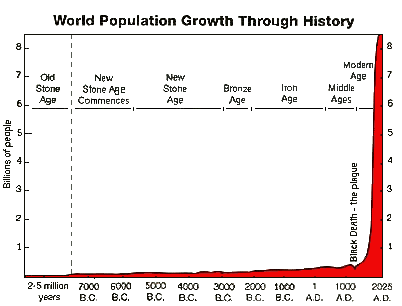
    Even if we could all agree, if just for the sake of this discussion, that the population went exponentially parabolic with the advent of the industrial revolution, as indicated in the chart, and is not sustainable, very few respondents to this thread have offered solutions.

    The elite are implementing their own solutions, with or without our consent, with or without ET help, and with or without benevolent intent. Barry Trowers research on microwave technology, the proliferation of such technology on this planet, and the long term effects on our own extinction, go relatively ignored. The effects of bleach and fluoride in our water, chemicals in our food and air, and all the toxic things we ingest into our bodies goes relatively unnoticed by the general population. We are being eliminated folks, plain and simple.

    Most of the pollution comes from burning oil. Why do we still use oil when we have the Tesla energy which comes directly from the earth, is unlimited and wireless? Why do we have a wired electric grid, when the technology exists to energize the planet with free energy? Because godzilla, as Wade Frazier calls them, wants it that way. The psychopathic elite want it that way.

    Why was NAWAPA stopped, which would provide clean water to the entire planet, and a 14 trillion dollar lien placed against the original organic Treasury of 1786? Because the psychopathic elite want it that way.

    Why are toxins being introduced into our food supply and our air supply? Because the elite want it that way.

    Why are all inventions which would increase consciousness, increase the husbandry of this planet, never implemented? Because the psychopathic elite want it this way.

    To me, there is nothing benevolent about what they are doing, and any solutions we would attempt to implement just get circumvented and destroyed by these elite. Many who have tried have paid with their lives.

    Its almost as if they WANT to expand the population exponentially, while telling us they are helping to solve it for our own good. Seems like one big fat lie to me. Why would they continue to rape and pillage this planet with total disregard for their own survival, as well as the survival of the genome? Makes no sense unless....

    They are planning on leaving the planet, or they are planning a huge ritualistic human sacrifice to appease their gods, the greatest collective energy vamp in history. These are the only two answers which make any sense at all.
    Last edited by gripreaper; 15th December 2013 at 19:26.
    "Lay Down Your Truth and Check Your Weapons
    The Next Voice You Hear Will Be Your OWN"
    https://www.youtube.com/watch?v=IhS69C1tr0w

  8. The Following 10 Users Say Thank You to gripreaper For This Post:

    AutumnW (15th December 2013), Eram (15th December 2013), mosquito (17th December 2013), observer (16th December 2013), OnyxKnight (15th December 2013), RMorgan (15th December 2013), Robin (15th December 2013), Rocky_Shorz (16th December 2013), skippy (15th December 2013), Wind (15th December 2013)

  9. Link to Post #125
    Canada Avalon Member
    Join Date
    4th November 2012
    Posts
    3,234
    Thanks
    6,391
    Thanked 14,309 times in 2,886 posts

    Default Re: How to reduce the human population ???

    Quote Posted by Kindred (here)
    First off... all this talk about 'overpopulation', is just so much programming by the 'controllers'.

    It's getting very tiresome to read the comments of proponents of 'depopulation', as it does Not address, much less, acknowledge what you are truly suggesting... i.e; Mass Murder.

    I thought humans have had enough of That.

    For all those that feel that depopulation is the only answer... well... not to be too flippant, BUT

    You First! You're welcome to go at Any Time... then you will Never need to worry about 'overpopulation' on Earth, Ever Again (if you so Choose)

    You have Free Will, after all.

    Who said anything about mass murder? The greatest mass murders occur by default, through systems under stress. Attrition is the best, most humane de-population program. And the elite conspiracy to depopulate?? Where is the evidence. Corporations are voracious, feeding off percentages of human transactions--the more the merrier.

  10. The Following 3 Users Say Thank You to AutumnW For This Post:

    Eram (15th December 2013), RMorgan (15th December 2013), skippy (15th December 2013)

  11. Link to Post #126
    Canada Avalon Member
    Join Date
    4th November 2012
    Posts
    3,234
    Thanks
    6,391
    Thanked 14,309 times in 2,886 posts

    Default Re: How to reduce the human population ???

    Grip, The greatest energy vamp is accumulation of wealth accrued off the most workers, consumers. If anything the moral midgets running this side show want more people-more more and more. The expansion of markets. I think they are going to be stopped in their tracks by black swan events. But is it part of their plan? Kind of doubt it.

  12. The Following 3 Users Say Thank You to AutumnW For This Post:

    Eram (15th December 2013), gripreaper (15th December 2013), RMorgan (15th December 2013)

  13. Link to Post #127
    Brazil Avalon Retired Member
    Join Date
    28th June 2011
    Location
    Belo Horizonte, Brazil
    Age
    42
    Posts
    3,857
    Thanks
    18,436
    Thanked 24,133 times in 3,536 posts

    Default Re: How to reduce the human population ???

    Quote Posted by gripreaper (here)

    Its almost as if they WANT to expand the population exponentially, while telling us they are helping to solve it for our own good. Seems like one big fat lie to me. Why would they continue to rape and pillage this planet with total disregard for their own survival, as well as the survival of the genome? Makes no sense unless....

    They are planning on leaving the planet, or they are planning a huge ritualistic human sacrifice to appease their gods, the greatest collective energy vamp in history. These are the only two answers which make any sense at all.
    I've asked myself the same question countless times, Grip.

    I mean, if they want to kill us all and reduce the population to 500.000.000, why they've been financing so many advances in medicine and this kind of stuff?

    In my opinion, they do this because they still need us. They need a lot of us to accomplish their goals...They need their slaves.

    They need us to do the hard work for them and to keep generating wealth for them.

    When eventually automation takes over most productive lines, they wont need us anymore, so they'll proceed with their massive genocidal plan.

  14. The Following 4 Users Say Thank You to RMorgan For This Post:

    AutumnW (15th December 2013), Eram (15th December 2013), gripreaper (15th December 2013), Rocky_Shorz (16th December 2013)

  15. Link to Post #128
    Avalon Member Kindred's Avatar
    Join Date
    4th February 2011
    Location
    At Peace, within the Noise
    Age
    70
    Posts
    1,160
    Thanks
    2,318
    Thanked 5,762 times in 1,045 posts

    Default Re: How to reduce the human population ???

    This little picture and it's inferences, when expanded into all realms of our current support systems, describes almost exactly what is going on... the 1% having total access and control over almost everything needed for human survival, and the remaining 99% making do with the left-overs, and being blamed for humanity's 'dilemma'.
    Attached Images  
    “A wizard is never late, nor is he early, he arrives precisely when he means to.”
    - Gandalf (J.R.R. Tolkien, The Fellowship of the Ring)

  16. The Following 4 Users Say Thank You to Kindred For This Post:

    AutumnW (15th December 2013), Eram (15th December 2013), OnyxKnight (15th December 2013), Rocky_Shorz (16th December 2013)

  17. Link to Post #129
    Netherlands Avalon Member Eram's Avatar
    Join Date
    19th March 2012
    Age
    52
    Posts
    1,479
    Thanks
    65,666
    Thanked 11,043 times in 1,437 posts

    Default Re: How to reduce the human population ???

    Quote Posted by gripreaper (here)


    This graphic goes for a lot of developments these days.
    • The rate of development in technology.
    • The rate at which we accumulate knowledge (This used to be a doubling of knowledge every thousand year. At the moment we double our knowledge about every 4 year)
    • The rate at which animals are becoming extinct.
    • The rate wt which C02 is pumped in the atmosphere
    • ...

    It's a pretty big list, though I can't remember it all at the moment.

    Drunvalo Melchizedek brought it up in one of his interviews that I watched way back at 2000 or so. (I consider him delusional now, or acting as a disinfo agent, but these graphics were pretty accurate and impressive)

    Anyway, it goes to show that we live in extreme times.
    hylozoic tenet: “Consciousness sleeps in the stone, dreams in the plant, awakens in the animal, and becomes self-conscious in man.”

  18. The Following 5 Users Say Thank You to Eram For This Post:

    AutumnW (15th December 2013), OnyxKnight (15th December 2013), RMorgan (15th December 2013), Rocky_Shorz (16th December 2013), skippy (15th December 2013)

  19. Link to Post #130
    Aaland Avalon Member Agape's Avatar
    Join Date
    26th March 2010
    Posts
    5,801
    Thanks
    14,834
    Thanked 27,083 times in 4,838 posts

    Default Re: How to reduce the human population ???

    Quote Posted by skippy (here)
    Quote Posted by Rocky_Shorz (here)
    actually, this planet going completely green will allow it to grow to 50 billion people...
    My personal estimate for equilibrium was at 20 billion, but Rocky's 50 billion people must be closer to the truth. Thanks Rocky to put things into perspective.

    The threshold is somewhere at 80 billion - 10 times more than now , from what is socio-economically possible , by which time ( even if all 'go green' which is highly improbable and much more complex than 'eat veggies only' ) people would beg for free oxygen , recycle water , survive on artificial food ..right the opposite than what is on most 'healthy peoples' 'to do list' still now.

    We would be living like sardines, personal space would have to be sacrificed to the 'greater good' more than now , social stress would increase considerably ..
    this has nothing to do with 'how much free space there is on Earth' ,

    it's lot to do with how much freedom and quality of life you want to see for you and your children .

    I really do NOT understand people being so excited about how much they're able to flood this Earth with numbers ( even crickets can do that ) ,

    stressing the quantity against quality .

    This is NOT about killing people, this is about caring for those who are alive , acknowledging your individual lives, choices, talents, finding what's so precious in each of you ..God .. you are not cockroaches people, you are not army of drones ,

    you don't want to copy life on other, more densely inhabited planets either because you are not them .

    Even with current 7 billions people , you are not able to care for everyone basic needs, not to speak of advanced needs.

    Yes by growing the population real big you will cultivate huge 'worker class' , copies of copies of people who will remain tight to organised systems and live from carefully limited supplies and won't believe how in past this planet , its nature was so resourceful and allowed you to roam free .


    I really don't wish to live in any such times.


  20. The Following 9 Users Say Thank You to Agape For This Post:

    AutumnW (15th December 2013), blufire (15th December 2013), Eram (15th December 2013), mosquito (17th December 2013), OnyxKnight (15th December 2013), RMorgan (15th December 2013), Robin (16th December 2013), Shezbeth (15th December 2013), sunflower (18th December 2013)

  21. Link to Post #131
    Avalon Member OnyxKnight's Avatar
    Join Date
    26th May 2010
    Location
    In a troubled world ...
    Age
    37
    Posts
    1,214
    Thanks
    2,405
    Thanked 5,662 times in 944 posts

    Default Re: How to reduce the human population ???

    41 Bil. is the best stable number. But by that time we need to have a second threshold, preferably without such limitations as local biosphere (like Mars). I'm sorry to keep bringing it up, but its closest and the most feasible.

  22. The Following 3 Users Say Thank You to OnyxKnight For This Post:

    AutumnW (16th December 2013), Eram (15th December 2013), Rocky_Shorz (16th December 2013)

  23. Link to Post #132
    Brazil Avalon Retired Member
    Join Date
    28th June 2011
    Location
    Belo Horizonte, Brazil
    Age
    42
    Posts
    3,857
    Thanks
    18,436
    Thanked 24,133 times in 3,536 posts

    Default Re: How to reduce the human population ???

    Honestly,

    I think you guys are insane, saying that it would be fine to grow our population up to 40 billion people.

    Have you lost your minds?

    Do you think we have the right to transform Earth into a big sterile metropolis?

    We're just ONE among many other species who have the right to live here. We don't have the right to turn all of Earth's surface into human habitat.

    We've already crossed the line long ago. We've already taken more than we should. Lots of species have gone extinct because of human interference, and many precious natural environments have been and are in the process of being completely devastated.

    We may even manage to barely sustain 40 billion people here, but then it would be just us, cockroaches and maybe rats. Forget about all the rest.

    Come on folks...What do you have inside your skulls? Pudding?

    Why is it so hard for you to get it?

    We don't own this planet. We share it!

    Do you really believe that our goal here in this planet is to reproduce like rabbits? Do you think we have the right?

    You guys talk about overpopulation prevention as it were the ultimate sin...Come on! How dare you! Really!

    We do this to other animals all the time through control mechanisms like hunting, pest control and things like that...So it's ok to do it with other animals but it's not ok to do this to us?

    Next time you have "pests" in your house, try not calling pest control...Let their population grow out of control...Try living with a million rats; I'm sure they could fit just fine in your lovely home...It will be a very pleasant experience, you can be sure about that.

    Remember: Don't do to OTHERS what you don't want done to you.

    The word "others" doesn't mean other humans. It means everybody else!

    Wake up folks! We, the smartest animal in this planet, are behaving like PESTS...And you're defending this behavior? Really? Why are you so resistant about changing such despicable behavior? What's wrong with you?

    You come with all this "humans are spiritually evolved beings" talk and then behave exactly like monkeys or worse...

    If you want to sacrifice all the riches, diversity and beauty of this planet so we could all have nonstop sex until we consume all the planet into ashes, don't expect me to agree with it.

    Grow up! Is it really worth it? Do you have any idea of what you're defending here? You look like a virus defending itself...

    Raf.
    Last edited by RMorgan; 15th December 2013 at 21:47.

  24. The Following 7 Users Say Thank You to RMorgan For This Post:

    Agape (15th December 2013), AutumnW (16th December 2013), blufire (15th December 2013), Eram (15th December 2013), loungelizard (28th December 2013), mosquito (17th December 2013), Shezbeth (15th December 2013)

  25. Link to Post #133
    Aaland Avalon Member Agape's Avatar
    Join Date
    26th March 2010
    Posts
    5,801
    Thanks
    14,834
    Thanked 27,083 times in 4,838 posts

    Default Re: How to reduce the human population ???

    Quote Posted by SamwiseTheBrave (here)
    I like open space. I like miles and miles of pristine nature that is not tampered with human interference where I can freely roam and bathe in the natural systems that nature provides. I like breathing fresh air from trees that have grown from a seed placed in the ground by natural forces, not uniformly by man in a crowded city.

    I like going outside and seeing Earth that has grown a forest through natural processes. I like irregularity and I like assymetry. Cities that grow forests within buildings are not pleasing to me. It is not natural to me. Humans on this planet focus too much on uniformity. Nature does not form straight, linear structures for a reason. Think about it.

    Animals and plants and fungi and everything in between need a lot of space, too. If we create corridors of nature, organisms do not have the space they need to roam for foraging and mating purposes. You must understand this. Different species have different niches. They need a lot of open space that is not crossed with man-made roads or buildings.

    If we do not provide this space for humans (like me) and other organisms, then we are limiting the amount of intrinsic happiness that they have. If we continue building, then naturalists like myself will be less and less satisfied with daily living. Other organisms, who also experience emotions in different ways, are not as happy either.

    By allowing a lot of open space, we are allowing nature to continue its ecological systems unimpeded. We allow bees to pollinate flowers (including our crops), we allow grizzly bears to find mates through vast stretches of open forest, we allow ants to aerate soil, etc. etc. etc.

    Forests that develop through an infinite amount of universal systems are beautiful and sustainable. We cannot even fathom understanding how a pristine forest comes into being...so why should we tamper with it? One system, created by humans, creates a bare, broken, unsustainable form of living.

    Please understand this. We cannot continue to produce more humans. We just cannot.

    I would totally agree with Sam's post here .


    Adding this little video because I like the idea so much . Idea adopted as 'national policy' of the little kingdom of Bhutan , namely its young king Jigme Wangchug ,
    stressing it's not 'the gross national product' but 'gross national happiness' that is important
    and reflects true advancement of society ..

    http://en.wikipedia.org/wiki/Gross_national_happiness

  26. The Following 4 Users Say Thank You to Agape For This Post:

    AutumnW (16th December 2013), Eram (15th December 2013), Robin (16th December 2013), Shezbeth (15th December 2013)

  27. Link to Post #134
    Unsubscribed
    Join Date
    22nd January 2013
    Location
    Toronto
    Posts
    764
    Thanks
    4,724
    Thanked 3,847 times in 715 posts

    Default Re: How to reduce the human population ???

    Really Bad Ideas: Population control

    Quote Frank Furedi

    Sociologist, commentator and author of Culture of Fear, Where Have All The Intellectuals Gone?, Paranoid Parenting, Therapy Culture, and On Tolerance: In Defence of Moral Independence.


    Really Bad Ideas: Population control
    Alongside today’s respect for human life there is the increasingly popular idea that there is too much human life around, and that it is killing the planet.
    .....

    Since the beginning of time, one of the clearest markers of an enlightened society has been the moral status it attaches to human life.


    The humanist impulse that once drove the development of the modern world has been replaced by a tendency to view humanity with suspicion, or even outright hostility. The vocabulary of our times – ‘human impact on the environment’; ‘ecological footprint’; ‘human consumption’ – invokes a sense of dread over the active exercise of human life. Apparently, there are too many of us doing too much living and breathing. In a world where humanity is portrayed as a threat to the environment and to the very survival of the planet, human activity – from birth to consumption to procreation – is regarded as a mixed blessing. Consequently, our concern with preserving and improving the quality of life of some people sits uneasily with an increasingly shrill demand to prevent people from being born in the first place.

    Today, many green-leaning writers and activists argue that population control is the best solution to the problems we face. This belief that there are ‘too many people’ inhabiting the globe has reared its ugly head numerous times over the past 200 years. Since the times of Thomas Malthus (1766-1834), a catastrophic vision of population growth causing the collapse of society has formed an important part of the culturally pessimistic outlook. Back in the eighteenth century it was predicted that population growth would lead to famine, starvation and death. Today’s pessimists have raised the stakes further: they denounce population growth as a threat to biodiversity and to the very existence of the planet. Twenty-first-century Malthusians are not so much worried about an impending famine: they’re more concerned that people are producing and consuming too much food and other commodities.

    Where in the eighteenth and nineteenth centuries Malthusians warned that population growth threatened people with starvation, today’s Malthusians denounce people for threatening the planet by consuming too much. As a result, contemporary Malthusianism has an unusually strident and misanthrophic streak. In the West, the population-control lobby castigates those who have large families for being environmentally irresponsible. Having children, especially lots of children, is now discussed as an ‘eco-crime’ on a par with pollution. From this perspective, a new human life is seen as little more than another producer of carbon; new life is seen as a form of pollution. So it would be better, the Malthusians argue, if these new human lives did not exist at all. As one Malthusian crusader notes: ‘A non-existent person has no environmental footprint; the emission “saving” is instant and total.’ (1) This preference for the non-existent over the existent speaks to a powerful anti-humanist sensibility. And it is not only eccentric and isolated misanthropes who value ‘non-existence’ as being somehow morally superior to existence – rather, this outlook is symptomatic of a wider trend for devaluing the status of human life today.

    For contemporary Malthusians, every new child is another pollutant: she may just be a baby now, but by the time she is 80 she will be responsible for the emission of 9.3 tonnes of CO2! So why worry about how much pollution your car causes? Apparently you should be far more concerned with limiting the size of the population. ‘Population limitation should…be seen as the most cost-effective carbon offsetting strategy available to individuals and nations’, argues the dreary British-based population-control outfit, the Optimum Population Trust (OPT) (2). Once the emission of greenhouse gases is taken to be the defining feature of human activity, then it follows that controlling fertility is the ideal ‘carbon offsetting strategy’. ‘If we had half as many people, we wouldn’t have much of a climatic warming problem’, says Ric Oberlink of the US-based group Californians for Population Stabilization (3). And no doubt if the human species disappeared off the face of the Earth altogether, then the crisis of global warming would resolve itself and the planet would be very happy.

    For Oberlink and his associates, global warming is a symptom of the far greater menace of population growth. ‘Global warming is a very serious problem, but it is a subset of the overpopulation problem’, claims Oberlink. John Seager, president of Population Connection, the American campaign group that was formerly known as Zero Population Growth, also believes that the ‘underlying cause of global warming’ is ‘human population growth’ (4). The idea that population growth is the principal threat to the planet is widely disseminated through the mainstream media. While giving the prestigious BBC Reith Lectures earlier this year, the economist Jeffrey Sachs argued that ‘our planet is crowded to an unprecedented degree’, and such overcrowding is ‘creating….unprecedented pressures on human society and on the physical environment’ (5). This pessimistic view of population growth is so taken for granted that it is very rarely challenged in mainstream intellectual and cultural circles.

    The catastrophic imagination in contemporary Western culture has encouraged the Malthusian lobby to target the very aspiration for procreation. Controlling fertility is now described as a duty rather than a matter of choice. ‘Couples making decisions about family size do so in the belief that it is a matter for them and their personal preferences alone’, says the OPT, with incredulity (6). The idea that people should have the right to make choices about their family size is dismissed as an indefensible outrage against common sense.

    This assault on the right to procreate is often intrusive, even coercive. Take the example of Rwanda. The world was horrified by the mass slaughter in Rwanda in 1994, during which an estimated 800,000 Rwandans were killed. Yet it appears that, so far as the population-control lobby is concerned, there are still too many people living in Rwanda. As one headline earlier this year put it: ‘After so many deaths, too many births.’ Apparently, ‘After the 1994 genocide, in which more than 800,000 Rwandans were slaughtered, it seemed difficult to believe that overpopulation would ever be a problem. Yet Rwanda has long had more people than its meagre resources and small area can support.’ Now, with the guidance of Western non-governmental organisations (NGOs), the Rwandan government is planning a sweeping population-control programme. From now on, everyone who visits a medical centre will be ‘counselled’ about family planning (7). Experience shows that such ‘counselling’ in reality means putting pressure on women to use contraception.

    It is in poverty-stricken, insecure countries like Rwanda, where people lack the resources to assume even a modicum of control over their lives, that the truly inhumane nature of population-control policies becomes clear.


    A cause in search of an argument

    The distinctive feature of Malthusianism is its profound consciousness of limits. The fatalistic Malthusian outlook looks upon people as parasitic consumers whose appetites are limited only by the obstacles thrown up by nature. Malthus’ Essay, which was written in 1798, was a reaction against the optimistic visions of humanity put forward by Enlightenment thinkers. For Enlightenment thinkers such as Condorcet and Godwin, people were not simply consumers – they were are also creative actors, innovators, producers. Thankfully, in the centuries since he wrote Essay and other works, Malthus’ alarmist warnings have proven to be unfounded: food production has generally increased in line with population growth and there has not been a global famine. However, the fact that Malthus’ predictions did not come true has not discouraged anti-humanists from pursuing the population-control project. They simply invent new reasons for why we must control population growth.

    Over the past two centuries, a bewildering array of problems has been blamed on population growth. At various times, famine, poverty, the failure of Third World economies, instability, revolution, the spread of communism and the subordinate position of women have been linked to population growth (8). The approach of the population growth lobby is devastatingly simple: they take a problem and argue that it would diminish in intensity if there were fewer people. Such simplistic methodology is even used to account for the emergence of new forms of terrorism today.

    .....


    Losing faith in the human

    You don’t have to be a sophisticated student of global politics to see through the simplistic and opportunistic arguments on security put forward by the new Malthusians. But then, the success of Malthusianism has never been down to the rigour or eloquence of its ideas. Rather, the success of Malthusian ideas depends on the strength of cultural pessimism at any given time. And today it is the loss of faith in the human potential, a fatalistic view of the future, which has rejuvenated the population-control crusade.

    So powerful is cultural pessimism today that even the special quality of human life is now called into question. Today, pollution is seen as the principal feature and consequence of human existence. Indeed, today’s neo-Malthusian thinking is far more dismal and misanthropic than the original version. For all his intellectual pessimism and lack of imagination, Thomas Malthus possessed a far more robust belief in humanity than do his contemporary followers. Although he shared today’s cultural obsession with the limits of nature, he nonetheless expressed a conviction that humanity had a positive role to play. He argued that although ‘our future prospects respecting the mitigation of the evils arising from the principle of population may not be so bright as we could wish…they are far from being entirely disheartening, and by no means preclude that gradual and progressive improvement in human society, which before the late wild speculations on this subject, was the object of rational expectation’ (9).

    Malthus’ reservations about the human potential were a product of his deep-seated hostility to the optimistic humanism of his intellectual opponents: Condorcet, Godwin and others. And yet, he made it clear that despite his pessimistic view of population growth ‘it is hoped that the general result of [my] inquiry is not such as to make us give up the improvement of human society in despair’ (10).

    In contrast to today’s singularly pessimistic neo-Malthusians, Malthus’ On The Principle of Population managed to convey a belief in humanity. Over the past two centuries, his followers have often tried to discourage people from the ‘wrong’ classes and the ‘wrong races’ from procreating – yet despite their prejudices they continued to affirm the special status of the human species (or at least certain sections of it). In some instances – for example, during the rise of the eugenic movement – rabid prejudice against so-called racial inferiors was combined with a belief in human progress.

    By contrast, today’s Malthusians share all the old prejudices and in addition they harbour a powerful sense of loathing against the human species itself. Is it any surprise, then, that some of them actually celebrate non-existence? The obsession with natural limits distracts society from the far more creative search for solutions to hunger or poverty or lack of resources. Worse still, by calling into question the special quality of the human, the population-control lobby seeks to corrode people’s confidence in their ability to tackle the problems of the future. Human life should always be treated as precious and special. How can there possibly be too many of us?

    Frank Furedi is author of Population And Development; A Critical Introduction.

  28. Link to Post #135
    Avalon Member OnyxKnight's Avatar
    Join Date
    26th May 2010
    Location
    In a troubled world ...
    Age
    37
    Posts
    1,214
    Thanks
    2,405
    Thanked 5,662 times in 944 posts

    Default Re: How to reduce the human population ???

    Quote Posted by RMorgan (here)
    Honestly,

    I think you guys are insane, saying that it would be fine to grow our population up to 40 billion people.

    Have you lost your minds?

    Have you studied architecture? Industrial design maybe? Maybe a bit of economy?


    If some solutions reach practical use, there wont be any need to wait till there are 40 billion humans here. More ethical, and green suggestions, I made some while back (perhaps it was a different thread that BG made). Such designs should provide enormous territory for not only animal survival, but also repopulation. Old areas will grow back, and deserts should become green again.

    Territorial expansion should be reduced by as little as 0.1% per decade in horizontal, x/y sense.


    I don't think we are any more insane than those who think wiping out portions of the present population somehow equates a better future. I just haven't seen you make such an outburst before, in regards to them. But you did with us, and that surprises me. In an unpleasant way.


    If you don't have your own ideas on how to handle this (like you said you don't), I suggest you keep labels about other people's state of mind to yourself. If you have something better in mind, please do share. If not, than its just a pointless arguing over numbers and no potential solutions are discussed, and you are treading the way Bright Garlick did with ... well, all his few threads about the same subject matter.
    Last edited by OnyxKnight; 15th December 2013 at 21:58.

  29. The Following 2 Users Say Thank You to OnyxKnight For This Post:

    Eram (15th December 2013), Rocky_Shorz (16th December 2013)

  30. Link to Post #136
    Unsubscribed
    Join Date
    22nd January 2011
    Location
    Everywhere
    Age
    45
    Posts
    1,505
    Thanks
    5,486
    Thanked 5,216 times in 1,274 posts

    Default Re: How to reduce the human population ???

    My solution overpopulation is simple.

    I am not want to suffer a child of my loins to this world of perdition.

    Those who wantonly, irresponsibly, and ignorantly reproduce are welcome to this world, and once I'm finished with it they can have my 'share' too. Those who are not wanton, irresponsible, or ignorant about their reproduction and dealings - and their children - have my blessings and pity.

  31. Link to Post #137
    Unsubscribed
    Join Date
    22nd January 2013
    Location
    Toronto
    Posts
    764
    Thanks
    4,724
    Thanked 3,847 times in 715 posts

    Default Re: How to reduce the human population ???

    Overpopulation: The Making of a Myth
    Where did this myth come from? When was humanity supposed to end?


    Quote


    Did Malthus really say to kill off the poor?

    Yep. In his Essay on the Principle of Population, Malthus calls for increased mortality among the poor:

    ‘All the children born, beyond what would be required to keep up the population to this level, must necessarily perish, unless room be made for them by the deaths of grown persons… To act consistently therefore, we should facilitate, instead of foolishly and vainly endeavoring to impede, the operations of nature in producing this mortality; and if we dread the too frequent visitation of the horrid form of famine, we should sedulously encourage the other forms of destruction, which we compel nature to use. Instead of recommending cleanliness to the poor, we should encourage contrary habits. In our towns we should make the streets narrower, crowd more people into the houses, and court the return of the plague. In the country, we should build our villages near stagnant pools, and particularly encourage settlements in all marshy and unwholesome situations.’ (Book IV, Chap. V) — Read it online.

    .....


    Did Paul Ehrlich really say that famines would devastate humanity in the 1970s?


    Yep. In his 1968 work The Population Bomb, Ehrlich stated:

    “The battle to feed all of humanity is over. In the 1970s the world will undergo famines--hundreds of millions of people will starve to death in spite of any crash programs embarked upon now.”

    What's the UNFPA? How do they profit from fear?

    The United Nations Fund for Population Activities (UNFPA) was founded in 1969, the year after Ehrlich published The Population Bomb. They have been involved in programs with governments around the world who deny their women the right to choose the number and spacing of their children. Their complicit work with the infamous “one-child policy" mandated by the government of the People's Republic of China, uncovered by an investigation of the U.S. State Department in 2001, led the United States to pull its funding.

    The wealthy of the West, in their terror of poverty, have given copiously to the UNFPA and its population control programs. Visit Population Research Institute for more info.


    No way everyone could fit in Texas …


    According to the U.N. Population Database, the world's population in 2010 will be 6,908,688,000. The landmass of Texas is 268,820 sq mi (7,494,271,488,000 sq ft).

    So, divide 7,494,271,488,000 sq ft by 6,908,688,000 people, and you get 1084.76 sq ft/person. That's approximately a 33' x 33' plot of land for every person on the planet, enough space for a town house.


    Given an average four person family, every family would have a 66' x 66' plot of land, which would comfortably provide a single family home and yard -- and all of them fit on a landmass the size of Texas. Admittedly, it'd basically be one massive subdivision, but Texas is a tiny portion of the inhabitable Earth.


    Such an arrangement would leave the entire rest of the world vacant. There's plenty of space for humanity.

    Where are you getting these numbers?

    U.N. Population Database. While they provide Low, Medium, and High Variants, the Low Variant is the one that keeps coming true, so the Low variant numbers are the ones used in this video. Check their online database.


    The world's population will peak in 30 years? Prove it.

    According to the U.N. Population Database, using the historically accurate low variant projection, the Earth's population will only add another billion people or so over the next thirty years, peaking around 8.02 billion people in the year 2040, and then it will begin to decline. Check their online database.

    7 Billion People: Will Everyone Please Relax?
    It's a huge number. But it's not what you think.


    You are very confident about the earth’s population leveling off and then falling. How can you prove this? After all, population is still growing.


    Population is still technically growing, but according to the United Nation Population Division’s numbers, that growth is slowing dramatically.

    The United Nations Population Division (UNPD) is the most reliable source of population statistics in the world, which is why we use their numbers for our videos. And, according to the UNPD, population growth will continue to slow down over the next few decades. In fact, if current trends persist, our growth will halt right around 8 billion by 2045. After that, our numbers will start to fall off, slowly at first, and then faster.

    If you find this whole idea counterintuitive, don't worry! You're not alone. At first glance, it really does seem like population is skyrocketing. That’s because we're still adding a billion people every few decades . . . and a billion people is a lot of people. But the way we can tell that population is not ballooning out of control is precisely the fact that we’re only adding a billion people each time. And soon, we won’t even be adding that many.

    You claim that the UN’s predictions are reliable. How reliable have they historically been?


    Again, it depends on which variant you use. In our research, we’ve looked at the UN’s predictions and how they have compared with real life--and in every case the “low variant” has been the most accurate. You can run the numbers yourself here

    Even if population growth is slowing down, a billion people every 15 years is still a lot of people. Isn’t this still a problem?


    It is a lot of people. And of course, greater numbers bring their own challenges and issues. But there isn't any convincing evidence to show that the size of our population is the cause of the world's most pressing issues, like war, famine, disease, and poverty.

    Let's put it another way. Since we have more people, our wars are bigger. Our famines may affect more people, and more people will have diseases and be poor. But population growth didn't create these problems--they have have existed since people have existed.

    In other words, we can't blame population for problems that have been around forever. The only difference is, since there are more of us now, these problems affect more people.

    Why has the global total fertility rate dropped so much?


    Scientists are still debating exactly why, but there's no doubt that it is happening. All over the world, birthrates have been dropping quickly, and for nearly 50 years now.

    Many demographers think that it is because more and more people are urbanizing (moving into large cities). When families live out in the country on farms, it makes more economic sense to raise larger families, so that they have people to help them and care for them in their old age. It’s also true that cities tend to have better healthcare facilities, which reduce infant mortality. This in turn means that parents end up having fewer children, since more of their existing children are surviving to adulthood.

    Demographic expert Philip Longman observes, in his book The Empty Cradle, “As more and more of the human race find itself living under urban conditions in which children no longer provide any economic benefit to their parents, but are rather costly impediments to material success, people who are well adapted to this new environment will tend not to reproduce themselves. And many others who are not so successful will imitate them.” (p.31, available here)

    Overpopulation is a myth. This myth has caused human rights abuses around the world, forced population control, denied medicines to the poor, and targeted attacks on ethnic minorities and women.

  32. Link to Post #138
    Brazil Avalon Retired Member
    Join Date
    28th June 2011
    Location
    Belo Horizonte, Brazil
    Age
    42
    Posts
    3,857
    Thanks
    18,436
    Thanked 24,133 times in 3,536 posts

    Default Re: How to reduce the human population ???

    Quote Posted by RMorgan (here)
    Honestly,

    I think you guys are insane, saying that it would be fine to grow our population up to 40 billion people.

    Have you lost your minds?

    Quote Posted by OnyxKnight (here)
    Have you studied architecture? Industrial design maybe? Maybe a bit of economy?
    Yes. Officially, both Architecture and Industrial Design; Economy as a hobby.


    Quote Posted by OnyxKnight (here)
    If some solutions reach practical use, there wont be any need to wait till there are 40 billion humans here. More ethical, and green suggestions, I made some while back (perhaps it was a different thread that BG made). Such designs should provide enormous territory for not only animal survival, but also repopulation. Old areas will grow back, and deserts should become green again.

    Territorial expansion should be reduced by as little as 0.1% per decade in horizontal, x/y sense.


    I don't think we are any more insane than those who think wiping out portions of the present population somehow equates a better future. I just haven't seen you make such an outburst before, in regards to them. But you did with us, and that surprises me. In an unpleasant way.


    If you don't have your own ideas on how to handle this (Like you said you don't, I suggest you keep labels about other people's state of mind to yourself. If you have something better in mind, please do share. If not, than its just a pointless arguing over numbers and no potential solutions are discussed, and you are treading the way Bright Garlick did with ... well, all his few threads about the same subject matter.
    So, you'd rather transform Earth into a vertical human farm instead of taking preventive measures like having just one or two children per family?

    Is that it?

    You'd rather stick the Earth with a billion massive vertical habitations, instead of taking simply preventive measures such as birth control?

    Do you think it's worth it? For what? Just to keep the luxury of reproducing as much as we want?

    And please, don't distort what I'm saying, man. I'm not defending "them", whoever they are. I don't like these people, but I don't ignore the fact that we also carry a big slice of responsibility for this mess.

    I'm talking about prevention. Nothing more, nothing less.

    Governments should study educational and economic measures to prevent people from having more than just a couple of children per family. This is the most simple, practical, cost effective, harmless and logical measure we could take right now.

    I'm talking about the NOW, not somewhere in a hypothetical future scenario.


    Anyway, man, don't we have enough misery in this planet with just 7 billion people?

    Honestly, what do you think is most probable? The misery and social contrast would increase with the population number, or magically decrease?

    You're talking about an Utopia here. We have to work with trends and probabilities; Dreaming is just good until a certain point.

    There's no indicative that this system is going away anytime soon. Probably, if we ever achieve a 40 billion people population, only 1% or less would live in these places you're talking about, these technological oases, and the rest would live drowned in their own excrement.

    We have to be wise now, preventing this scenario from becoming a reality.

    Raf.
    Last edited by RMorgan; 15th December 2013 at 22:32.

  33. The Following 6 Users Say Thank You to RMorgan For This Post:

    Agape (15th December 2013), AutumnW (16th December 2013), Eram (15th December 2013), Freed Fox (16th December 2013), Kindred (25th February 2014), mosquito (17th December 2013)

  34. Link to Post #139
    Unsubscribed
    Join Date
    22nd January 2013
    Location
    Toronto
    Posts
    764
    Thanks
    4,724
    Thanked 3,847 times in 715 posts

    Default Re: How to reduce the human population ???

    The Myth of Overpopulation

    by Drutakarma Dasa

    Quote


    “According to the Vedas, population experts are wrong in their crucial assumption that earth cannot supply the needs of a large population. If people are God conscious, there is virtually no limit to the population the earth can comfortably support.”

    One of the myths most strongly entrenched in the modern mind is that birth control is necessary because of the threat of overpopulation. But His Divine Grace A. C. Bhaktivedanta Swami Prabhupada has stated: “There is no scarcity for maintenance in the material world.” According to Srila Prabhupada, human society’s leadership “is disturbed about the food situation and, to cover up the real fact of administrative mismanagement, takes shelter in the plea that the population is excessively increasing” (Bhag. 3.5.5, purport).

    The world is far from being overpopulated. A simple calculation shows that all five billion men, women, and children on earth could be placed within the 267,339 square miles of the state of Texas, with each person occupying about fifteen hundred square feet of space.

    But what about food? A study by the University of California’s Division of Agricultural Science shows that by practicing the best agricultural methods now in use, the world’s farmers could raise enough food to provide an American style diet for ten times the present population. And if people would be satisfied with an equally nourishing but mostly vegetarian diet, we could feed thirty times the present population.

    Studies of an African famine in the early 1970’srevealed that every country affected had within its borders the agricultural resources to feed its people. As Frances Moore Lappe points out in her well-researched book Food First, much of the best land was being misused for production of exportable cash crops.

    Srila Prabhupada also noted this fact. During a visit to Mauritius in 1975, in a lecture attended by some of the nation’s leading citizens, he stated, “So I see in your Mauritius island you have got enough land to produce food grains.” He then challenged, “I understand that instead of growing food grains you are growing sugarcane for exporting. Why? You first of all grow your own eatables, and if there is time and if your population has sufficient food grains, then you can try to grow other fruits and vegetables for exporting.”

    Srila Prabhupada went on to say, “I have traveled to Africa, Australia, and America, and everywhere there is so much land vacant. If we use it to produce food grains, then we can feed ten times as much population as at the present moment. There is no question of scarcity. The whole creation is so made by Krishna that everything is purnam, complete.”

    Food resources are also wasted by improper diets. During his lecture in Mauritius, Srila Prabhupada said, “I have seen in the Western countries that they are growing food grains for the animals, and the food grains are eaten by the animals, and the animal is eaten by the man.... What are the statistics? The animals are eating food grains, but the same amount of food grains can be eaten by so many men.”

    Such statistics do exist. Government figures show that about ninety percent of the edible grains harvested in the United States are fed to animals that are later killed for meat. But for every sixteen pounds of grain fed to beef cattle, only one pound of meat is produced.

    Srila Prabhupada concluded, “If there were one government on the surface of the earth to handle the distribution of grain, there would be no question of scarcity, no necessity to open slaughterhouses, and no need to present false theories about overpopulation” (Bhag. 4.17.25, purport).

    The first person to sound the overpopulation alarm was the English economist Malthus (1766-1834), who calculated that population tends to increase much faster than the earth’s limited food supply. New farmland, of which there is only so much, said Malthus, can be brought into production only slowly and with great labor and careful planning, whereas—because of the constant pressure of sex desire—people will have as many children as they are able, unless they are checked. Therefore the population is almost always pushing the limit of available food, and suffering results. Malthus summarized this with his maxim that food production increases arithmetically, while population increases geometrically.

    “That population has this constant tendency to increase beyond the means of subsistence,” states Malthus “… will sufficiently appear from a review of the different states of society in which man has existed.” But according to the Vedic viewpoint, the earth can produce an almost unlimited amount of life’s necessities. Restriction occurs not from overpopulation but from some other cause, namely the self-destructive attitudes and actions of the planet’s population.

    The science of ecology has awakened us to a greater appreciation of how different organisms and natural resources are linked in complex interdependency, and how easily this interdependency can be disturbed—as in the case of acid rain, for example. While doing research for NASA, scientist Jim Lovelock concluded that the “earth’s living matter, air, oceans, and land surface form a complex system which can be seen as a single organism and which has the capacity to keep our planet a fit place for life.” He calls his hypothesis the “Gaia principle,” after the Greek goddess of the earth.

    Lovelock himself, adhering to the principles of materialistic science, does not believe in a personified earth deity. But he does point out, “The concept of Mother Earth, or, as the Greeks called her long ago, Gaia, has been widely held throughout history and has been the basis of a belief which still coexists with the great religions.” The Vedic scriptures clearly state that the earth is the visible form of the goddess Bhumi, who restricts or increases her production according to the population’s level of spiritual consciousness.

    “Therefore,” states Srila Prabhupada, “although there may be a great increase in population on the surface of the earth, if the people are exactly in line with God consciousness and are not miscreants, such a burden on the earth is a source of pleasure for her” (Bhag. 3.3.14, purport).

    So according to the Vedas, Malthus and later population experts are wrong in n their crucial assumption that earth cannot supply the needs of a large population. If people are God conscious, there is virtually no limit to the population the earth can comfortably support.

    .....


    Is reincarnation just a belief? According to the Vedas, it is a fact each of us must face. Even Western science has turned up evidence (in research into out- of-body experiences and memories of past lives) that strongly suggests there is a conscious part of us that survives the death experience. We return, the Vedas explain, to suffer the reactions to the activities we performed in our previous life.

    .....


    Srila Prabhupada further states, “This material world is created to give the conditioned souls a chance ... for going back home, back to Godhead, and therefore generation of the living being is necessary, … and as such one can even serve the Lord in the act of such sexual pleasure. The service is counted when the children born of such sexual pleasure are properly trained in God consciousness” (Bhag. 2.10.26, purport).

    If the people are good, then no matter how numerous they are, they will be able to cooperate peacefully and, with the blessings of God, receive ample resources from Mother Earth. On the other hand, even a very limited population of bad character can make the planet into a hell. Selfish sex, aided by abortion, pills, condoms, and so on, is not going to make this world a happier place for anyone. People will continue in the cycle of birth and death, and the world will be a chaos of greed, anger, envy, and violence.


  35. Link to Post #140
    Unsubscribed
    Join Date
    22nd January 2013
    Location
    Toronto
    Posts
    764
    Thanks
    4,724
    Thanked 3,847 times in 715 posts

    Default Re: How to reduce the human population ???

    Overpopulation Is Not the Problem
    By ERLE C. ELLIS
    Published: September 13, 2013


    Quote BALTIMORE — MANY scientists believe that by transforming the earth’s natural landscapes, we are undermining the very life support systems that sustain us. Like bacteria in a petri dish, our exploding numbers are reaching the limits of a finite planet, with dire consequences. Disaster looms as humans exceed the earth’s natural carrying capacity. Clearly, this could not be sustainable.
    Enlarge This Image


    This is nonsense. Even today, I hear some of my scientific colleagues repeat these and similar claims — often unchallenged. And once, I too believed them. Yet these claims demonstrate a profound misunderstanding of the ecology of human systems. The conditions that sustain humanity are not natural and never have been. Since prehistory, human populations have used technologies and engineered ecosystems to sustain populations well beyond the capabilities of unaltered “natural” ecosystems.

    The evidence from archaeology is clear. Our predecessors in the genus Homo used social hunting strategies and tools of stone and fire to extract more sustenance from landscapes than would otherwise be possible. And, of course, Homo sapiens went much further, learning over generations, once their preferred big game became rare or extinct, to make use of a far broader spectrum of species. They did this by extracting more nutrients from these species by cooking and grinding them, by propagating the most useful species and by burning woodlands to enhance hunting and foraging success.

    Even before the last ice age had ended, thousands of years before agriculture, hunter-gatherer societies were well established across the earth and depended increasingly on sophisticated technological strategies to sustain growing populations in landscapes long ago transformed by their ancestors.

    The planet’s carrying capacity for prehistoric human hunter-gatherers was probably no more than 100 million. But without their Paleolithic technologies and ways of life, the number would be far less — perhaps a few tens of millions. The rise of agriculture enabled even greater population growth requiring ever more intensive land-use practices to gain more sustenance from the same old land. At their peak, those agricultural systems might have sustained as many as three billion people in poverty on near-vegetarian diets.

    The world population is now estimated at 7.2 billion. But with current industrial technologies, the Food and Agriculture Organization of the United Nations has estimated that the more than nine billion people expected by 2050 as the population nears its peak could be supported as long as necessary investments in infrastructure and conducive trade, anti-poverty and food security policies are in place. Who knows what will be possible with the technologies of the future? The important message from these rough numbers should be clear. There really is no such thing as a human carrying capacity. We are nothing at all like bacteria in a petri dish.

    Why is it that highly trained natural scientists don’t understand this? My experience is likely to be illustrative. Trained as a biologist, I learned the classic mathematics of population growth — that populations must have their limits and must ultimately reach a balance with their environments. Not to think so would be to misunderstand physics: there is only one earth, of course!

    It was only after years of research into the ecology of agriculture in China that I reached the point where my observations forced me to see beyond my biologists’s blinders. Unable to explain how populations grew for millenniums while increasing the productivity of the same land, I discovered the agricultural economist Ester Boserup, the antidote to the demographer and economist Thomas Malthus and his theory that population growth tends to outrun the food supply. Her theories of population growth as a driver of land productivity explained the data I was gathering in ways that Malthus could never do. While remaining an ecologist, I became a fellow traveler with those who directly study long-term human-environment relationships — archaeologists, geographers, environmental historians and agricultural economists.

    The science of human sustenance is inherently a social science. Neither physics nor chemistry nor even biology is adequate to understand how it has been possible for one species to reshape both its own future and the destiny of an entire planet. This is the science of the Anthropocene. The idea that humans must live within the natural environmental limits of our planet denies the realities of our entire history, and most likely the future. Humans are niche creators. We transform ecosystems to sustain ourselves. This is what we do and have always done. Our planet’s human-carrying capacity emerges from the capabilities of our social systems and our technologies more than from any environmental limits.

    Two hundred thousand years ago we started down this path. The planet will never be the same. It is time for all of us to wake up to the limits we really face: the social and technological systems that sustain us need improvement.

    There is no environmental reason for people to go hungry now or in the future. There is no need to use any more land to sustain humanity — increasing land productivity using existing technologies can boost global supplies and even leave more land for nature — a goal that is both more popular and more possible than ever.

    The only limits to creating a planet that future generations will be proud of are our imaginations and our social systems. In moving toward a better Anthropocene, the environment will be what we make it.

    Erle C. Ellis is an associate professor of geography and environmental systems at the University of Maryland, Baltimore County, and a visiting associate professor at Harvard’s Graduate School of Design.

Page 7 of 10 FirstFirst 1 7 10 LastLast

Posting Permissions

  • You may not post new threads
  • You may not post replies
  • You may not post attachments
  • You may not edit your posts