+ Reply to Thread
Results 1 to 7 of 7

Thread: Bad Science - Plate Tectonics

  1. Link to Post #1
    Canada Unsubscribed
    Join Date
    8th May 2014
    Location
    Laval
    Posts
    48
    Thanks
    14
    Thanked 108 times in 33 posts

    Default Bad Science - Plate Tectonics

    From http://unconventional-wisdom.info/Page_2.html:

    Plate tectonics theory (tectonics being the science of crustal structure) has been severely challenged by many geologists who point out its many inconsistencies, implausibilities, and predictive failures (see Plate Tectonics: a Paradigm Under Threat, David Pratt, J. Sctfc. Expltn. 14: 307-52, 2000 (davidpratt.info and scientificexploration.org); Problems with Plate Tectonics: Reply, David Pratt, New Concepts in Global Tectonics Newsletter, pp. 10-24, 2001).

    Lowman points out 3 mechanical obstacles for moving plates in continents: slab pull can not drive plates with continental leading edges, there is no LVZ (low velocity zone) under shields, and continents have roots 250 mi. (400 km.) to 435 mi. (700 km.) deep (Plate tectonics with fixed continents-a testable hypothesis, parts 1 and 2, P. D. Lowman, Jr., J. Petroleum Geol., 1985, 1986; Mechanical obstacles to the movement of continent-bearing plates, Geophysical Research Letters 12: 223-225, Paul D. Lowman Jr., 1985 (on-line)). He also claims plate motions have been confirmed for ocean basins, but this is contradicted by Pratt and others.

    Probably the most damning evidence against continental drift is the deep roots of continental cratons, which are large stable masses of rock, a major tectonic unit, and practically synonymous with "shield," and which go down to the mantle below the asthenosphere, which is below the lithosphere, and are fixed to it. The continental nuclei have very deep roots, reaching down 186 - 250 mi. (300-400 km.). The geometrical relations between continental margins and midocean ridges and rifts imply that continental nuclei were in their present positions when midocean ridges formed. And Meyerhoff et al claim the latter are as old as the lithosphere, almost certainly older than the Paleozoic (meaning they date back to Precambrian times), and that the MidAtlantic Ridge is at least as old as the early Paleozoic and probably much older. As Meyerhoff et al affirm, "Thus, the deep roots of continents are a major and very likely fatal obstacle to any hypothesis requiring continental movements." (Surge Tectonics, p. 320-21, in New Concepts of Global Tectonics, 1992).

    Wrench tectonics, by Norwegian geologist Karsten Storetvedt, is possibly the most plausible of the alternative theories proposed (Global Wrench Tectonics, Karsten Storetvedt, 2003 (proposed also in Rotating Plates: new concept of global tectonics in New Concepts in Global Tectonics, edited by Sankar Chatterjee and Nicholas Hotton III, pp. 203-20, 1992, Texas Tech U. Press and Our Evolving Planet, K.M. Storetvedt, 1997; storetvedt.com; Storetvedt, 2011, Facts, Theories, Blind Commitments, and Socio-Dynamics, NCGT Newsletter, Issue 61, pp. 112-43). In connection to this model, Dr. Storetvedt also opposes the planetismal hypothesis, proposing formation of the Earth from a confined nebular sphere expelled from a contracting sun, into condensates that accumulated and consolidated, a model essentially similar to those of Louis Jacot, Thomas Van Flandern, and electric universe theory--planets form from the sun.
    Last edited by Bill Ryan; 11th May 2014 at 15:42. Reason: added source link

  2. Link to Post #2
    United States Avalon Member
    Join Date
    22nd February 2014
    Location
    Lexington, KY
    Age
    55
    Posts
    953
    Thanks
    6,393
    Thanked 9,037 times in 927 posts

    Default Re: Bad Science - Plate Tectonics

    I was under the impression plate tectonics was long outdated. Expanding earth seems to make much more sense. If you shrink the earth in size, the land masses fit together almost perfectly.

    Fear is simply a consequence of a lack of information.

  3. The Following User Says Thank You to Matt P For This Post:

    Applesprig (14th January 2023)

  4. Link to Post #3
    Canada Unsubscribed
    Join Date
    8th May 2014
    Location
    Laval
    Posts
    48
    Thanks
    14
    Thanked 108 times in 33 posts

    Default Re: Bad Science - Plate Tectonics

    It does make some sense but apparently still involves continental drift n there are problems with it.

    Evidence against expansion involves paleomagnetic data, geodetic measurements (with some data removed as unreliable), and the lack of a convincing mechanism for causing the expansion (Wikipedia-Expanding earth). Also, if the reconstructions of the expanding earth are based on the recency of the ocean floor, as they seem to be, then they may be wrong as the ocean floor isn't at all recent and may date to 2 bya (Pratt, loc. cit).

    Results from growth rings in corals (Wells, 1963; Scrutton, 1965) did in fact suggest that deceleration of the Earth’s spin had, on average, been an ongoing process at least since Devonian time, but later studies revealed that it had been interrupted by periods of acceleration, and these break-points in the length-of-day (LOD) corresponded to major geological time boundaries--observations which neither the expansion model nor plate tectonics were able to explain (and therefore the LOD data were conveniently ignored)(Storetvedt, 2011, Facts, Theories, Blind Commitments, and Socio-Dynamics, NCGT Newsletter, Issue 61, pp. 112-43).

    If the Earth was indeed expanding, newly added crust would be expected to occur as ridge-parallel sheeted intrusives, but subsequent deep sea drilling revealed that such dyke-in-dyke complexes, required both by the expansion model as well as the seafloor spreading hypothesis, are practically nonexistent in the deep sea crust, which, even along mid-ocean ridges, is packed with old continental and altered rocks, in a range of metamorphic grades, hence, the favoured continental reconfigurations, hypothesized by expansion and seafloor-spreading models, seem physically impossible (Storetvedt, 2011, Facts, Theories, Blind Commitments, and Socio-Dynamics, NCGT Newsletter, Issue 61, pp. 112-43).

    A study of the Terrestrial Reference Frame origin versus the hypothesis of Earth expansion by Wu et al. in 2011 concluded that the mean radius of the solid Earth is not changing to within the current measurement uncertainties of .2 mm per year (Storetvedt, 2011, Facts, Theories, Blind Commitments, and Socio-Dynamics, NCGT Newsletter, Issue 61, pp. 112-43).

    And then there's the issue of continental drift, which is supported by both PT and expansion. As well, Grant (loc. cit.) states that many earth scientists concede that it is impossible to distinguish between a plate-tectonic earth and an expanding earth.

  5. Link to Post #4
    France Honored, Retired Member. Hervé passed on 13 November 2024.
    Join Date
    7th March 2011
    Location
    Brittany
    Posts
    16,763
    Thanks
    60,315
    Thanked 96,068 times in 15,483 posts

    Default Re: Bad Science - Plate Tectonics

    An expanding earth scenario disregards subduction zones...

  6. The Following 5 Users Say Thank You to Hervé For This Post:

    Bob (11th May 2014), fourty-two (12th May 2014), Foxie Loxie (17th May 2017), silvanelf (9th August 2019), william r sanford72 (15th May 2014)

  7. Link to Post #5
    United States Administrator ThePythonicCow's Avatar
    Join Date
    4th January 2011
    Location
    North Texas
    Language
    English
    Age
    78
    Posts
    30,293
    Thanks
    36,326
    Thanked 152,130 times in 23,214 posts

    Default Re: Bad Science - Plate Tectonics

    Quote Posted by Amzer Zo (here)
    An expanding earth scenario disregards subduction zones...
    I'm not convinced of this.

    I can imagine the following expanding earth scenario with subduction zones:
    1. Start with smaller earth, more or less entirely covered with thick crust
    2. Expand earth substantially, say twice as big, with original crust fractured into continental plates
    3. Currently earth continues to expand at mid ocean ridges
    4. The expanding uprising magma at the mid ocean forms a thinner crust
    5. That thinner crust expands out from the mid ocean ridges as more is formed
    6. The expanding thinner crust is pushed up against and beneath the continental plates.


    ¤=[Post Update]=¤

    Quote Posted by Pilote Tempête (here)
    It does make some sense but apparently still involves continental drift n there are problems with it.
    So ... what do you figure is going on with this planet's crust?
    My quite dormant website: pauljackson.us

  8. The Following 3 Users Say Thank You to ThePythonicCow For This Post:

    Bob (15th May 2014), Foxie Loxie (17th May 2017), william r sanford72 (15th May 2014)

  9. Link to Post #6
    France Honored, Retired Member. Hervé passed on 13 November 2024.
    Join Date
    7th March 2011
    Location
    Brittany
    Posts
    16,763
    Thanks
    60,315
    Thanked 96,068 times in 15,483 posts

    Default Re: Bad Science - Plate Tectonics

    Quote Posted by Paul (here)
    Quote Posted by Amzer Zo (here)
    An expanding earth scenario disregards subduction zones...
    I'm not convinced of this.
    I know, Paul... ever since those post over there:

    Quote Posted by Amzer Zo (here)
    Quote Posted by Paul (here)
    [...]

    The expansion in the middle of the Atlantic ocean, along the Atlantic rift and in the other oceans, along various Indian Ocean and Pacific ocean rifts, pushes various ocean plates into and sometimes under older continental plates:

    Great graphics, Paul!

    I guess the confusion comes from the use of the term "expansion" as in "oceanic expansion" and which is taken to mean that the earth is "expanding" as in increasing its volume and therefore increasing its total surface area.

    If that were the case, subductions would seldom occur and earth's surface would keep "cracking."

    However, subductions do occur to accommodate for the accretion of fresh oceanic crust at mid-oceanic ridges. This, therefore, is more in favor of a fairly constant volume for earth as well as earth keeping a fairly constant and nearly fixed total surface area.

    Moreover, the existence of "fossilized," older subduction zones are an indication that such a mechanism of accommodation for "oceanic expansion" (which would be better termed as "oceanic accretion") has been going on for a very long while.

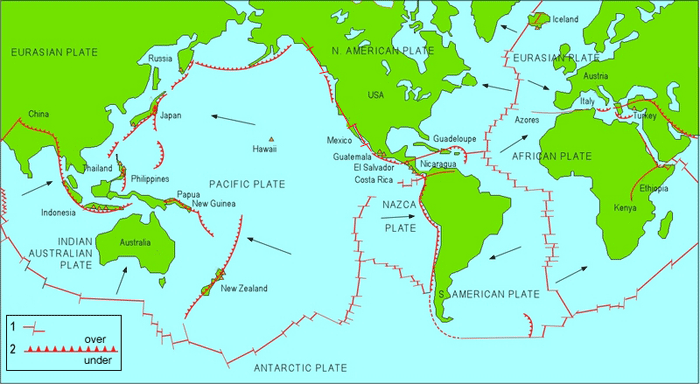
    What makes the Pacific plate so active at its subducting borders is that the bulk of mid-oceanic ridges accretions from all over the planet is accommodated there: the gap between the African plus the Eurasian plates and the North and South American plates keeps increasing and is accommodated solely by subductions along the North and South American plates western boundaries.
    A similar scenario is presented by the African plus the Eurasian plates and the Indo-Australian plate where the increasing gap is accommodated only at the eastern margins of said Eurasian and Indo-Australian plates along the various Trenches (Indonesia, Philippines, New Zealand, Mariana, Japan, Kamchatka, etc).

    Since the North American plate and the Pacific plate are getting pretty much "locked-in" (as are India and China with the Himalayas) the bulk of the mid-ocean ridges accretions are almost directly translated to being accommodated along the Mariana-Japan-Kamchatka trenches/subduction zones.

    Hope that the above makes for a clearer picture?
    ****************************************************************
    Quote I can imagine the following expanding earth scenario with subduction zones:
    1. Start with smaller earth, more or less entirely covered with thick crust
    2. Expand earth substantially, say twice as big, with original crust fractured into continental plates
    3. Currently earth continues to expand at mid ocean ridges
    4. The expanding uprising magma at the mid ocean forms a thinner crust
    5. That thinner crust expands out from the mid ocean ridges as more is formed
    6. The expanding thinner crust is pushed up against and beneath the continental plates.
    Now, to address those points, there is a problem of rate of expansion (earth's volume increase) versus rate of subductions.

    That, because we have active subduction zones (Pacific Rim of Fire) and passive "margins" (Peri-Atlantic) with accretion of newly formed oceanic crusts at both main Mid Oceanic Ridges (Pacific and Atlantic).

    The thing with subduction zones, is that they are also responsible for the formation of the Andes, Rockies, Cascades, etc... indicating that these subduction zones have been active for a very long while and are seemingly increasing in activity.

    My point of contention is that the rate of accretion at Mid Oceanic Ridges is entirely accommodated with the rate of subduction at active margins. That is, what appears at Oceanic Ridges disappears at subduction zones. An earth expansion scenario would imply that what appears at Oceanic Ridges > what disappears at subduction zones.

    In other words, were there an earth expansion, i.e. increase in diameter/overall surface/volume, there would be a large discrepancy between accretion at Mid Oceanic Ridges and dissipation of oceanic crust at subduction zones and earth crust would keep cracking open, sea level would drop from being thinned out, etc.

    That is, subductions would be less and less active, Andes and Rockies would flatten from not being constantly and continuously fed by new oceanic material being subducted and melted, overthrusting would stop and compressional (tectonic) earthquake would decrease to rare occurrences, etc...

    In short, if there is indeed such a thing as an expansion of earth diameter/overall surface/volume, such would have to be infinitesimal compared to subduction rates at active margins (Pacific Rim) to match current data (volcanic and tectonic activities).

    On the other hand, if there were a contraction, subduction rates would be exacerbated/amplified at active margin, earthquakes would increase in number and magnitude, sea level would "rise," etc...

  10. The Following 2 Users Say Thank You to Hervé For This Post:

    Foxie Loxie (17th May 2017), ThePythonicCow (16th May 2014)

  11. Link to Post #7
    United States Administrator ThePythonicCow's Avatar
    Join Date
    4th January 2011
    Location
    North Texas
    Language
    English
    Age
    78
    Posts
    30,293
    Thanks
    36,326
    Thanked 152,130 times in 23,214 posts

    Default Re: Bad Science - Plate Tectonics

    Quote Posted by Amzer Zo (here)
    In short, if there is indeed such a thing as an expansion of earth diameter/overall surface/volume, such would have to be infinitesimal compared to subduction rates at active margins (Pacific Rim) to match current data (volcanic and tectonic activities).
    Good point (likely one of quite a few good points, but this one I happened to notice.)

    Pretty clearly, various flows and motions, of the earth's crust and I presume also of its interior, dominant over changes in the earth's mass.
    My quite dormant website: pauljackson.us

  12. The Following 2 Users Say Thank You to ThePythonicCow For This Post:

    Foxie Loxie (17th May 2017), Hervé (16th May 2014)

+ Reply to Thread

Posting Permissions

  • You may not post new threads
  • You may not post replies
  • You may not post attachments
  • You may not edit your posts