+ Reply to Thread
Page 2 of 3 FirstFirst 1 2 3 LastLast
Results 21 to 40 of 44

Thread: "NO" to Data Centers

  1. Link to Post #21
    United States Avalon Member onawah's Avatar
    Join Date
    28th March 2010
    Language
    English
    Posts
    26,053
    Thanks
    54,586
    Thanked 140,720 times in 24,465 posts

    Default Re: "NO" to Data Centers

    That would be wonderful, if true.
    However, attributing a great revolutionary tech to China makes it appear doubtful.
    It could well just be sourced from more absurd CCP propaganda.
    So I would advise caution--whether it's true or not remains to be seen.

    Quote Posted by Arcturian108 (here)
    It looks like data centers are already obsolete, which is great news! I have only seen a few minutes of this video, but everybody needs to know about this revolutionary change in computing!
    Each breath a gift...
    _____________

  2. The Following 6 Users Say Thank You to onawah For This Post:

    Bill Ryan (23rd June 2026), East Sun (17th June 2026), ExomatrixTV (24th June 2026), Harmony (1st June 2026), Vicus (16th June 2026), Yoda (31st May 2026)

  3. Link to Post #22
    United States Avalon Member onawah's Avatar
    Join Date
    28th March 2010
    Language
    English
    Posts
    26,053
    Thanks
    54,586
    Thanked 140,720 times in 24,465 posts

    Default Re: "NO" to Data Centers

    ENERGY REQUIREMENTS OF THE TECHNOCRATIC CONTROL GRID ARE FORCING THE POWERS-THAT-BE TO RELEASE SUPPRESSED ENERGY TECHNOLOGIES, LIKE COLD FUSION AND HYDROGEN INTO COMMERCIAL USE
    Forbidden.News
    Jun 01, 2026

    (Hyperlinks in the article not embedded here)

    https://substack.com/home/post/p-199943985

    VIDEO: “Human Endgame” - Pub. May 31, 2026:


    "You know about those data centers that are popping up everywhere?

    The bad news is that the technocratic control grid is real and they’re being built to house all of your biometrics, your brain impulses and your genetic information, to be integrated into a new financial system via wireless Brain-Computer Interface (BCI) technology.

    The Good news is that the implementation of this plan will take several years, because the power generation needed to execute computing at this scale does not yet exist and this means we do have some time to fight back.

    The technocratic takeover desired by the Powers-that-Be is not feasible within the current energy paradigm. The energy requirements of the control grid are forcing them to release suppressed energy technologies, like cold fusion and hydrogen into commercial use.

    This is according to James Martinez, who joined Nino’s Corner on Saturday. James is the last living original MKULTRA whistleblower, who served on the Board of Advisors for the Freedom of Thought Foundation in 1994, alongside Colonel Thomas Bearden, Colonel Fletcher Prouty and his best friend, ‘Operation Mind Control’ author Walter Bowart.

    James says that for over 30 years, the work of the Freedom of Thought Foundation has been to educate the public and to prepare them for this very moment, in this ultimate battle for our own cognitive liberty and sovereignty.

    James suggests that people watch the 2009 60 Minutes episode, “Cold Fusion is Hot Again”, which I published on my site in 2014 and I remember being very moved by the story of the two Utah University scientists, Dr Martin Fleischmann and Dr Stanley Pons who discovered cold fusion in 1989 and were smeared by the Deep State and were forced to flee the United States amid a trail of mysterious murders, including that of MIT’s Dr Eugene Mallove, who had defended them by publicizing the fraud perpetrated by MIT, in their endeavor to “reproduce” Fleischmann and Pons’ findings – in other words, to quash their findings.

    VIDEO & ARTICLE: “Cold Fusion is Hot Again: 60 Minutes” - Pub Dec 26, 2014 by ForbiddenKnowledgeTV.net


    The modern term for Cold Fusion is “Low Energy Nuclear Reactions” [LENR] and James also recommends that people watch ‘The Saint’ and visit coldfusionnow.org for the backstory on all of that.

    But even with the release of these exotic energy technologies and the years of time that it will take to deploy them at scale, James doesn’t think that BlackRock can actually come up with the money to pull off their technocratic takeover, as it is currently envisioned.

    So the data centers might be popping up everywhere but they’re not completed or functional, as far as implementing the dystopian control grid. He says the data centers basically real estate investments, at this point.

    James says there are two quantum computers that are operational. One is in the United States and the other one is in China and all they do is “break into everything”, in order for the technological elite to use the stolen data for their own purposes and to create a Breakaway Civilization. But he says, “They can’t do it, because all the information and the ability to keep things private, it’s not possible.”

    He says this relates to the upcoming hearings on UFO disclosure and the extraterrestrial presence and the genetic engineering of humans, which he says, “Has been going on discreetly, that I’m aware of, since the early 1990s.”

    He says, “There’s going to be lots of disinformation designed by the people that are doing it to cover up for the real stuff. This is the biggest game on Earth going on, right now.”

    When Nino tells him that he just had David Icke on his show, who’s convinced that we’re in the middle of an “alien takeover”, James shoots back:

    “No, they’ve already taken over. We’re already occupied. He’s correct in that term, if you talk about it, in terms of a verb. Yes, it’s ongoing, because they’re altering our species. They’ve been doing it for quite some time.

    “All the films and all the information that’s been put out about abductions and all that stuff is directly related to MKULTRA, which is why I came to do this in the first place, to talk to you, because this is the first time I’m talking about this…since the announcements of these hearings that were supposed to happen involving Tulsi Gabbard and Congressman Luna and all the 16 other people related to it.

    “Because I have been tapped on the shoulder to testify before Congress about all of this stuff but I’m going to tell you – and I’m going to announce it here first – that I’m not going to be doing that, not in the way they want to, because the Corporation [of the United States] is bankrupt and finished.

    “They’re not going to fix anything by me coming out and testifying before Congress…They’ve had this around in their neuroscience, with CIA, NSA, and all these other people, and they haven’t come to talk to you about it and where all the children have gone and how it’s related to all that stuff. MKULTRA is not just mind control, it’s social engineering on a genetic level.

    “It was initially to be designed for behavior modification for sociopolitical purposes when it first was initiated in the early ‘50s. But in 1978, my business partner and best friend, who’s no longer here, Walter Bowart, wrote the book, ‘Operation Mind Control’ Volume 1, where all of this came from, out in the press.

    “He was the first guy to come in. Nobody even knows that name. You’ll hear so much bullsh¡t on so many other networks who have not done their homework and really don’t know what’s happened. It’s very difficult for people, when they’re learning all this stuff, because the amount of scattered information in an attention economy, that’s the problem.

    “They’ve created an attention economy. Attention economy means that you don’t survive unless you get attention and clicks and your advertisers get paid. That’s a post-information effect of the internet that they created by design. It’s not a mistake that people have their faces in front of screens for eight hours a day. It’s been done on purpose.”

    He says that while the upcoming disclosure hearings may have good intentions, most of the people on the committee have no idea about what’s really going on. He says he’s met Tulsi Gabbard and John Ratcliffe and they don’t know anything.

    Of Ratcliffe, James says:

    “If he did know what he was talking about, he would have told the American People immediately of what the neuroscience is and how they’re going to fuse the brain and the body and mix it with all the biometrics and banking into the new system and attempt the complete technological technocracy takeover that has been suggested and told by Walter Bowart and myself for a very, very long time. For a very long time.

    “So what I’ve decided to do – and I’ve mentioned it to some people, at this point – is there is no point testifying before a congressional committee or anything. It’s just showboating bullsh¡t. And those people can’t get anything done, anyway. It’s too late for that.

    “I will be addressing the New Republic, though. I’m not going to address the Dead Corporate Fiction of the United States of America and its total, lying-on-its-deathbed scenario, as we are going into a new era, where this whole transition is going to be taking place, starting in June. Because this is a behavioral thing. This is behavior that they are engineering, to put everybody into place.

    “Now, this is the most important thing that I’ll say on this entire thing: Most people that are immersed in electronics and communications right now did not rebut any of the User Agreements that they were given upon getting their new phones and computers.

    “For instance, I guarantee you, on your phone that you do not read all your updates and contractual agreements. Those are tacit agreements that you agree to, without even reading them. You don’t rebut anything. So you agree to all their terms, right? So you give everything, right at that thing, right?

    “In the current situation that we’re in, with the towers and communications that we use, the powers-that-be are going to get you to unconsciously, consciously affirm and agree to these new contractual consent policies of merging the brain and computer and then, accessing all that data from the Brain-Computer infusion – and they’re going to own it.

    “You’ve already agreed to that. You don’t know it yet, right? You don’t know it, yet, because you haven’t rebutted any of your agreements that you have with your computers, your emails, all the apps that you have, all your communications, everything having to do with your physical being and your – I’m talking about you, Nino, your specific identity and how it relates in the digital environment. They own it all. They own it all and they can change it all, if they feel like it. This is one of the dangers.

    “So I will probably give a statement that I will permit on a network to the Congressional Committee, but I will be addressing the New Republic and I will be speaking to somebody quite shortly about that that is a guest of yours, Juan O Savin, about that because when I was with him in South Africa, in Cape Town actually, I was speaking to them and the only reason I was there is to make sure that our neurocognitive rights are going to be placed in the new constitution there, when they initiate a new country.

    “Because a new beginning is happening for the United States and behind-the-scenes, because I know what’s going on at Treasury. They’re getting ready to redo our entire financial system, but what they’re not telling you – and this is the problem – is when they bring in the new system, yeah, they say they’re going to have gold-backed and silver-backed notes, but those notes are still administered through the banking system, electronically, OK?..

    “But the end goal is to have control over your neurocognitive impulses, which they already have, because they’ve shaped you. Because you’re in front of a screen most of the day. Most people are in front of screens all day long. And by doing so, they’re giving away all of their biometric impulses into that system…

    “I know Juan is there explaining what’s going on as far as the regrouping and the change that’s happening in the United States.

    “But behind-the-scenes, there is a the biggest war of all time; is the war over your mind. That’s where all the big money and all the big players, the ones that want to spend a trillion dollars for data centers, it’s to create what José Delgado said, ‘A psycho-civilized mind’ and a culture, mixed so that that culture will have robots and it will have humans that interface with robots and they will have given up their Central Nervous System and brain impulses to that system, because they will be essentially forced to do so…

    “They’ve got more than they ever asked for. They’ve got everything. They’ve got every keystroke. They’ve got everything you’ve ever done, related to your voice. Everything. Got it all.

    “So this is the big problem and this should be the conversation because you, Nino, and your audience and everybody else that I know, you have a right to your own thoughts. You have the right to your own freedom of thought. And this is where the birth of our Constitution and everything else has to do with freedom of thought. And there’s been actual case law, regarding all of that stuff and freedom of thought is critical.

    “But if you do not state that, in a legal way to the system, they’re going to think that you’re just agreeing to go where they want to go, because you haven’t rebutted.

    “You have to rebut everything. Everything. And you have to do it in an official capacity through your local county and through the UCC and Federal Government, if necessary.

    “Everything having to do with you, Nino, your name in the commercial space, you have to tell them, “No, no, no, no. We’re changing the contract, now. And we’re rebutting. We’re not going to do this. We’re not going to do this. We’re not going to do this.”

    “OK? It’s very, very important because I know the guests that you have on here and I’ve listened and I scour like everybody else. And it’s very difficult for new people to wrap their head around this because they don’t realize that unconsciously, they’ve agreed to all of this stuff. They agreed to it.

    “And you don’t want to agree to it, because it’s all going to be used against you. Just in the banking sector, I know, right now that the Treasury is moving new notes into banks. Some of those notes are being accepted. Some of them are not, because the structure in a way, the banks are going to be using it with the public. They want to get rid of all the problems that the digital world has created: Fraud out the ass.

    “There’s more financial fraud than anybody would ever imagine. It’s in numbers that you can’t even, people don’t even know exist. Quadrillions.

    “And that’s how the technological companies, that’s how they took over: through fraud. That’s how they did it. They do it through fraud and consent, because everybody agreed…

    “You cannot just watch a podcast, press a button and think everything’s going to get fixed. It takes time to file stuff with the local county court office. It takes time to tell the UCC. You have to write written-up contracts, asserting your rights as an American under rules of Covenant Law, which were the basis of this country. This country was founded on the Bible. Go to FirstLanding1607. It’s there.

    “It says, basically there that this country and all its laws were founded on Biblical Law. So you can still change your status, here by changing how you relate to the system that’s coming in, whatever it’s going to be.

    “Because you know, there’s this war between the Good Guys and the Bad Guys, right? Juan comes in and says, “We’re doing this and we’re doing this and we’re doing this,” and I’m totally supportive of all that. And there’s a lot of stuff going on behind the scenes that cannot be discussed, at all.

    “And then, you have the other guys that are just trying to kill off everybody and create a psychocivilized society, where they can just use people for energy, similar to ‘The Matrix’, and then control those people and enslave them to do other things that they weren’t being able to do before to survive.

    “Because they’re going to use our survival instincts against us. That’s the final act of what they’re doing, is getting people to go against their intuitive faculties and put them in survival mode, which is basically what’s going on now, because I’m watching culture very closely on what people are saying on all the social distortion channels of Instagram and Facebook and all that stuff. And it’s a complete mess.

    “We’re going to have, like one of the things that’s going to occur that has to occur is the new DSM-5, which is basically the mental health professions, understanding or overstanding of what various syndromes are.

    “So they’re the ones who are going to be legislating consciousness, because the whole thing’s going to change next month, because we’re going to have an exopolitical perspective that’s going to come out in the public that’s already out there, now.

    “We’re going to have residual effects on the brain and new behavior that has never been cataloged before. And we’re going to have a complete mental breakdown, because of the ontological shock that comes in from this new information that’s going to be given to us, in an ongoing fashion.

    “They’re going to come out with trunks of it, you know, so part of it’s going to come out and then two months later another part’s going to come out and they’re going to use what’s called “fractionalization”.

    “Fractionalization is a thing used in hypnosis to deepen a belief or a deepen a heightened state and you have to be in a certain state to take on all this new information.

    “People don’t understand they’ve had all the money and time to study you and how you respond to stimulus, the entire time you’ve been alive. And they’ve used all the technology, everything from print to visual space, with the TV and the internet and computer to put us into a situation, where now most of the population is in front of a screen for 10 hours a day. Humans weren’t designed to do that. We’re not supposed to be in front of screens all day long!

    “That’s part of the problem. It’s part of the problem, because we’ve lost our humanity. We’ve lost who we are, because of these things – and we’re doing it. We’re agreeing to be in front of this all the time.

    “So you have to take responsibility, as an individual. You can’t just rely on governments. They don’t work anymore, anyway. They know that. They don’t want you to know that they don’t work – but they don’t work, because they’ll talk to anybody and they’ll basically see that, now.

    “Our government’s not working, which is why it’s going to be a new form of it’s going to come online, now. But I’m trying to get people to be aware of these changes and do something about it.

    “You have to do it, individually and that doesn’t mean pressing a button on a keyboard. It means actually studying law, studying your personal relationship to law, as a member of this country, because you actually run it. You’re in charge.” "
    Each breath a gift...
    _____________

  4. The Following 7 Users Say Thank You to onawah For This Post:

    Bill Ryan (23rd June 2026), Dumpster Diver (3rd July 2026), East Sun (17th June 2026), ExomatrixTV (24th June 2026), Harmony (2nd June 2026), Raskolnikov (2nd June 2026), Yoda (4th June 2026)

  5. Link to Post #23
    Canada Avalon Member bojancan's Avatar
    Join Date
    31st July 2014
    Posts
    3,835
    Thanks
    14,974
    Thanked 14,184 times in 2,982 posts

    Default Re: "NO" to Data Centers

    Real distraction of planet and humanity....

    May, 27
    PBS Terra
    and Floodlight News
    We Saw What AI Data Centers Don't Want You to See


    We investigated one of the world’s largest AI data centers, using thermal drone footage to reveal the hidden pollution powering the AI boom. As companies race to build the future of artificial intelligence, residents and experts warn that fossil fuels, secrecy, and weak regulation may be putting communities at risk.

    You can learn more about ‪@floodlightnews‬ and its mission by visiting https://floodlightnews.org/

  6. The Following 7 Users Say Thank You to bojancan For This Post:

    Bill Ryan (23rd June 2026), Dumpster Diver (3rd July 2026), East Sun (17th June 2026), Harmony (7th June 2026), onawah (9th June 2026), Raskolnikov (7th June 2026), Yoda (9th June 2026)

  7. Link to Post #24
    United States Avalon Member Raskolnikov's Avatar
    Join Date
    23rd July 2018
    Location
    Here
    Posts
    2,551
    Thanks
    9,887
    Thanked 22,696 times in 2,539 posts

    Default Re: "NO" to Data Centers

    Americans have had enough. Good to see them beginning to stand up. 45 second video, won't even take a minute.


    And another, "Living next door to Stargate..."


    Source: https://www.bitchute.com/video/srMpba6kzrY
    Last edited by Raskolnikov; 10th June 2026 at 05:01.

  8. The Following 9 Users Say Thank You to Raskolnikov For This Post:

    Bill Ryan (23rd June 2026), bojancan (9th June 2026), Dumpster Diver (3rd July 2026), East Sun (17th June 2026), ExomatrixTV (24th June 2026), Harmony (10th June 2026), onawah (9th June 2026), Vicus (9th June 2026), Yoda (9th June 2026)

  9. Link to Post #25
    United States Avalon Member Raskolnikov's Avatar
    Join Date
    23rd July 2018
    Location
    Here
    Posts
    2,551
    Thanks
    9,887
    Thanked 22,696 times in 2,539 posts

    Default Re: "NO" to Data Centers

    Elizabeth April remote views data centers and gives her theory on their purpose: "The AI data centers are being used as a mass surveillance and programming system...They are using AI infrastructures in order to tap into humanity's subconscious." The four-step agenda: 1) Understanding human behavior, 2) Manipulating the subconscious, 3) Experimenting with AI programming, and 4) Predictive programming. "They are using AI to program our subconscious" because "they want to take away our free will."

    Start at 5:55 to skip the announcements.

    (Disclaimer: She speaks of the Galactic Federation and the White Hats so take it all with a grain of salt, but the information is worth consideration and resonated as truth for me.)


    See description for the time stamps:

    0:00 Introduction and Topic Overview
    0:07 Exploring Data Centers
    0:23 Conspiracies around Data Centers
    1:59 The Main Agenda of Data Centers
    2:23 Announcements of Upcoming Events
    5:55 Remote Viewing Experience
    7:03 Finding Purpose in Data Centers
    7:58 Conversation with White Hats
    9:27 AI Data Centers as Surveillance and Programming
    12:32 Four-Step Agenda of the Shadow Government
    12:45 Step 1: Understanding Human Behavior
    14:35 Step 2: Manipulating the Subconscious
    18:22 Step 3: Experimenting with AI Programming
    20:53 Step 4: Predictive Programming
    22:09 The Impact of AI and Future Predictions
    24:28 Human-First Movement and Reality Disillusionment
    27:27 New Energy Solutions and Free Energy Technology
    28:28 Concerns about AI and Livestreaming
    29:09 Potential Emergence of Sentient AI
    29:50 Conclusion and Empowerment
    33:28 Erin Brockovich's Initiative on Data Centers
    34:08 Call to Action

  10. The Following 7 Users Say Thank You to Raskolnikov For This Post:

    Arcturian108 (16th June 2026), Bill Ryan (23rd June 2026), Dumpster Diver (3rd July 2026), East Sun (17th June 2026), ExomatrixTV (24th June 2026), Harmony (16th June 2026), Yoda (15th June 2026)

  11. Link to Post #26
    United States Avalon Member
    Join Date
    1st April 2016
    Posts
    6,788
    Thanks
    35,235
    Thanked 38,703 times in 6,438 posts

    Default Re: "NO" to Data Centers

    Just going to add that one of these has come up for the city council or something around here.


    It would be 450 acres about twenty miles from here, towards the nuclear power plant.

    The facility is expected to cost about $900,000,000; I wonder what you get for that these days.

    It claims to offer the benefit of 30 - 40 jobs.

    Obviously, they have the chance to turn down the proposal, which seems extremely unlikely to me.


    Something happened -- they built a suburb near where I used to live -- and at one time its new water recovery system was promoted as suitable for a data center. But now there is a company there and I don't think this is the same:


    Quote Born from the need to manufacture high-precision electronics for our Software-Defined Electricity (SDE) power quality systems, we built capabilities that now serve defense, energy, university research, and advanced technology clients nationwide. Our Capabilities: Electronics Manufacturing – High-speed SMT assembly (100,000+ cph), 8-zone reflow, conformal coating (MIL/NASA/UL compliant), chip-on-board wire bonding, and in-house X-ray inspection CNC Precision Machining – Swiss-type turning, 3- and 4-axis milling, and TIG/MIG welding to aerospace and defense standards Engineering Services – Complete analog, digital, and mixed-signal design; PCB layout; embedded firmware; and BOM optimization Materials Analysis & Science – SEM/AFM microscopy, ALD/CVD deposition, failure analysis, and custom coatings Why It Matters: By unifying engineering and manufacturing under one roof, we eliminate the costly disconnect between design and production—reducing costs by up to 30% and accelerating time to market.

    Apparently, this is a service that can be provided to a data center by 3DFS:


    Quote 3DFS develops and manufactures Software-Defined Electricity™ (SDE). SDE is real-time power quality optimization that improves efficiency, resilience, and asset lifespan for industrial facilities, data centers, microgrids, and maritime power systems.

    I take that to be something else entirely. The thing I noticed today was about them voting on it sometime this week I think. So that will probably be another one.

  12. The Following 6 Users Say Thank You to shaberon For This Post:

    Bill Ryan (23rd June 2026), Dumpster Diver (3rd July 2026), East Sun (17th June 2026), Harmony (16th June 2026), Raskolnikov (16th June 2026), Yoda (16th June 2026)

  13. Link to Post #27
    United States Avalon Member Raskolnikov's Avatar
    Join Date
    23rd July 2018
    Location
    Here
    Posts
    2,551
    Thanks
    9,887
    Thanked 22,696 times in 2,539 posts

    Default Re: "NO" to Data Centers

    Quote Posted by shaberon (here)
    It claims to offer the benefit of 30 - 40 jobs.
    The profit/loss ratio for the owners vs plebians is astounding, feudalism on steriods.

  14. The Following 6 Users Say Thank You to Raskolnikov For This Post:

    Bill Ryan (23rd June 2026), Dumpster Diver (3rd July 2026), East Sun (17th June 2026), Harmony (16th June 2026), shaberon (16th June 2026), Yoda (16th June 2026)

  15. Link to Post #28
    Australia Avalon Member
    Join Date
    2nd December 2015
    Posts
    248
    Thanks
    3,883
    Thanked 1,420 times in 246 posts

    Default Re: "NO" to Data Centers

    “Kill the tech Bros and destroy their evil Data Centers”

    …the uniting cry of MAGA and Woke…

    …is it possible?

  16. The Following 6 Users Say Thank You to Dumpster Diver For This Post:

    Bill Ryan (23rd June 2026), East Sun (17th June 2026), Harmony (17th June 2026), Raskolnikov (17th June 2026), shaberon (17th June 2026), Yoda (17th June 2026)

  17. Link to Post #29
    United States Avalon Member
    Join Date
    1st April 2016
    Posts
    6,788
    Thanks
    35,235
    Thanked 38,703 times in 6,438 posts

    Default Re: "NO" to Data Centers

    It came back to me like this from a young person:


    "The drought is so bad, you can walk almost all the way across the dry lake bed, so they're putting in a data center to re-direct some of that same water."

    "And this is maybe for something useful, like bitcoins?"

    "No, just a surveillance state."

    "But that's non-productive."

    "It's a speculator's bubble that will be gone in five years."


    That sounds about right for a useless, non-productive power hog. Hard to see how it has a viable future.

  18. The Following 6 Users Say Thank You to shaberon For This Post:

    Bill Ryan (23rd June 2026), Dumpster Diver (3rd July 2026), Ewan (20th June 2026), Harmony (20th June 2026), Raskolnikov (20th June 2026), Yoda (20th June 2026)

  19. Link to Post #30
    United States Avalon Member
    Join Date
    1st April 2016
    Posts
    6,788
    Thanks
    35,235
    Thanked 38,703 times in 6,438 posts

    Default Re: "NO" to Data Centers

    There's a good chance this bubble will collapse before it fully inflates:


    Quote South Korean stocks plunge on AI overvaluation fears

    The KOSPI tumbled nearly 10%, with Samsung and SK Hynix leading a historic sell-off

    South Korean stocks suffered their sharpest drop in more than three months on Tuesday as fears that an AI-driven rally pushed semiconductor valuations to unsustainable levels sparked a market-wide sell-off.

    The rout also followed weakness in US technology shares. A broader tech sell-off spread into Asian markets, with investors increasingly questioning whether AI-linked valuations had run too far too fast, MarketWatch said.

    The market turmoil comes as investors increasingly question whether the AI boom is creating a financial bubble. OpenAI, Oracle, and SoftBank have committed hundreds of billions of dollars to new AI infrastructure projects, while chipmakers and cloud providers continue to pour money into the sector despite limited evidence that profits are keeping pace with spending.

    Some analysts argue that AI investment has become concentrated within a tightly linked network of companies whose valuations depend more on expectations and capital inflows than on proven profitability.

  20. The Following 7 Users Say Thank You to shaberon For This Post:

    Bill Ryan (23rd June 2026), Dumpster Diver (3rd July 2026), Ewan (24th June 2026), Harmony (24th June 2026), onawah (23rd June 2026), Raskolnikov (4th July 2026), Yoda (24th June 2026)

  21. Link to Post #31
    United States Avalon Member onawah's Avatar
    Join Date
    28th March 2010
    Language
    English
    Posts
    26,053
    Thanks
    54,586
    Thanked 140,720 times in 24,465 posts

    Default Re: "NO" to Data Centers

    Investing in AI is a huge gamble when you consider that the entire global electric grid could go down at any time.
    Given that a CME the size of the 1859 Harrington Event which destroyed telegraph equipment, if it occurred now, would do the job.
    That information is being slowly leaked by the MSM now, but seems to be largely ignored so far.
    (Though the number of Preppers continues to rise.)
    See:https://projectavalon.net/forum4/sho...s-and-Ice-Ages
    ...or watch the documentary:
    Each breath a gift...
    _____________

  22. The Following 8 Users Say Thank You to onawah For This Post:

    Arcturian108 (3rd July 2026), Bill Ryan (23rd June 2026), Dumpster Diver (3rd July 2026), East Sun (3rd July 2026), Ewan (24th June 2026), Harmony (24th June 2026), Raskolnikov (24th June 2026), Yoda (24th June 2026)

  23. Link to Post #32
    United States Avalon Member onawah's Avatar
    Join Date
    28th March 2010
    Language
    English
    Posts
    26,053
    Thanks
    54,586
    Thanked 140,720 times in 24,465 posts

    Default Re: "NO" to Data Centers

    Are Taxpayers Helping to Finance America’s Data Center Boom?
    A Quest for Clarity
    June 22, 2026
    By Taylor Hudak
    https://solari.com/are-taxpayers-hel...t-for-clarity/

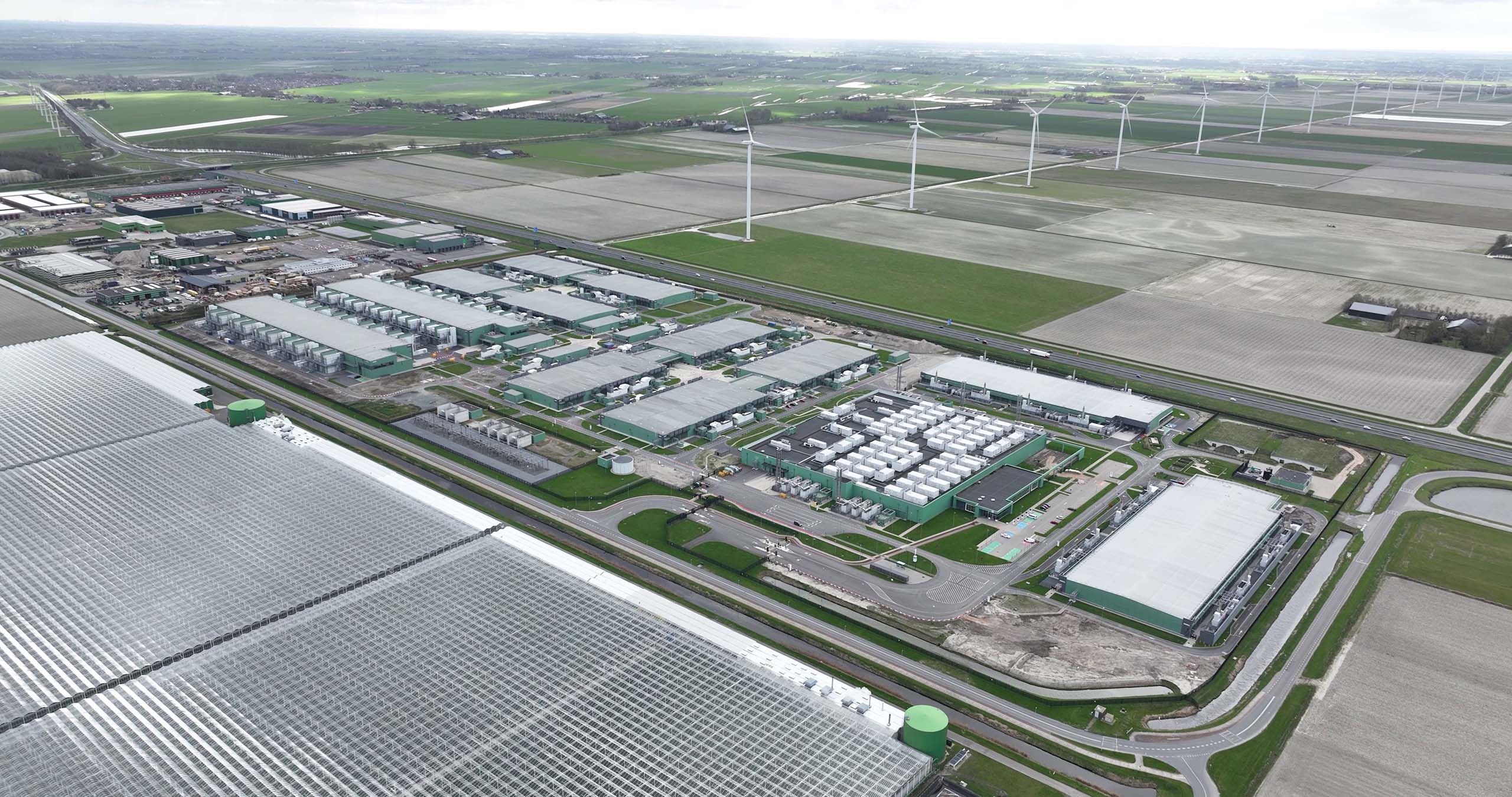
    (Large scale datacenter, aerial drone view, at Agriport Middenmeer, The Netherlands)


    "“Government is the great fiction through which everybody endeavors to live at the expense of everybody else.”
    ~ Frédéric Bastiat

    A strikingly large number of massive data centers are being built across the United States. It is currently estimated that there are more than 4,000 data centers in the U.S., and more are on the way.


    Source: https://www.statista.com/statistics/...de-by-country/

    The federal government as well as local and state governments are providing financial incentives for these investments. Such incentives occur in an environment that lacks transparency and proper disclosure. As an extension of this opaqueness, the benefits to justify these subsidies also remain unclear. Many would argue that promises of job creation have been grossly overstated (and the data centers’ potential role in creating a digital control grid kept secret), while energy and resource concerns—as well as the potential costs of site cleanup if and when the facilities close down or fail—have been minimized. This, in addition to the secrecy surrounding the planning and financing of the data center industry, indicates that the negative impact to local residents and the American taxpayers may be substantial.

    The following report examines this matter and is organized into two main sections. The first covers the federal layer of financial influence helping to advance the data center boom—the One Big Beautiful Bill. The second section focuses on the generous state and local government tax incentives, which are costing state governments billions in revenue losses. The conclusion elaborates on an opportunity to join the effort in seeking clarity on America’s data center industry, with additional resources provided in the links below.

    I. The One Big Beautiful Bill and the Data Center Boom
    The One Big Beautiful Bill (OBBB), signed into law on July 4, 2025, impacts the Internal Revenue Code (IRC) and includes significant changes to business tax incentives, among other things.

    It is important to make clear that the OBBB does not specifically mention data centers, nor does the legislation appropriate a single dollar for them. There is no vote to fund the industry, no line item, and thus, there is nothing to oppose. Yet, the OBBB is one of the most significant data center policies enacted in the United States. “The government isn’t funding data centers,” says Attorney Anthony Parent, an American tax lawyer who advises on business tax planning and Internal Revenue Service (IRS) controversy. “It’s declining to tax the people who build them—which feels identical to everyone except the lawyers.”

    This is the mechanism of the tax expenditure—it is money the government declines to collect rather than money it chooses to spend. It never appears as a budget line, and it requires no appropriation. In Atty. Parent’s assessment, it is a subsidy that the public rarely sees because it does not look like spending.

    There are three ways in which this tax expenditure works as permitted by the OBBB in relation to the data centers:

    Through bonus depreciation
    Through factory-level deductions
    Through Opportunity Zones/real estate
    Bonus Depreciation

    The most consequential provision applied to the data centers is the amendment to Section 168(k) of the IRC found in OBBB Section 70301. The new rule restores 100% bonus depreciation for equipment purchased after January 19, 2025.

    Typically, when a business purchases expensive equipment, it cannot deduct the entire cost immediately. It spreads the deduction across several years—a process called depreciation. The amended Section 168(k) allows businesses to deduct the full cost in Year One. The advantage for firms is that they are reducing their profits by the amount of depreciation and hence they are also reducing their tax bill.

    For data centers, this is very beneficial because it applies to the most expensive part of the data center—the chips.

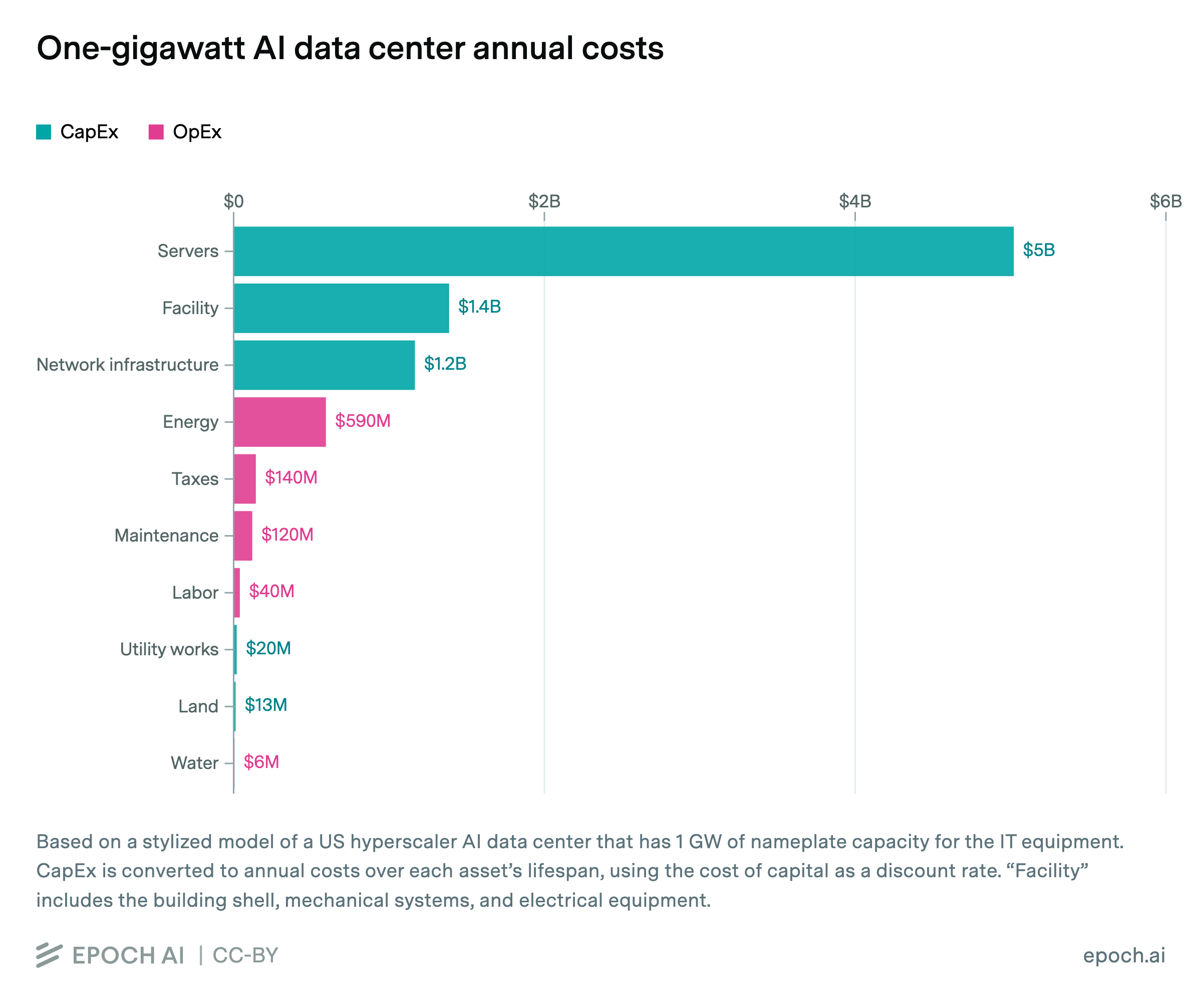
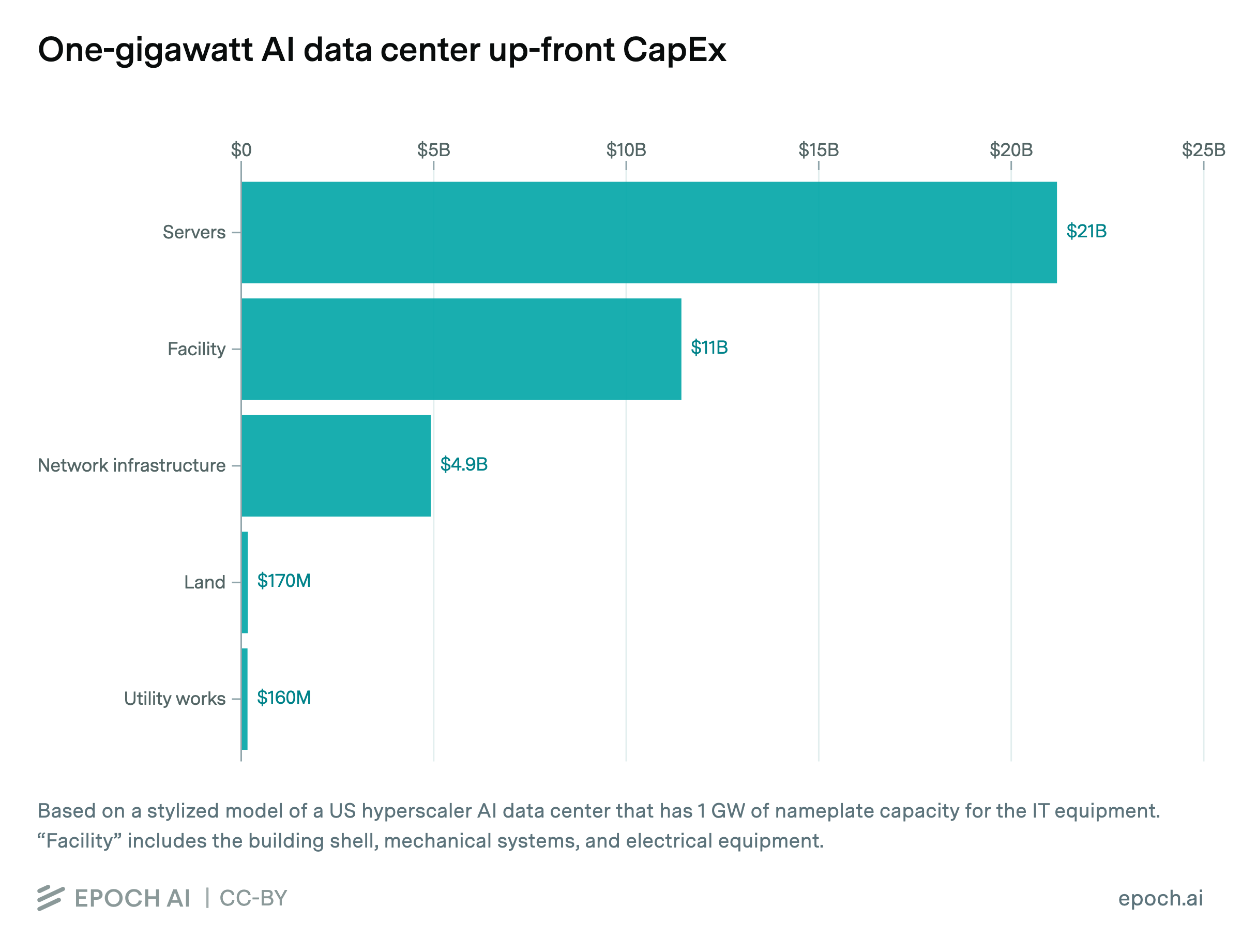
    According to a cost breakdown published by Epoch AI, servers account for 60% of the total cost of ownership (TCO) of a typical one-gigawatt data center. The report estimates that an average data center requires $38 billion in up-front capital expenditure (CapEx) and $8.5 billion per year in total annualized cost—of which servers alone account for $5 billion annually.


    Credit: Epoch AI, Amelia Michael and Ben Cottier


    Meanwhile, operating costs, including energy, are much smaller in comparison. Utility works, land, and water combined make up only $39 million of the total annual CapEx and Operating Expenditure (OpEx).

    The building itself, by comparison, is relatively inexpensive and does not qualify for bonus depreciation under amended Section 168(k). However, the chips and server hardware do qualify.

    Atty. Parent says, “Sixty cents of every dollar spent goes toward the chips—which are also given the biggest tax break. That’s the cleanest version of the giveaway: the tax break is biggest on the most expensive, fastest-obsolete part of the project.”

    The most expensive components, the hardware and IT equipment, must also be replaced and repurchased every three to five years, on average. Under amended Section 168(k), a new full deduction applies each replacement cycle. The building requires renovation approximately every 14 years and, as mentioned, does not qualify for bonus depreciation under amended Section 168(k).

    Thus, in summary, the tax code has effectively structured the incentives to sit precisely on the components that cost the most, depreciate the fastest, and must be repurchased most frequently.

    Factory-Level Deductions That Feed the Supply Chain
    The second provision that impacts the data centers is the new Section 168(n) established in OBBB Section 70307. This subsection allows a business to deduct the entire cost of a qualified production property (often referred to as QPP)—a factory or manufacturing facility—in Year One rather than throughout a 39-year depreciation schedule.

    Initially, this provision appears to be a direct data center break, given that it covers large facilities, offers immediate deductions, and thus, at first, seems to be an obvious fit. However, it is not that simple.

    To meet the criteria as a qualified production property under Section 168(n), the facility must be used to manufacture, produce, or refine a tangible product. Data centers process data, which is intangible. IRS Notice 2026-16, issued in February 2026, ties eligibility to manufacturing industry codes that data centers do not fall under.

    Atty. Parent explains, “Congress wrote a special break for factories that physically make things. A data center makes data. It probably doesn’t qualify—but it didn’t need to, because the equipment break already did the work.”

    Where Section 168(n) does benefit the data center build-out is one step back in the supply chain. Semiconductor fabrication plants, or chip fabs, manufacture the physical chips that data centers rely on. Therefore, these chip fabs produce tangible property and almost certainly meet the criteria as qualified production property under Section 168(n).

    Put simply, as prescribed in the OBBB, amended Section 168(k) subsidizes the purchase of chips for the data center. The new Section 168(n) subsidizes the factories that manufacture those chips. The incentives run through the entire supply chain without ever naming the industry they benefit.

    Opportunity Zones and the Real Estate Half of the Investment
    A data center is not just one investment. “A data center is really two assets with two completely different tax treatments—and that quietly decides who invests in each half,” says Atty. Parent.

    The first half is the expensive, fast-depreciating half, which includes the chips, the servers, and the cooling equipment. This is an income-tax play. The bonus depreciation under amended Section 168(k) creates immediate deductions that attract operators and high-income investors who need losses to offset current income.

    The second half is the appreciating half, which includes the land, the building, the power access, and the grid connections. These assets are relatively inexpensive to acquire and have long-term durability. They cannot be written off quickly and do not benefit from Section 168(k) bonus depreciation. However, these assets do qualify for a different set of tax advantages such as capital gains treatment, like-kind exchanges under Section 1031, and Opportunity Zone investments.

    Furthermore, the OBBB permanently renews and expands the Opportunity Zone Program, which was first enacted under the Tax Cuts and Jobs Act (TCJA) of 2017. Opportunity Zones provide capital gains tax exemptions for investments in designated lower-income areas. The OBBB extends the program indefinitely and introduces a new category, the Qualified Rural Opportunity Funds (QROF) that offer even greater tax benefits for investments in rural areas, which is defined as any area outside a city or town with a population greater than 50,000.

    Data centers are land-intensive and power-intensive. They are being built in rural areas and in smaller markets precisely because the land is cheap and the power infrastructure is available. Many of those locations will qualify as Opportunity Zones or rural opportunity areas under the OBBB’s expanded program.

    The tax code has effectively divided the investment in a data center into two streams—a depreciation stream for the hardware-focused investor and a capital gains stream for the real estate-focused investor—and provided a different incentive for each.

    Clean Energy Credit Cuts
    The picture is not entirely favorable for data centers. The OBBB also accelerated the wind-down of solar tax credits and ended an energy-efficiency deduction that data centers had been using.

    “Claiming the OBBB is a data center giveaway is too simple,” says Atty. Parent. “It is a giveaway on the equipment side and a clawback on the energy side.”

    Data centers consume significant amounts of power. Atty. Parent explains that the clean energy credits that were helping operators offset energy costs have been reduced or eliminated. The industry that benefits most from the equipment provisions is simultaneously losing the incentives that were making its power consumption more financially manageable.

    The Bigger Picture: Complexity Up, Enforcement Down
    The OBBB is arguably the most complex piece of tax legislation in recent history. It was enacted at a time in which the IRS is facing significant institutional instability. The IRS has no confirmed Commissioner, its workforce is down 25% from cuts, and a Supreme Court decision in Loper Bright Enterprises v. Raimondo narrowed the IRS’s authority to interpret the very tax provisions that are now expanding.

    “More tax complexity being built with one hand, while the agency that enforces it cracks in the other,” says Atty. Parent. “Nobody is putting those two facts on the same page.”

    He suggests that the simultaneity is the story. A law that creates new categories of deductions, new opportunity fund structures, and new manufacturing incentives—all requiring interpretation, guidance, and enforcement—landed in the hands of an agency that is simultaneously losing the legal authority to interpret it and the personnel to enforce it.

    II. State and Local Governments
    State tax abatements add another layer. Data center investments receive substantial additional subsidies at the state level through sales-tax exemptions and property-tax abatements. According to a June 2026 report in Good Jobs First, several states are already losing more than $1 billion per year in revenue from data center tax breaks. Meanwhile, comprehensive data remain difficult to obtain because 14 of the 37 states with relevant exemptions do not properly disclose their revenue losses.

    “This is central planning,” says Atty. Parent. “It only gets called patriotism because it runs through the tax code instead of a communist chairman’s five-year plan.”

    The specifics of the state and local-level policy implementation and reporting and compliance guidelines do slightly vary state to state. Yet, the data indicate there are very clear themes observed across all the states. Recent developments in Ohio serve as a helpful example to understand what is occurring more broadly in other regions across the country.

    Ohio Case Study
    The state of Ohio has considered a bill aimed at reducing massive sales-tax exemptions for companies involved in the data center industry. Ohio House Bill (H.B.) 646 received bipartisan support and eventually passed the Ohio House in March 2026. The legislation would have reduced sales-tax exemptions on the purchase of materials and equipment by large companies for data centers from 100% to 50%. However, after H.B. 646 reached the Ohio Senate and underwent significant revisions, some Democratic and Republican lawmakers opposed the final, revised version of the proposed legislation, which included revisions adjusting the tax exemption rate from 50% to between 50% and 75%.

    There was also mention of non-disclosure agreements (NDAs) in the substitute bill, but it did not include a constructive ban on such agreements. NDAs and other confidentiality clauses have been used in other state and local government data center proposals and planning initiatives. Eventually, in June 2026, substitute H.B. 646 did not pass the Ohio House. The Ohio House intends to reconvene again at the end of June to attempt to reach a compromise.

    Specifically, H.B. 646 aimed at reducing a lesser-known, and now rather controversial, tax exemption which was introduced in the mid-2010s under then-Governor John Kasich. The tax benefit allowed a 100% sales-tax exemption for companies purchasing equipment for data centers.

    However, H.B. 646 would not apply to companies with existing contracts like Meta, Google, and Amazon—whose contacts, which include the tax exemptions, are in effect for 40 years. The bill would only apply to new companies seeking a contract in Ohio, and even then, the sales-tax exemption would not be eliminated but rather reduced by 50%. What’s more, the costs to the state due to these tax exemptions are already extremely high and are very hard to predict. And this does not apply to just the state of Ohio.

    According to a news report, Ohio state officials’ estimates for sales-tax exemption costs for the year 2025 were wildly off. Instead, the actual costs were more than 10 times greater than predicted, reaching almost $1.6 billion in sales-tax exemptions for the purchase of data center equipment and materials. Another news report published in May 2026 cites Ohio Department of Taxation data (presumably the same data examined in the previously mentioned report). According to the article, the revenue losses increased dramatically in just one year. A year prior, in 2024, the state lost $555 million and localities lost $166.8 million in revenue. Good Jobs First claims these figures indicate that Ohio has one of the most expensive subsidy programs in the nation.

    After it became public that Ohio’s Department of Taxation underestimated the costs of the data center tax exemptions by more than $1 billion, Ohio Governor Mike DeWine paused the sales tax break for data center companies at the end of May 2026. Yet, given that the proposal, H.B. 646 failed, Ohio’s 100% sales-tax exemption will still apply to new companies seeking a data center-related contract in the state. Despite the U.S. Congress adjourning for summer recess, the Ohio House expects to meet at the end of June to reach a compromise.

    While seemingly specific, predicaments like the one described for Ohio are experienced all across the country. For many states, like Ohio, the common trend is generous tax exemptions for mega corporations, followed by billions in lost tax revenues by state governments, and the inability to accurately predict projected costs due to a lack of transparency and compliance in the reporting.

    The Data Reflect the Reality on the Ground
    These points, and others related to the impact of the data center rush, are presented in a series of financial analyses published in Good Jobs First, an American policy research center that promotes government and corporate accountability in the area of economic development. Founded in 1998, Good Jobs First, a non-profit entity, advocates for transparency in the use of public money. The organization has closely tracked various aspects of the data center industry as it pertains to local and state governments.

    The following section references three in-depth financial research reports published by Good Jobs First—one released in April 2025, a second in April 2026, and a third in June 2026. All three reports examine common issues surrounding the data center industry observed at the state and local levels. This includes, but is not limited to, tax abatements (including property tax abatement), non-compliance, and lack of transparency, as well as state tax revenue losses and future trends.

    Tax Abatements
    First, it is important to understand that there are varying degrees of disclosure regarding tax abatement-related revenue losses:

    Some states do not disclose at all, including Alabama, Arkansas, Idaho, Indiana, Iowa, Louisiana, Maryland, Mississippi, Missouri, North Carolina, North Dakota, Oklahoma, South Carolina, and Utah.

    A few states disclose in their Annual Comprehensive Financial Reports (ACFRs), including Texas, Virginia, and Washington.

    Some states also or only disclose in their Tax Expenditure Reports (TERs), including Arizona, Connecticut, Florida, Georgia, Kentucky, Michigan, Minnesota, Nebraska, New York, Ohio, Pennsylvania, Tennessee, Texas, Washington, West Virginia, and Wisconsin.

    The information about tax abatement disclosure is from a chart published in April 2026 by Good Jobs First. In the same April 2026 report, which is focused primarily on the “too-often undisclosed ways [the data centers] take taxpayer funds in the form of tax abatements,” it is important to note that the tax-abatement laws applying to the data centers predate the existence of the large Artificial Intelligence-driven data centers being built today. Thus, these tax-abatement laws were written for much smaller facilities and at a time when cloud-computing server farms were much smaller.

    In its April 2025 report, Good Jobs First examines the data centers’ impact on state budgets. According to the report, the figures at the time indicated that “at least 10 states lose more than $100 million per year in tax revenue to data centers.” The report also notes that accurate cost projections are difficult given the data center industry’s high-velocity growth combined with the state tax exemptions.

    At the time the report was published, Good Jobs First estimated that the actual losses are likely far worse than they are able to document, given that 12 of the 32 states (with tax incentives for data center business infrastructure) fail to disclose aggregate revenue losses. Three of those 12 states are Indiana, North Carolina, and Utah, each of which has significant data center investments. Today, most Americans are familiar with the Box Elder County, Utah, data center, which has been the subject of much controversy and is expected to be the largest data center (aspiring to cover 40,000 acres) in the country.

    In its report, Good Jobs First then outlines what they argue is a disclosure compliance issue regarding tax exemptions for companies facilitating the development of data centers. They consider the data center tax exemption/s to meet the definition of “tax abatement” as it is outlined in Statement No. 77 on Tax Abatement Disclosures of the Governmental Accounting Standards Board (GASB) of the Generally Accepted Accounting Principles (GAAP).

    GASB Statement 77 requires the existence of an agreement between a government and an entity or an individual, in which the government agrees to receive less tax revenue in exchange for that individual or entity providing a positive economic impact on the state such as job creation. If such an agreement is made, then the resulting tax revenue losses meet the GASB definition of a tax abatement, and thus it is required to disclose the loss in GAAP-compliant jurisdictions. The 2025 Good Jobs First report explains that the tax exemptions meet the tax abatements definition because “they involve an agreement between a state and a data center company in which the state agrees to forego income in exchange for the company doing something (such as investing and/or hiring) that the state deems beneficial.”

    One year later, Good Jobs First shared the application forms in a report proving that states are, in fact, seeking eligibility for “sales and use tax exemptions on building materials and/or equipment and/or utility charges.” They argue that this makes it clear that state governments and companies are making agreements, which then qualifies the tax exemptions as “tax abatements,” and, therefore, there is an obligation to disclose revenue losses.

    Based on this, the Good Jobs First suggests that each state and each local government that uses GAAP and also experiences revenue losses due to data center tax abatements should disclose those revenue losses in their Annual Comprehensive Financial Report.

    Worsening Trends
    Additionally, as Good Jobs First reported in April 2026, 14 states and several local municipalities still fail to disclose revenue losses. Based on the information provided from the states that do the proper reporting, losses are rapidly increasing. In some instances, revenue losses have reached beyond $1 billion per year. Whether there are even higher losses and worse estimates in some non-reporting states is a reasonable question. According to the report, these states “are almost certainly hiding massive and sharply escalating budget-busters.” In the case of Indiana, the Indiana Economic Development Corporation (IEDC) and state Comptroller’s office have since revealed additional data, which show significant losses of nearly $700 million to data center tax exemptions in 2025.

    As previously mentioned, in the states that do disclose, the trend shows that losses are continuing to increase. Despite this, according to the organization’s June 2026 report, “comprehensive and up-to-date data on subsidy costs remain limited…. [S]ome states do not publish costs annually, and 14 of the 37 states with sales and use tax exemptions for data centers do not publish their official revenue losses at all in a timely matter.” Therefore, this presents larger issues. The lack of disclosure combined with rapid industry growth makes it difficult to accurately determine the costs of data center subsidies or produce a complete cost-benefit analysis.

    Furthermore, the companies running the data centers routinely stack subsidies that often do not have caps on the total tax-break benefit for any given data center. Thus, these companies simultaneously collect sales tax exemptions, property tax abatements, and income tax credits that do not favor job creation but rather capital investment, according to the findings.

    Property Tax Abatements
    Property tax abatements are also often applied to data center companies at the local level. According to the Good Jobs First June 2026 report, property tax abatements are typically very costly, given that property taxes are the largest form of state or local tax a corporation owes. However, it is often difficult to track property tax abatements as they are typically negotiated on a case-by-case basis and only a few states maintain centralized databases that include local property tax abatements. With more data centers, the cost of property tax subsidies increases.

    The report cites two examples in which property tax abatement information is disclosed and easy to access—in Oklahoma and Oregon. In both states, the findings demonstrate that the major tech companies are receiving millions in property tax abatements. For example, and to put this into perspective, in Oregon between 2016 and 2023, four tech giants (Amazon, Meta, Apple, and Alphabet) received approximately $615.8 million in property tax abatements.

    Although information on property tax abatements is generally difficult to find and access, these data were obtained either through elected officials’ public statements or through individual lawmakers, journalists, and civil society members submitting public records requests. Put simply, when members of the community become engaged with the issue, they can get the results that they want—the answers and more information.

    Unknown Benefits, Unjustified Subsidies
    Given that the cost of tax subsidies for data centers is not fully disclosed in many states, it is often impossible to ascertain the benefits against the costs to the average taxpayer. Furthermore, one must ask, what are the perceived benefits?

    Some states have explained their tax abatement policy by referring to benefits in terms of job creation. However, in comparison to the telephone call center boom in the 1980s and ‘90s, data centers are not even creating low-level jobs. With staffing at data centers expected to be minimal, the benefit of job creation to justify massive tax exemptions for corporations is questionable. To further complicate the matter, many states have not presented a transparent case for their cost-benefit assessment that could be used to check if the subsidies actually benefit the public.

    In addition to costs in the form of lost tax revenues, there are many other potential costs to society with the establishment of many large-scale data centers, including the possibility of reduced local access to electricity and the water supply, especially if data centers are prioritized. This means that locals either lose access to such resources, or alternatively, access is much more expensive. These increased costs would also have to be held against any perceived benefits.

    Thus, if the benefits do not exceed total aggregate costs, including tax and societal costs, then states are not justified in granting tax rebates and subsidies to companies involved in the data center industry. This could explain states’ failure to disclose certain data and their lack of transparency on such issues.

    III. A Collaborative Effort
    While the data center boom in America has generated significant public interest and concern, we have yet to reach a full understanding of how the costs, the use of resources, and the tax incentives will impact our daily lives and the functioning of our local communities and state and national governments. Even in an environment that lacks transparency, the data that are accessible indicate that the tax incentives for companies engaged in the data center industry are costing states millions and billions of dollars.

    These facts leave no question about the potential impact this industry may have. However, in several local communities throughout the U.S., there have been cases in which citizens successfully have pushed back against the data center build-out. Take, for example, the state of Florida, where in May 2026 Governor Ron DeSantis passed an AI data center law. Many would argue against this new law, yet it does include a provision which preserves the local governments’ authority over planning and land development regulations. As a result, several counties have already implemented permanent bans on AI data centers or are seeking to restrict or delay building and planning, reflecting the sentiment and attitudes of many Floridians.

    This is why it is essential to push back against the local governments signing NDAs that keep data center plans and negotiations secret from local citizens until it is too late for them to stop a deal that is bad for the local community. In her report for Solari titled Mr. Global in Your Street, Elze van Hamelen suggests the time has come for citizens to crowdfund a local reporter or other local resident to carefully track local municipal budgets, contracts, and negotiations. This can provide an early warning system to busy local business leaders and farmers, ensuring that they learn about instances where their tax dollars are being invested in a way that will harm their business or their personal finances and health.

    The massive Box Elder County data center facility in Utah, expected to cover 40,000 acres, has received strong and vocal opposition from members of the community through attendance at city council meetings and protests. Likely as a result, the Box Elder County commissioners approved a broader effort to limit the data center industry in Utah in the form of a 180-day moratorium on new data centers and data center power plants in the county. With regard to the specific Box Elder County data center, it has been reported that Kevin O’Leary, the main investor, must significantly reduce the size and scale of the project.

    Both the Florida and Utah examples demonstrate that the opportunity to initiate positive change and redirect the course of events is upon us now. Developing a clear financial map and outlining the major sources and types of funding driving this data center boom are of great importance. Given that the industry is vast, multifaceted, and rapidly developing, we welcome your assistance in our efforts to seek clarity. If you have any relevant insights, personal experience, or expertise that may assist in determining who and what is funding and advancing the data center boom in America, we kindly encourage you to email more information at intel@solari.com. Solari hopes to continue this series by next taking a look at how our private savings and pension funds are being used to finance data centers."

    Links
    The links below include selected reports, including articles and videos, that provide further information and analysis pertaining to the data center industry not otherwise covered in this report. (Disclaimer: The views expressed do not necessarily represent the views of Solari.)

    Tucker Debates Kevin O’Leary on AI, American Jobs and the Fall of the American Empire (The Tucker Carlson Show, May 13, 2026)

    The Data Center & Smart City Connection | Daily Pulse Ep 271 (Maria Zeee at Zeee Media, June 12, 2026)

    Virginia Neighbors Fed Up with Constant Hum (Brian Entin’s News Nation, June 19, 2026)

    Timeline: How the Kevin O’Leary Data Center Plan Came to Be, and What’s Happened Since (The Salt Lake Tribune, May 19, 2026)

    How Wall Street Launders Dog**** into Retirement Funds

    Related at Solari
    Private Equity: See the Game, Change the Game with Tiffani Cianci (January 6, 2026)

    Update on the Trouble in Private Credit with Tiffany Cianci (March 24, 2026)

    Lunacy Threatens 401(k) and Index Fund Regulation with Tiffany Cianci (June 23, 2026)

    Pushback of the Week: May 31, 2026: Data Center Opponents Exploit a Loophole
    Last edited by onawah; 2nd July 2026 at 21:23.
    Each breath a gift...
    _____________

  24. The Following 9 Users Say Thank You to onawah For This Post:

    Bill Ryan (4th July 2026), bojancan (4th July 2026), Dumpster Diver (3rd July 2026), East Sun (3rd July 2026), Ewan (3rd July 2026), Harmony (3rd July 2026), Raskolnikov (2nd July 2026), shaberon (3rd July 2026), Yoda (3rd July 2026)

  25. Link to Post #33
    Avalon Member East Sun's Avatar
    Join Date
    13th May 2010
    Location
    USA
    Language
    English
    Posts
    2,217
    Thanks
    8,105
    Thanked 9,333 times in 1,820 posts

    Default Re: "NO" to Data Centers

    Hi Onawah
    Hope I can ask you for info. on that later if possible as it seems I'll
    need it. Thanks
    Question Everything, always speak truth... Make the best of today, for there may not be a tomorrow!!! But, that's OK because tomorrow never comes, so we have nothing to worry about!!!

  26. The Following 7 Users Say Thank You to East Sun For This Post:

    Bill Ryan (4th July 2026), Dumpster Diver (3rd July 2026), Harmony (3rd July 2026), onawah (3rd July 2026), Raskolnikov (3rd July 2026), shaberon (3rd July 2026), Yoda (3rd July 2026)

  27. Link to Post #34
    United States Avalon Member
    Join Date
    1st April 2016
    Posts
    6,788
    Thanks
    35,235
    Thanked 38,703 times in 6,438 posts

    Default Re: "NO" to Data Centers

    That's a really big deal, depreciation, and avoiding that is grafting.

    Exemption from property tax is grafting.

    The explanation that comes to mind, is, there is a huge ocean of cash rolling around with nowhere to go, which causes inflation. So, for a need to do an intense amount of money laundering, this is one of the most ideal handouts ever given to those looking for a favor.

    What, exactly, one does with $21B of data servers is of no particular interest to me. I have no need or use of anything like that.

    Why they do not have to provide their own power station is beyond me.

    I would also tend to wonder why does there appear to be at least one even in most of the tiny countries.

    You might think of this as the money that was made during Covid. So far it sounds like each one is a money laundering scheme the size of Ukraine.

  28. The Following 7 Users Say Thank You to shaberon For This Post:

    Bill Ryan (4th July 2026), Dumpster Diver (3rd July 2026), Ewan (3rd July 2026), Harmony (3rd July 2026), onawah (4th July 2026), Raskolnikov (3rd July 2026), Yoda (3rd July 2026)

  29. Link to Post #35
    United States Avalon Member onawah's Avatar
    Join Date
    28th March 2010
    Language
    English
    Posts
    26,053
    Thanks
    54,586
    Thanked 140,720 times in 24,465 posts

    Default Re: "NO" to Data Centers

    You might do better by joining up with Erin Brokovich and her supporters. She has taken on the cause, and they will know much more, much sooner than I will.
    See: https://www.brockovich.com
    https://www.facebook.com/ErinBrockovichOfficial

    Quote Posted by East Sun (here)
    Hi Onawah
    Hope I can ask you for info. on that later if possible as it seems I'll
    need it. Thanks
    Each breath a gift...
    _____________

  30. The Following 6 Users Say Thank You to onawah For This Post:

    Bill Ryan (4th July 2026), bojancan (4th July 2026), Harmony (4th July 2026), Raskolnikov (4th July 2026), shaberon (5th July 2026), Yoda (8th July 2026)

  31. Link to Post #36
    United States Avalon Member onawah's Avatar
    Join Date
    28th March 2010
    Language
    English
    Posts
    26,053
    Thanks
    54,586
    Thanked 140,720 times in 24,465 posts

    Default Re: "NO" to Data Centers

    If Data Centers Are So Great, Why Are They Being Built in Secret?
    We Have A Transparency Problem When It Comes To Data Center Construction

    The Brockovich Report/Erin Brockovich and Suzanne Boothby
    May 27, 2026
    https://www.thebrockovichreport.com/...e-so-great-why

    "I have spent my career listening to the people, especially those who were told to sit down and be quiet, who were told their backyard was safe, and that the water was safe to drink….

    I’ve shown up to community after community across the country for decades because the people who live in these towns invite me. I get hundreds of emails every single day, and what they say boils down to two little words: help me.

    So when I started hearing from people about AI data centers appearing in their communities with little to no notice, I paid attention.

    On April 27, I put out a simple ask: if you have concerns about an AI data center near you, tell me about it. I expected some response. What I got was a flood.

    We started with 30 reports on the map at BrockovichDataCenter.com. In a month, 3,862 residents submitted reports. The map now has 2,716 pins and represents 49 states. The single most common concern—more than noise, more than water usage, more than rising utility bills—is the one word that keeps appearing in submission after submission: transparency.

    Residents are using words like silenced, ignored, secretive, and not seen and not heard.

    They write about back-door deals and NDAs. They describe showing up to planning meetings only to find out the decisions have already been made.

    They’re watching their utility bills climb, finding sick animals they can’t explain, and worrying about the long-term impacts on their health and property values. These complaints are not small. They show a national pattern.

    When you hear about issues in one community here or there, it looks bad. But when you line these communities up side by side, you see the larger picture.

    So let me ask the question directly: if AI data centers are such a tremendous benefit to communities, why are so many of them being built without meaningful community input?

    Quote How AI Data Centers Are Building a New Political Coalition
    The New York Times
    5.2M subscribers

    May 4, 2026

    "Residents in Saline Township, Michigan, are banding together to oppose an AI data center, crossing political lines in surprising new ways. Our writer, Sabrina Tavernise, reported from the state.

    Tap the link in our bio to read more about how data centers are drawing bipartisan opposition. Video by Sabrina Tavernise, Mimi Dwyer, Melanie Bencosme, June Kim, Orlando de Guzman and Jon Miller/The New York Times

    Read the story here: https://nyti.ms/4d4eI3s "

    The Scale of What’s Being Built
    To understand what communities are dealing with, you first have to understand the scale of what is being constructed, and how fast it’s all happening.

    I’m not talking about a handful of buildings going up quietly in industrial zones. What we’re seeing is a wholesale remaking of the American landscape, town by town, county by county.

    In the flatlands of northeast Louisiana, know for soybean fields and dense clusters of rivercane, Meta is building a 4-million-square-foot AI campus called Hyperion. When finished, it will consume more electricity than the entire city of New Orleans and cover a footprint the size of lower Manhattan.

    “Meta’s investment establishes the region as an anchor in Louisiana’s rapidly expanding tech sector, revitalizes one of our state’s beautiful rural areas and creates opportunities for Louisiana workers to fill high-paying jobs of the future,” said Louisiana Governor Jeff Landry in a press statement. “I thank Meta for their commitment to our state.”

    Diane Cobb, a resident of Holly Ridge an unincorporated community in Richland Parish, said she found out about the data center the way everyone else in her community did—when they started digging.

    “Nobody told us anything,” she told New Orleans Public Radio. “They supposedly had a big meeting. The whole community was supposed to come. Nobody knew anything about it. Ever.”

    At a meeting at Diane’s house in February, local community members brought their questions.

    Why does their water sometimes turn brown?

    Why has their electricity has been shutting off without any notice, sometimes for days at a time?

    Why does everyone seem to have gotten sicker since Meta showed up?

    Quote The community around Meta’s Louisiana data center has questions. We’re looking for answers.
    Gulf States Newsroom
    Mar 11, 2026

    "The Gulf States Newsroom met with residents in Holly Ridge, Louisiana to hear their concerns about the impacts of Hyperion -- Meta's largest data center being built next door.

    People in Holly Ridge feel like they’ve been kept in the dark.

    They wanted to know why their water sometimes turns brown, why their electricity has been shutting off without any notice, sometimes for days at a time, why their roads are so dangerous — and why everyone seems to have gotten sicker since Meta showed up.

    These are questions the Gulf States Newsroom hopes to answer — to find out what residents want to know by monitoring and testing the air, water and dust.

    The closest Louisiana Department of Environmental Quality air monitoring site is in Monroe, 30 miles away — too far to have any idea what people are breathing in."

    In West Memphis, Arkansas, Alphabet’s Google has started construction on what state officials are calling the largest private capital investment in state history, a multibillion dollar campus on 1,100 acres of scrubland.

    In South Memphis, Tennessee, Elon Musk converted a vacant Electrolux factory into his Colossus supercomputer in just 122 days. He is now building a second, larger version targeting a million GPUs, has acquired a third building to expand further, and purchased a former Duke Energy power plant to keep it all running.

    Quote A New Polluting Factory Outside Memphis? It's A Supercomputer.
    Erin Brockovich and Suzanne Boothby
    June 4, 2025
    Read full story: https://www.thebrockovichreport.com/...utside-memphis
    Microsoft has invested more than $7 billion in its data centers in Racine County, Wisconsin.

    “In the heart of the American Midwest, a modern marvel is rising,” Microsoft Vice Chair and President Brad Smith said in a statement. “We’re in the final phases of building the world’s most powerful AI datacenter in Mount Pleasant, Wisconsin—part of a region forged by generations of hard work and ingenuity.”

    Meanwhile, environmental groups are pursuing legal action and policy advocacy.

    “Transparency cannot depend on a company’s goodwill or public relations strategy, according to a 2026 statement released by the org. “Rather, transparency is foundational to democratic decision-making and community trust, especially for projects with environmental impacts as significant as large-scale data centers. These facilities will place enormous demands on our water supplies, electricity grids, and local infrastructure. Communities have a right to full, timely, and meaningful information before decisions are made—not after deals are signed behind closed doors.”

    In rural Indiana near the banks of Lake Michigan, Amazon has transformed 1,200 acres of farmland into an $11 billion facility called Project Rainier.

    Hundreds of data centers are already operating in Texas with hundreds more on the way. Concerns about water consumption at these facilities is rising as the state stares down a major water shortage due to prolonged drought, population growth and industrial demand that outpace existing supplies. Texas will need at least $174 billion in the next 50 years to avoid a major water crisis, according to a new state analysis.

    Quote I could go on, and on, and on. Read more here: https://sustainabilitydialogue.uchic...s-left-behind/
    U.S. data centers also consumed more than 4 percent of total U.S. electricity in 2023, according to the MIT Energy Initiative. That number could more than double to 9 percent by 2030, the research group projects. A single hyperscale data center can consume as much electricity as 50,000 homes.

    Meet the Messengers
    As residents across the country have begun pushing back, they’ve started encountering a well-funded counter-effort, and it’s worth knowing who is behind it.

    NetChoice is a Washington, D.C.-based trade association whose members include some of the biggest names in the tech sector: Amazon, Google, Meta, and others. It’s funded primarily through membership dues and sponsorships paid by those same corporations.

    The association’s stated mission is to promote free enterprise and free expression online. NetChoice lobbies against regulations its corporate members find inconvenient, litigates against state laws those members oppose, and runs public campaigns designed to shape how communities and lawmakers think about technology policy.

    One of those campaigns is called “Data Centers Help Local Communities.” Maybe you’ve seen an ad on YouTube? It promotes the economic benefits of data centers and encourages states to offer tax exemptions to attract them.

    The messaging emphasizes job creation, tax revenue, and broadband expansion. It does not emphasize community consent, environmental impact, or the right of residents to know what is being built next door before the permits are signed.

    This effort is not put out by an independent research organization or a neutral policy group. It’s an industry lobby funded by the very companies building these facilities, running ads and campaigns designed to smooth the path for their members’ projects.

    When you see messaging about how data centers are good for your town, it’s worth asking: who paid for that message, and what are they selling?

    The economic arguments NetChoice makes are not fabricated. Data centers do create some jobs. They can generate tax revenue. In places like Loudoun County, Virginia, that revenue has been genuinely significant. But an industry lobby will always lead with the benefits and bury the costs.

    It will not tell you about the strain on your power grid, the draw on your water supply, the noise that doesn’t stop, or the back-door deals your local officials may have already signed before you heard a word about it.

    Communities Are Pushing Back —> & Winning
    The good news is that when communities organize and show up, conditions can change.

    In Monroe Township, New Jersey, residents began packing planning board meetings after discovering a proposed 1 million-square-foot data center and 522,000-square-foot warehouse on 172 acres of vacant farmland.

    People raised concerns about electricity consumption, water usage, and noise. Officials heard them.

    By April, Monroe Township passed ordinances banning data centers entirely. When developer Hexa Builders’ application was subsequently denied as incomplete, the ban took full effect. You can read the Mayor’s full statement about it here.

    Monroe Township is not alone. Pemberton Township in Burlington County passed what advocates say was New Jersey’s first municipal data center ban in February.

    Advocates are now pushing for a state moratorium on new data centers.

    Kassi Solberg a mom in rural Montana made national headlines taking on a proposed 5,000-acre AI data center near her property. At a recent town hall meeting, she asked if anyone on the town council had signed a nondisclosure agreement with the developer that would keep them silent about the project.

    The mayor replied that the council wasn’t obliged to answer the public’s questions at the town meetings, according to what the town’s lawyer had told him.

    “I think they count on us being dumb country people and us not pushing back,” she told The New York Times. “But by the time you figure out what these companies are planning to do, they’ve got the data centers built already.”

    In Utah, Kevin O’Leary’s massive proposed facility is facing mounting community opposition.

    The pattern is consistent. When communities are informed and organized, they can change the conversation. They can take action.

    What Transparency Looks Like

    I want to be clear. I’m not making a blanket argument against data centers or against the technology they support. Some communities have welcomed these facilities after genuine public engagement, honest disclosure of impacts, and real negotiation of community benefits. When that happens, that’s democracy working the way it should.

    What is not acceptable is the pattern our map documents: projects announced after permits are already secured, developers who don’t return calls, local officials who signed NDAs before their neighbors knew a project was being considered.

    A company can be planning something the size of lower Manhattan in your county, drawing more electricity than a major American city, backed by hundreds of billions in borrowed money, and the people who live there may have no idea it’s coming until the trucks arrive.

    Transparency means notifying residents before decisions are made, not after. It means public hearings with real, complete information about energy consumption, water use, noise levels, and effects on local infrastructure. It means elected officials who answer to their constituents first, not to the corporations seeking tax breaks and zoning variances.

    When a company the size of Meta or Amazon wants to put a billion-dollar facility in a town of less than 20,000 people, give the people who live there a seat at the table. It’s that simple.

    What You Can Do
    The map at BrockovichDataCenter.com exists because of you. Every pin represents a real person who refused to be silent. A new feature where you can upload photos and videos is coming soon, which means the documentation will only get stronger. Get your phones out and start showing us what your water looks like, what your neighborhood sounds like, or any other visual changes in your neighborhood.

    If there is a data center issue in your community, report it.

    Attend your local planning board meetings. Ask your elected officials what they knew and when they knew it. Ask whether any NDAs were signed. Ask for the full environmental and energy impact assessments, and if they don’t exist, ask why not.

    The race to build AI infrastructure is unfolding town by town across this country. In some places, it is welcomed. In others, it is being forced through the back door.

    The difference, in almost every case, comes down to whether the community was informed, whether they organized, and whether they showed up.

    To all of you who have already submitted, thank you! Keep it coming.

    Note: We have about 4,000 data centers operating in the U.S., many built before the AI boom. The map isn't intended to show every data center. It's focused on locations where community members are actively voicing concerns.

    Report your AI data center concerns and view the full map at https://brockovichdatacenter.com/

    Want to learn more? Need more support?

    🚨Resource Alert 🚨
    Halt the Harm: https://halttheharm.net/about/
    ...has a Help Desk where individuals can request help and they will respond within 48 hours. They can help in a variety of ways: information sharing, strategy development, connecting community members to experts, financial assistance, and often times just being someone to listen and be thought partner.

    The Brockovich Report is a reader-supported publication. "
    Each breath a gift...
    _____________

  32. The Following 7 Users Say Thank You to onawah For This Post:

    Bill Ryan (8th July 2026), bojancan (9th July 2026), Ewan (8th July 2026), Harmony (8th July 2026), Raskolnikov (9th July 2026), shaberon (8th July 2026), Yoda (8th July 2026)

  33. Link to Post #37
    United States Avalon Member
    Join Date
    1st April 2016
    Posts
    6,788
    Thanks
    35,235
    Thanked 38,703 times in 6,438 posts

    Default Re: "NO" to Data Centers

    I took a quick look at who is doing this. The leading contributor shuffles around; this is from a dated list in 2025:


    Quote 1. Bain Capital

    Historically known for leveraged buyouts, the firm has increasingly focused on digital infrastructure since 2019, recognising data centres as a key enabler of the digital economy.

    That's Mitt Romney, a major investor in South American death squads.

    Surely that also must be one of the earliest references to such projects.

    Apparently they are mostly "pre-leased" for 10 -15 years for someone who, I guess, found cloud computing insufficient. Why that is, I don't know. The sales terminology about this is all junk. It's entirely non-productive as witnessed by this contributor:


    Quote 10. National Government of the Kingdom of Saudi Arabia (PIF)

    Recycled gas money.


    If this can be explained, in any way, as other than a tremendous waste of electricity, I don't know what that is. What happened to Google reducing its carbon footprint? Chances are, you will be forced to pay for this, in more than one way.

    As far as the transparency goes, I'm utterly baffled why this exists at all. I do know all those trillions of dollars need to be tied down in something, which will not amount to a single finger lifted about the world's problems. That's all I can be sure of. It looks exactly like Satan. But that's what we've come to expect.

  34. The Following 5 Users Say Thank You to shaberon For This Post:

    Bill Ryan (Yesterday), bojancan (9th July 2026), Ewan (8th July 2026), Harmony (8th July 2026), Raskolnikov (9th July 2026)

  35. Link to Post #38
    United States Avalon Member onawah's Avatar
    Join Date
    28th March 2010
    Language
    English
    Posts
    26,053
    Thanks
    54,586
    Thanked 140,720 times in 24,465 posts

    Default Re: "NO" to Data Centers

    Erin named a few here:
    Quote Posted by onawah (here)

    In the flatlands of northeast Louisiana, know for soybean fields and dense clusters of rivercane, Meta is building a 4-million-square-foot AI campus called Hyperion. When finished, it will consume more electricity than the entire city of New Orleans and cover a footprint the size of lower Manhattan.

    In West Memphis, Arkansas, Alphabet’s Google has started construction on what state officials are calling the largest private capital investment in state history, a multibillion dollar campus on 1,100 acres of scrubland.

    In South Memphis, Tennessee, Elon Musk converted a vacant Electrolux factory into his Colossus supercomputer in just 122 days. He is now building a second, larger version targeting a million GPUs, has acquired a third building to expand further, and purchased a former Duke Energy power plant to keep it all running.

    Microsoft has invested more than $7 billion in its data centers in Racine County, Wisconsin.

    “In the heart of the American Midwest, a modern marvel is rising,” Microsoft Vice Chair and President Brad Smith said in a statement. “We’re in the final phases of building the world’s most powerful AI datacenter in Mount Pleasant, Wisconsin—part of a region forged by generations of hard work and ingenuity.”


    In rural Indiana near the banks of Lake Michigan, Amazon has transformed 1,200 acres of farmland into an $11 billion facility called Project Rainier.

    NetChoice is a Washington, D.C.-based trade association whose members include some of the biggest names in the tech sector: Amazon, Google, Meta, and others. It’s funded primarily through membership dues and sponsorships paid by those same corporations.
    [/B]
    More are named at the links in that article.
    Each breath a gift...
    _____________

  36. The Following 7 Users Say Thank You to onawah For This Post:

    Bill Ryan (Yesterday), bojancan (9th July 2026), Ewan (8th July 2026), Harmony (8th July 2026), Raskolnikov (9th July 2026), shaberon (Yesterday), Yoda (Yesterday)

  37. Link to Post #39
    United States Avalon Member Raskolnikov's Avatar
    Join Date
    23rd July 2018
    Location
    Here
    Posts
    2,551
    Thanks
    9,887
    Thanked 22,696 times in 2,539 posts

    Default Re: "NO" to Data Centers

    Building these date centers makes as much sense as getting everyone in electric cars - the grid can't handle either and yet they push on.


    https://easternherald.com/2026/07/02...ai-power-grid/

    Exelon CEO Warns US Could Face Blackouts as Early as 2027 as AI Drives Unprecedented Demand on Power Grid

    The check engine light is flashing for America's power grid — and Exelon CEO Calvin Butler says the country has yet to take it seriously.


    A high-voltage electrical substation. Grid operators warn that AI data-center demand is outrunning the transmission and generation capacity needed to serve it. [Image Source: U.S. Department of Energy / NREL]

    WASHINGTON – The check engine light is on for the American power grid, and Calvin Butler is not sure anyone wants to look under the hood.

    Butler, chief executive of Exelon Corp., the nation’s largest utility operator by customer count with more than 10 million customers across six states, told the Financial Times in a recent interview that Americans could “absolutely” face rolling blackouts as early as next year. His warning, delivered with an automotive metaphor that carried more urgency than any capacity chart, reflects a structural problem deepening in US electricity markets: the grid is not growing fast enough to absorb what artificial intelligence wants from it.

    “The warning lights are on,” Butler said. “It’s like you’re driving your car, the check engine light is on, and you just don’t want to take it into the shop.”

    The specific threat Butler is pointing to is the PJM Interconnection, the wholesale electricity market serving roughly 65 million people across 13 states and the District of Columbia. At its December 2025 capacity auction, PJM recorded a supply shortfall of 6.5 gigawatts – a gap roughly equivalent to the output of six large nuclear reactors. The market operator now projects that summer 2027 will be the first season in which it cannot guarantee sufficient capacity to meet peak demand. Summer, when air conditioning loads strain the grid hardest, is when the risk of rotating outages runs highest.

    The demand surge driving that gap has a single dominant cause. AI data centers across PJM’s service territory consumed approximately 31 gigawatts of electricity in 2025. By 2027, that figure is projected to reach 66 gigawatts – a doubling in under two years driven by the construction of GPU-intensive compute facilities that run continuously at power densities conventional industrial loads never approached. Exelon itself is projecting a 26 percent compound annual growth rate in data center electricity demand across its northern Illinois territory, where some of the densest concentrations of AI infrastructure in the country are located.

    That demand is colliding with supply moving in the opposite direction. The United States has scheduled the retirement of roughly 83 gigawatts of coal-fired generation over the next several years, as aging plants face tightening emissions rules and unfavorable economics against cheaper natural gas and renewables. Replacing that capacity takes time the grid may not have. New generation projects typically require three to five years from announcement to commercial operation – and connecting a new large load to the transmission system now means joining a queue that stretches years into the future.


    Power transmission infrastructure. PJM’s December 2025 auction recorded a 6.5-gigawatt supply shortfall, a gap roughly equal to six large nuclear reactors. [Image Source: U.S. Army Corps of Engineers / DVIDS]

    The regulatory alarm is already at its highest setting. The North American Electric Reliability Corporation, the federal body responsible for grid reliability standards, issued a Level 3 “Essential Actions” alert in May 2026 – the most severe category in its advisory framework. NERC found that 13 of 23 monitored regions across North America face elevated or high risk of electricity shortfalls during peak summer conditions, citing the convergence of surging demand, accelerated plant retirements, and inadequate new capacity additions.

    Butler is not the only utility executive who has raised these concerns. Grid operators and power company leaders have made similar projections at industry events over the past year, warning that interconnection queues are overwhelmed, that the timeline for new gas peakers and nuclear plants runs longer than the window before peak demand arrives, and that demand-response programs – which pay large industrial customers to curtail use during peak hours – can cushion but not close a gap of this size.

    The proposed solutions span multiple technologies. Advanced nuclear reactors represent the longest-lead but most reliable new baseload source; four units were racing toward commercial operation in the first half of 2026. New gas-fired peaker plants, which can come online faster and respond to demand spikes in minutes, are being permitted at accelerated rates across PJM’s territory. Transmission upgrades are also central – including a program to reconductor more than 118,000 miles of existing high-voltage lines with higher-capacity materials that can roughly double throughput without requiring new land rights.

    The Trump administration moved quickly on the federal side. The president declared a national energy emergency on his first day in office and invoked the Defense Production Act in April 2026 to accelerate domestic manufacturing of critical grid components, including transformers whose supply chains remain constrained after years of underinvestment. The administration also intervened to preserve 74 coal plants scheduled for retirement, arguing that the country could not afford to shed that baseload capacity before adequate replacement generation was online. The White House announced $15 billion in new generation investment commitments tied to those preservation efforts.

    Exelon, which operates as a pure transmission and distribution utility after spinning off its generation assets into Constellation Energy in 2022, is not building power plants. What it is doing is spending on the wires and substations that connect supply to demand: a $41.7 billion capital plan running from 2026 through 2029, aimed at upgrading its distribution network to handle the load growth Butler is warning about. The company’s position is unusual – it benefits from rising capital expenditure needs while bearing no direct exposure to generation risk – but it also places Butler in the role of an observer warning about a problem he cannot solve from his side of the meter.

    The industry has also begun exploring less conventional approaches. Floating data centers – vessel-based compute facilities that generate their own power and cool their racks with ocean water – have attracted regulatory approvals and partnership commitments as one way to sidestep the land-based interconnection bottleneck entirely. Whether such workarounds scale to the gigawatt level before 2027 remains undemonstrated.

    What no one in the industry will commit to on the record is whether the emergency orders, the capital plans, and the nuclear projects now under construction will arrive in time to close the PJM gap before summer 2027. NERC’s Level 3 alert does not project that the risk has been contained – it projects that it has become urgent enough to require immediate action. That distinction is the space Butler’s warning occupies.

    The warning lights have been on, in various forms, since at least 2023. The question Butler is raising is whether they have been on long enough that the country now has to decide whether to pull over.
    Last edited by Raskolnikov; Yesterday at 04:13.

  38. The Following 7 Users Say Thank You to Raskolnikov For This Post:

    Bill Ryan (Yesterday), bojancan (Yesterday), Ewan (Yesterday), Harmony (Yesterday), onawah (Yesterday), shaberon (Yesterday), Yoda (Yesterday)

  39. Link to Post #40
    United States Avalon Member
    Join Date
    1st April 2016
    Posts
    6,788
    Thanks
    35,235
    Thanked 38,703 times in 6,438 posts

    Default Re: "NO" to Data Centers

    Quote Posted by onawah (here)
    Erin named a few here:

    Yes, it's like a golf resort now, I just wanted to be able to rip on Bain and note that they appear to be a little ahead of the pack on this.


    By now, we are looking at "one cause" that is probably bigger than most countries. The consumption here probably dwarfs Germany. What is it, well, it's diesel and coal.

    This is utterly non-productive waste that could have been used to develop the third world. Apparently all the bleeding heart messages we used to get from Sally Struthers have not been found by Google.

    I can understand the level of surveillance state being designed here would require an unusually fast and privacy-invading network, to which the police are already helping themselves to, for non-work related recreational purposes.

    On my street we have two (2) 360-degree cameras hanging over an intersection. This is nowhere. There is absolutely nothing of value. Most of the neighbors are government toadies anyway. And, if "our" data center was just approved to be built a couple of weeks ago, that camera could be routed to Ohio; all I know is I watched it being installed relatively recently.

    The absolutely staggering size of the total data centers would seem to go beyond the needs of the camera network, and I'm not understanding the purpose or how it has monetary value. Even if I wanted the cameras, I would still be at a loss as to the existence of the rest of it. Seems speculative. Very nearly meets the definition of paranormal.

    On a socio-political level, I would have to simply say it is wrong, it is way too big to pass through all these backdoor deals and legal favoritism.

    On a moral level, I feel that if these resources are available, they have to be used for the obvious betterment of society. I've been unable to find that actually happening, and, so, this explains the relative theft of well being.

    On the uber financial scale, it, perhaps, is a new eleventh hour money laundering scheme to offset the likely collapse of other bubbles and other risks such as re-hypothecated derivatives.

    It's rushing me to the conclusion that there just will not be anywhere left in the whole country that's worth re-locating to, because you cannot escape garbage. We'd have to have autonomous zones or free cities. This is like closing the mortuary drape over the whole thing.

  40. The Following 6 Users Say Thank You to shaberon For This Post:

    Bill Ryan (Yesterday), bojancan (Yesterday), Harmony (Yesterday), onawah (Yesterday), Raskolnikov (Yesterday), Yoda (Yesterday)

+ Reply to Thread
Page 2 of 3 FirstFirst 1 2 3 LastLast

Posting Permissions

  • You may not post new threads
  • You may not post replies
  • You may not post attachments
  • You may not edit your posts