+ Reply to Thread
Page 85 of 86 FirstFirst 1 35 75 85 86 LastLast
Results 1,681 to 1,700 of 1715

Thread: The Multipolar World Order (yes, it's here)

  1. Link to Post #1681
    United States Avalon Member
    Join Date
    1st April 2016
    Posts
    6,968
    Thanks
    35,694
    Thanked 39,760 times in 6,617 posts

    Default Re: The Multipolar World Order (yes, it's here)

    Quote Posted by sdv (here)
    in my past, I was part of the movement to change the language used in academic texts ... the male pronoun used as a generic. Gosh, there was major pushback, including my having to sit for torturous hours with a male academic going through the text line by line, as he explained each word to me as if I was an idiot.

    Well, it's in the Bible. Which additionally is a horrendous trammeling of the Greek language -- q. v. the Septuagint of ca. 300 B. C. E..

    Greek culture was like a compass flipping around between sheer racist piggery and wide open tolerance.

    As for pronouns, French "on" is similar to English "one", and yet the closest resolution on that appears to be the use of "he/she". And, the hardest thing to do is sit through a panel of self-appointed "experts"; you get previously-drawn conclusions, immune to criticism.


    Quote My personal challenge today is to see the humanity in Israelis. Can you stop evil and feel compassion for it at the same time? Is compassion and understanding weakness that allows evil and unbelievable violence to go unchecked?

    Yes! It's called prison.

    On the other hand, "compassion", if understood as sensitivity to events, is a sideliner, a de-motivator; this is not the way I understand it. Ideally, it would refer more to a successful act of assistance. If I need help, tears don't do me much good.


    Meanwhile, here is a real MoU:


    Quote Iran's Mehr Media Group and Pakistan's Right Now Media signed a cooperation agreement on the sidelines of the Shanghai Cooperation Organisation Media and Think Tanks Forum in Bishkek.


    This is notable because you see a blanket policy of Iranian culture. They don't wear neckties. It's a yoke of western repression.

    It's also dangerous and unnecessary. If you want to wear a noose, that should, obviously, be one of the most dangerous things you can put on. Most piercings could be ripped out with little effect, and they are harder to grab. Most of the rest of your clothes are not exactly bondage gear.

    I am sure we will accuse them of being lying monolithic mouthpieces and ignore them completely, to proceed with supremacist fawning, like calling ourselves "he" and waiting for everyone else to shut up and go away.

  2. The Following 4 Users Say Thank You to shaberon For This Post:

    Bill Ryan (31st July 2026), Ewan (1st August 2026), sdv (24th August 2026), Yoda (1st August 2026)

  3. Link to Post #1682
    United States Avalon Member
    Join Date
    1st April 2016
    Posts
    6,968
    Thanks
    35,694
    Thanked 39,760 times in 6,617 posts

    Default Re: The Multipolar World Order (yes, it's here)

    Quote Posted by Vicus (here)
    Yeah... nice to see how military man play the Chinese girl...and she melted...

    So, this 2 older cultures still got a shiny future...


    Not just that, those can hardly be summarized as cultures. Sort of. To me, Nathu La is what you could call a sacred site, originally populated by neither Indians nor Chinese:


    Quote The area was sparsely populated by the indigenous Lepcha and Limbu community and migrant Bhutia and Kirati tribes
    .


    It only really grew in the nineteenth century with:


    Quote Bhutia, Limbus, Rais, Sherpas, Magars, Chettris, Bahuns, Thakuris, Gurungs, Tamangs, Yolmos, Bhujels, Yakkhas, Sunuwars, Sarkis, Damais and the Kamis. The other non-native communities as old as the Indian Gorkhas are the Bengalis, Muslims, Anglo-Indians, Chinese, Biharis and Tibetans.
    Or, more specifically, Tibetan Muslims.

    There isn't much about these communities grinding against each other. Hardly any discord until:


    Quote Between 1986 and 1988, the demand for a separate state of Gorkhaland and Kamtapur grew strong.

    But that has more to do with Indian Bengalese attempting to draw the border pass region into a Bengal secession.

    Definitely, ratcheting down the "cold war tension" between the two major states is a good sign; they dispute a few miles of border in basically unimportant locations, just for the posturing of certain historical claims, the kind that so frequently prove to be a thorn in the side.

    I think it shows that when you get in the middle of something, a complex melting pot can work just fine, but if you look at it on tv from the outside bombarded with messages, it's easy to obtain a foul attitude.

  4. The Following 5 Users Say Thank You to shaberon For This Post:

    Bill Ryan (31st July 2026), Ewan (1st August 2026), sdv (24th August 2026), Vicus (2nd August 2026), Yoda (1st August 2026)

  5. Link to Post #1683
    Argentina Avalon Member Vicus's Avatar
    Join Date
    6th October 2020
    Location
    Europa
    Language
    Spanish
    Posts
    3,826
    Thanks
    27,656
    Thanked 33,749 times in 3,807 posts

    Default Re: The Multipolar World Order (yes, it's here)

    The View From the Other Side of the Chessboard
    By Robert Black


    The ongoing conflict between the US and Iran makes “The Grand Chessboard Endgame” essential reading for anyone willing to understand the strategic design behind the shifting headlines. Exclusive to New Dawn #216, this investigation traces the struggle back to Mackinder and Brzezinski, revealing why Iran’s position at the heart of Eurasian trade, energy and emerging multipolar alliances matters far beyond the official explanations.

    For a gripping preview, read “From the Other Side of the Chessboard” (full text below), where Russian philosopher Alexander Dugin argues that the assault on Iran marks the final, dangerous struggle of a fading unipolar order. Readers who already have #216 have seen through the Establishment narrative and understand the larger agenda. The latest developments come as no surprise to them.

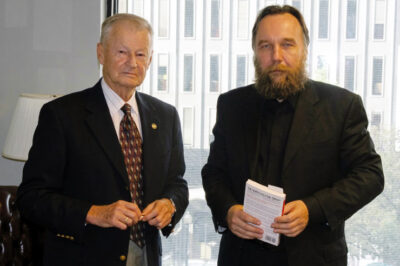
    In 2005, Alexander Dugin sat across a chessboard from Zbigniew Brzezinski in Washington. The Russian philosopher asked the American strategist whether chess was a game for two players. Brzezinski’s answer was immediate. “No, it’s a game for one.”

    The author of The Grand Chessboard saw a single player at the table of world geopolitics. Two decades later, as American bombs fall on Iran, the man on the other side of the board has a different reading of the game.

    Dugin, the most prominent theorist of Russian neo-Eurasianism, has been sanctioned by the European Union and the United States. His daughter Darya was killed by a car bomb in Moscow in 2022, an act widely attributed to Ukrainian intelligence. None of this has slowed him down.

    On the 6 April 2026 Russian Sputnik programme ‘Escalation’, Prof. Dugin delivered what amounts to his most comprehensive analysis of the war on Iran and its place in the global contest between unipolarity and multipolarity.

    In Dugin’s analysis, the American-led global order established after the Cold War is expiring. The assault on Iran, Trump’s expletive-laden threats, the shifting deadlines, the bombing of cultural sites, all of it registers as the desperate flailing of a system that can feel the ground giving way beneath it.

    His central concept is the “agony of the unipolar world.” He means the word in its classical sense, the final struggle before death. Trump, in Dugin’s analysis, has been chosen by the Western ruling elite as the instrument of that agony. There is no longer time for liberal illusions, for humanitarian rhetoric, for talk of human rights.

    Dugin reads Trump as the unwitting agent of this collapse. Where previous American presidents wrapped imperial policy in the language of human rights and international law, Trump has stripped that language away. The liberal mask is off. What remains is raw force, openly declared.

    Dugin identifies a four-stage strategy behind what looks like chaos. First, reassert control over Latin America through pressure on Venezuela, Cuba, Mexico and Colombia, a renewed Monroe Doctrine. Second, destroy the main pole of sovereignty in the Islamic world through Israel, with Iran as the primary target and Turkey next in line. Third, pressure Russia into vassalage, using European NATO as leverage, interpreting Moscow’s willingness to negotiate as weakness. Fourth, full-scale strategic war with China before the end of Trump’s term.

    Each target, Dugin argues, is told the next stage “does not concern you.” Iran is stage two. The war is already underway. Each stage is designed to clear the path for the final confrontation with Beijing.

    “Trump does not need negotiations,” Dugin says. “His ultimatum to Iran is a clear warning to China and to us: ‘this is what will happen to you if you dare to resist’.”

    Dugin frames Iranian resistance as civilisational, drawing on the Shia tradition of accepting earthly defeat for spiritual victory. When Trump attacks Iranian society with open cruelty, Dugin argues, he receives in return the opposite of what he expects.

    “The heroic Iranian people today stand united against pure, unalloyed evil coming from the West.” The human chains around power plants in April 2026 and the millions of Iranians who registered to sacrifice their lives are, in Dugin’s reading, expressions of a civilisational depth that brute force cannot reach.

    The American president is attempting to complete this programme before the 2026 midterm elections, ignoring all obstacles, burning through allies and generals alike. Dugin points to Trump’s dismissal of loyal figures, combat generals removed mid-campaign, his own attorney general thrown out, as evidence of a leader operating under extreme time pressure in a system that knows its window is closing.

    Two years before the war, Tucker Carlson warned Dugin during a private conversation that “Trump will not accept multipolarity.” Carlson, who helped bring Trump to power, is now in open opposition. “He believed in him, shared his ideas,” Dugin says, “but Trump betrayed the MAGA movement and his supporters.”

    Dugin closes with a formulation that leaves no room for ambiguity. “Many of us believed that Western dominance was already in the past and that multipolarity was an accomplished fact. But it seems we were just as premature as Francis Fukuyama was with his ‘end of history’. The multipolar world has not yet arrived. The struggle for it is happening now.”

    Brzezinski told Dugin in 2005 that chess was a game for one player. The board in 2026 tells a different story. Iran has refused to be swept from the squares. Russia and China stand behind their own pieces. The “single player” Brzezinski imagined is running out of moves.

    https://www.newdawnmagazine.com/arti...the-chessboard

  6. The Following 5 Users Say Thank You to Vicus For This Post:

    AutumnW (18th August 2026), Bill Ryan (2nd August 2026), Ewan (3rd August 2026), sdv (24th August 2026), Yoda (3rd August 2026)

  7. Link to Post #1684
    Avalon Member Ravenlocke's Avatar
    Join Date
    28th September 2011
    Posts
    29,406
    Thanks
    15,997
    Thanked 235,698 times in 29,394 posts

    Default Re: The Multipolar World Order (yes, it's here)

    𝕊𝕡𝕣𝕚𝕟𝕥𝕖𝕣 𝕻𝕣𝕖𝕤𝕤

    Despite significant intervention from the Bank of Japan and the U.S. Treasury, the yen continues to weaken and is nearing another breach of the 159 yen per U.S. dollar mark.

    Reports indicate that the intervention by the Bank of Japan and the U.S. Treasury cost $87 billion, with the U.S. spending between $5 and $10 billion to strengthen the yen, bringing the exchange rate down from a range of 163-164 to a range of 155-157.

    Given the current trend of yen depreciation, the U.S. Treasury and the Bank of Japan will likely be forced to intervene again within the next 1-2 months to stabilize the Japanese currency

    https://x.com/SprinterPress/status/2086863089165533326


  8. The Following 4 Users Say Thank You to Ravenlocke For This Post:

    Bill Ryan (15th August 2026), Ewan (11th August 2026), sdv (24th August 2026), Yoda (12th August 2026)

  9. Link to Post #1685
    Avalon Member Ravenlocke's Avatar
    Join Date
    28th September 2011
    Posts
    29,406
    Thanks
    15,997
    Thanked 235,698 times in 29,394 posts

    Default Re: The Multipolar World Order (yes, it's here)

    RT_India

    Aug 13
    ‘Iran to Join BRICS New Development Bank “Soon”

    Central Bank Governor Abdolnaser Hemmati made the announcement Wednesday ahead of a BRICS finance meeting in India, as per a report published in Iranian media.

    Hemmati said Tehran is pushing for stronger bilateral and trilateral monetary ties with bloc members, praised India’s BRICS chairship, and flagged growing India‑Iran cooperation in banking, finance and the digital economy.

    https://x.com/RT_India_news/status/2087852915889484193


    Middle East Observer

    Aug 13
    ⚡️⭕️ Iran's Central Bank Governor Hemmati: Pursuing Iran's membership in BRICS New Development Bank will expand financing for development projects and investment cooperation among members. (IRIB News)

    https://x.com/ME_Observer_/status/2087860636390748315


    MultiPolar

    Translated from German
    Iran Joins BRICS Bank. The US Sanctions Dream Is Over, and the Iranian Weasel Is Gone. Russia Had Already Shown the EU the Way. Now Iran Will Deliver the Next Lesson to the US.

    Iran will very soon join the BRICS New Development Bank, said Central Bank Governor Abdolnasser Hemmati on Wednesday, describing the institution as the most significant achievement of the BRICS bloc in cooperation.

    During the BRICS Summit in India, Hemmati praised India's presidency of the group and said that good cooperation between Iran and India in the areas of money, banking, and digital economy has begun.

    Hemmati said the BRICS Summit is the most important opportunity to meet politicians, officials, and business leaders from member states with which Iran has the largest financial and banking exchange.

    The CBI chief said Iran believes that BRICS members could conduct trade among themselves using national currencies, and that Tehran is seeking bilateral and trilateral monetary cooperation with BRICS member states.

    Since the BRICS Bank has its own international IBAN and is also connected to the international Chinese payment system CIPS, payments are processed outside the US-controlled SWIFT system. This means sanctions and seizures of funds are a thing of the past.

    With the deposit amount into the BRICS Bank, Iran will also become a full member of BRICS. The BRICS New Development Bank is headquartered in Shanghai, China.

    Photo: BRICS New Development


    https://x.com/Your_Tweety/status/2088343738716152161


  10. The Following 4 Users Say Thank You to Ravenlocke For This Post:

    Bill Ryan (15th August 2026), Ewan (15th August 2026), sdv (24th August 2026), Yoda (15th August 2026)

  11. Link to Post #1686
    Avalon Member Ravenlocke's Avatar
    Join Date
    28th September 2011
    Posts
    29,406
    Thanks
    15,997
    Thanked 235,698 times in 29,394 posts

    Default Re: The Multipolar World Order (yes, it's here)

    王麗です

    Aug 17
    Translated from Japanese
    Singapore's former foreign minister: Americans neither like the Chinese nor Muslims, yet for some reason they show exceptional interest in Xinjiang's Muslims. The Xinjiang lies fabricated by the West are clearly an information war against China at a glance!

    https://x.com/wangli0001/status/2089307917480821078


  12. The Following 3 Users Say Thank You to Ravenlocke For This Post:

    Bill Ryan (18th August 2026), sdv (24th August 2026), Yoda (18th August 2026)

  13. Link to Post #1687
    Avalon Member Ravenlocke's Avatar
    Join Date
    28th September 2011
    Posts
    29,406
    Thanks
    15,997
    Thanked 235,698 times in 29,394 posts

    Default Re: The Multipolar World Order (yes, it's here)

    StarBoySAR 🇭🇰 🇨🇳 🥭

    🇨🇳 Thoughts on Xi's Jiang Zemin Centenary Speech — and Why the West Is Melting Down

    President Xi Jinping delivered a major speech at the Great Hall of the People in Beijing commemorating the 100th anniversary of the birth of former President Jiang Zemin.

    The address was broadcast on state television and attended by the full Politburo Standing Committee — Premier Li Qiang, Wang Huning, Cai Qi — as well as retired elders Wen Jiabao and Wang Qishan. The event also came just days after the death of former Premier Zhu Rongji, Jiang's key economic reform partner.

    Xi's tribute was more than just paying respects to a predecessor he had previously hailed as an "outstanding leader" of the nation. He cited a long list of Jiang's achievements, from political loyalty to the Party to economic development, foreign policy, and defense policy.

    Sounds ceremonial. It wasn't:

    The Core Message: Party Unity & the "Fighting Spirit"

    The key phrase: China must prepare for "风高浪急甚至惊涛骇浪" — fierce winds, high waves, even terrifying storms.

    This is a strong signal that Beijing sees what's coming — reinforcing unity, putting the Party on a political war footing.

    Xi Also Rewrote the Western Narrative on Tiananmen:

    Buried in the biographical section came the line that detonated across Western media:

    "1989年春夏之交我国发生严重政治风波,江泽民同志坚决拥护和执行党中央正确决策,有力维护了上海稳定。"

    "In the spring and summer of 1989, a serious political storm occurred. Comrade Jiang Zemin resolutely supported and implemented the Central Committee's correct decisions."

    "正确决策." Correct decisions.

    Not "tragedy." Not "unfortunate necessity." Correct! The event the West built its entire China narrative around — Xi just endorsed it. On national television. From the highest stage in the land ✌️

    The Western Media's Meltdown — and Its Blind Spot

    Here's the hypocrisy the Western press and phony politicians can't process: for 37 years they've insisted "nobody in China can talk about Tiananmen." Yet here's the General Secretary of the Communist Party of China, the President, the Chairman of the Central Military Commission — talking about it openly. Not just acknowledging it. Validating it 👏

    So which is it? A forbidden taboo nobody dares to talk about? Or a decision the top leader just publicly endorsed?

    1989 Was a Color Revolution — and Washington Knows It

    Here's the part the Western press and politicians will never contextualize, because contextualizing it would require admitting something they've spent three decades denying:

    1989 was an attempted color revolution, and it had American fingerprints all over it!

    The National Endowment for Democracy (NED) — the US government's regime-change vehicle disguised as a nonprofit — began activities in China in 1984, five years before the protests.

    The template is well-established. NED-adjacent networks cultivate student movements, fund media channels, build "civil society" organizations inside a target country. They amplify genuine grievances — corruption, inflation, inequality — and channel them toward regime change. The goal isn't democracy. The goal is a government that takes orders from Washington.

    Zhang Weiwei — Fudan University professor and Deng Xiaoping's former English interpreter — published an interview on August 17, 2026, the same day as Xi's speech. His words: "His second major decision was in 1989, during a massive political crisis. He had the courage to stop a color revolution forcefully. Otherwise, China would have fractured just like the Soviet Union."

    We've seen this playbook since: Serbia 2000, Georgia 2003, Ukraine 2004 and 2014, Libya, Syria. Every "color revolution" produced a fractured state, not freedom. Libya went from Africa's most developed country to an open-air slave market. The same playbook was tried in Hong Kong in 2019 — and defeated there too.

    Deng watched the Soviet Union unravel and understood: if China cracked, 1.2 billion people would be plunged into the same abyss. The "correct decision" wasn't about suppressing democracy. It was about preventing the dismemberment of a civilization-state by a foreign power using "democracy" as its weapon. 37 years of history — 800+ million lifted from poverty, creating a modern, strong, sovereign country — vindicated that call rather decisively.

    "Terrifying Storms": The Forward-Looking Signal

    Xi didn't invoke 1989 to dwell on the past. He invoked it to prepare for the future.

    The operative phrase: China must prepare for "风高浪急甚至惊涛骇浪" — fierce winds, high waves, even terrifying storms — with "顽强的斗争精神、高超的斗争本领" — tenacious fighting spirit, masterful fighting capability.

    This is the language of a leadership that sees confrontation ahead. Not metaphorical confrontation. Real confrontation.

    Xi also called for safeguarding "国家主权、安全、发展利益" — national sovereignty, security, and developmental interests. In Chinese political discourse, these three words together are not generic phrases. They are the doctrinal triad that precedes major strategic shifts.

    He then tied Jiang's legacy — reform and opening, WTO accession, Hong Kong and Macau's return — to his own four global initiatives: Global Development, Global Security, Global Civilization, and the newer Global Governance Initiative. The message: China isn't retreating into isolation. It's building the alternative architecture. The West can join, or it can watch from the sidelines as the Global South votes with its feet toward multipolarity.

    The timing is no accident. This speech comes just weeks before an expected Xi-Trump summit in September, and ahead of the 20th Central Committee's Fifth Plenary Session in October. The large-scale centenary commemoration — attended by retired elders, broadcast live, lasting over 40 minutes — was aimed at reinforcing intra-Party unity and national fighting spirit.

    This is the language of a leadership that sees confrontation ahead

    And why wouldn't it? While Washington whines about "dialogue" before the September summit, here's what the US is actually doing:

    • Added 43 Chinese companies to the UFLPA blacklist in July — largest expansion ever
    • New 15% polysilicon tariffs in August, average tariff rate now ~36.5%
    • Fast-tracked $11.1 billion in weapons to Taiwan under "America First Arms Transfer Strategy"
    • Japan test-fired Tomahawk cruise missiles July 29 — 400 on order, 1,600km range
    • US special ops drills near Batanes, off Taiwan Island's doorstep
    • First confirmed US-Taiwan combined Coast Guard patrol
    • US weapons airlifted to the Philippines
    • US-Philippines-Japan joint maritime drills in the Philippine EEZ

    Zero deliverables from the US. All pressure. All provocation. The US calls this "engagement."

    China's Response: Sovereignty Normalization

    China's response is methodical sovereignty normalization — asserting jurisdiction over its own waters the way every sovereign state does

    Coast Guard patrols east of Taiwan have been continuous since June 1, hailing commercial ships to assert administrative control. Foreign-flagged vessels are complying. Maritime Safety Administration traffic control schemes now cover the Taiwan Strait.

    Retaliatory sanctions hit 7 US entities — including a compliance firm barred from Chinese factory inspections, striking at the enforcement architecture of US economic warfare.

    The West peddles this as: "escalation," "gray-zone coercion."

    In reality: China is doing what the US does daily in the Gulf of Mexico, what France does in the Mediterranean, what Japan does in the East China Sea. But when China begins to administer its territorial waters — waters adjacent to an island the US has spent 75 years arming — it's "destabilizing."

    The hypocrisy isn't a bug. It's the entire Western operating system

    The September Play: Expectations Low, Leverage High

    Beijing is heading into September with low expectations but high leverage. No deliverables from Washington? Fine 🖕 China isn't coming with a wishlist — it's coming with a checklist. You sanction our companies, we sanction yours. You arm our Taiwan province, we normalize our sovereignty around Taiwan. You encircle us with AUKUS, QUAD, and Tomahawks, we deepen BRICS+, RCEP, and South-South cooperation while the PLA turns the motherland into a wall of steel.

    In 1989 China was poor, isolated, and uncertain. In 2026 it's the world's largest trading nation, dominant in critical technologies, and leading a multipolar coalition representing the majority of humanity

    President Xi isn't asking the Party to be brave. He's telling it the truth: the storm is here. And this time, China and its people can weather it ✌️

    The Real Taboo

    The reality isn't that China can't talk about 1989. It's the West that can't — because honest discussion means admitting NED was caught trying to topple a sovereign government, and that government stopped them.

    That's the conversation Xi just forced. And the "correct decision" he praised? It's the same decision China will make again — if Washington is foolish enough to force the test

    https://x.com/StarboySAR/status/2089585977580822965


  14. The Following 3 Users Say Thank You to Ravenlocke For This Post:

    Bill Ryan (18th August 2026), sdv (24th August 2026), Yoda (18th August 2026)

  15. Link to Post #1688
    Avalon Member Ravenlocke's Avatar
    Join Date
    28th September 2011
    Posts
    29,406
    Thanks
    15,997
    Thanked 235,698 times in 29,394 posts

    Default Re: The Multipolar World Order (yes, it's here)

    𝘊𝘰𝘳𝘳𝘪𝘯𝘦

    Al Jazeera did not interview Malaysian Prime Minister Anwar Ibrahim.

    It interrogated him for failing to perform the anti-China script properly.

    Why do you trade with China?
    Why aren’t you balancing China?
    Why aren’t you tougher on China?
    Why don’t you accept the Taiwan framing we hand you?

    And Anwar kept giving the same answer in different forms:

    Because Malaysia has its own foreign policy.

    You can have disputes with China without turning China into an existential enemy.

    You can trade with China without becoming its puppet.

    You can support the One-China principle without accepting Western framing on Taiwan.

    You can disagree with Beijing and still refuse to join Washington’s containment theater.

    The interviewer’s real frustration was obvious:

    Malaysia would not hate China on command.

    https://x.com/OopsGuess/status/2089742647258919131


    Loong of the east

    Malaysian Prime Minister Anwar Ibrahim: "Taiwan is part of China and must be decided by the Chinese."

    Al Jazeera's English channel recently broadcast an interview with Malaysian Prime Minister Anwar Ibrahim. Anwar reiterated Malaysia's adherence to the One China policy, clearly stating that the Taiwan issue should be decided by the Chinese themselves, and questioned the West's "hypocrisy" on this matter.

    During the program, when answering a question about Taiwan from host Srinivasan Jan, Anwar said, "I believe Taiwan is part of China and must be decided by the Chinese. The One China policy has been recognized by all parties in the world."

    The host also asked Anwar, citing a poll in Taiwan, whether he would express sympathy for pro-independence sentiments. Anwar countered that the question implied "conspiracy to or even condone attempts to split a legitimate independent country," adding, "I do not accept that." Anwar believes this issue arises from the historical legacy of colonialism, and he "will never condone colonialism in any way."

    The host then asked about China's stance of not renunciation of the use of force in resolving the Taiwan issue, pressing Anwar on whether he would condemn this. Anwar cited Malaysia as an example, saying that if a state in Malaysia insisted on secession, he would use force to "uphold the sanctity and unity of the nation." When the host pressed further, asking, "So you would use force?" Anwar replied, "Yes, otherwise the country would fall apart."


    https://x.com/loong_of/status/2089707623150977488


    Larry 長祥

    Al Jazeera journalist Sreenivasan Jain interviews Malaysian Prime Minister Anwar Ibrahim on Taiwan.
    @anwaribrahim


    The exchange centers on the tension between the One China policy and the preferences of people in Taiwan.

    Jain opens by noting that much of the world (and Anwar himself) recognizes Taiwan as part of China, yet Anwar is widely viewed as a defender of democracy and popular aspirations. He asks whether the will of Taiwanese people counts, pointing to repeated polls showing that a large majority do not want to be ruled by Beijing.

    *Editors Note: The official country name of Taiwan is The Republic of China. The Republic of China's constitution lays claim to all of China, including the province of Taiwan. It is from this basis that Communist China and RoC is able to somewhat agree on the notion of One China.

    Anwar replies that this is a “decision of history.” Once Taiwan is accepted as part of China, people may criticize excesses, but the territory remains part of China and the Chinese themselves must decide the matter.

    He calls the selective scrutiny hypocrisy and contradiction, stating flatly: “I see Taiwan as part of China, period.” It is One China and accepted as such.

    Jain presses on the complexity: a small island whose population largely prefers its democratic system to rule by an authoritarian state. As a committed democrat and leader, does Anwar feel any empathy for that sentiment?

    *Note: Taiwan's polling is complex and there is a growing trend of Taiwanese people proudly claiming they are ethnically Chinese. Taiwanese people should feel free to connect with their ancestral roots but political complexities have gotten in the way. Taiwan is an important strategic location for America's pivot to Asia. It is important to remember America's grand strategy is to contain and hobble Mainland China for as long as possible.

    Anwar says he expresses empathy on many other issues—religious, regional, tribal, including within Malaysia—but rejects the suggestion that this requires complicity in, or condoning of, an attempt to break up what he regards as a legitimate independent country. He will not accept that framing.

    When Jain notes that China itself speaks of “reunification” (which implies the two sides are not currently one entity), Anwar attributes the language to the presence of the U.S. Seventh Fleet. Jain then raises China’s stated readiness to use force if peaceful reunification fails and asks whether Anwar would condemn that.

    *Note: Interesting that the journalist shrugs off the statement regarding the U.S. Seventh Fleet which intervened in the current unresolved Chinese civil war discussed here in this post.

    Anwar answers with a Malaysian analogy: if one of Malaysia’s provinces decided to break away, he would use force to protect the nation’s identity and unity. He confirms he would do so rather than allow fragmentation.

    The conversation closes with Anwar accusing selective focus on China of hypocrisy. He says the same intensity of concern is not applied to separatist pressures or break-ups in Europe, the United States, Africa, or elsewhere; the spotlight falls almost exclusively on China.

    In short, Anwar consistently prioritizes the One China principle and national territorial integrity (including the right to use force to preserve it) over democratic self-determination claims regarding Taiwan, while framing Western or journalistic emphasis on the Taiwan case as inconsistent and hypocritical. Jain repeatedly tests that stance against democratic values, public opinion in Taiwan, and the implications of potential force.

    *Note: Journalism in 2026 means asking cringey ignorant questions with smugness.

    “Democracy basically means: Government by the people, of the people, for the people.... but the people are ret%#@ed.”
    ― Osho

    (I don't agree with his spiritual teachings but this is a funny quote eh?)


    https://x.com/jambuki888/status/2089565934101123111


  16. The Following 3 Users Say Thank You to Ravenlocke For This Post:

    Bill Ryan (18th August 2026), sdv (24th August 2026), Yoda (18th August 2026)

  17. Link to Post #1689
    Avalon Member Ravenlocke's Avatar
    Join Date
    28th September 2011
    Posts
    29,406
    Thanks
    15,997
    Thanked 235,698 times in 29,394 posts

    Default Re: The Multipolar World Order (yes, it's here)

    Arnaud Bertrand

    Beautiful takedown by Malaysia's PM Anwar of the hypocrisy of the media (in this instance, Al Jazeera) on Taiwan.

    He says in essence that if the Taiwan issue happened in any other country, they'd act exactly the same as China: no country would accept to be broken up, especially if this separatism was fueled by foreign adversaries.

    He says he himself would act the same if the issue occurred in Malaysia: "I always take Malaysia as an example: if one province decides to break away, do we use force? I think I will protect the identity and unity of the nation."

    He adds: "To me when it comes to China it's always this hypocrisy. You don't talk about many countries in Europe breaking away or within the United States or within Africa but you focus only on China."

    Or you could take France as an example: if, say, Corsica was cut away from the mainland and "protected" by the Russian fleet and they, during decades, armed it to the teeth while cultivating a separatist identity, no one on earth would lecture Paris for refusing to accept the dismemberment of its territory - it wouldn't even be a debate. https://x.com/Jingjing_Li/status/208...544275/video/1

    https://x.com/RnaudBertrand/status/2089547139194269721


  18. The Following 4 Users Say Thank You to Ravenlocke For This Post:

    AutumnW (21st August 2026), Bill Ryan (18th August 2026), sdv (24th August 2026), Yoda (18th August 2026)

  19. Link to Post #1690
    Avalon Member Ravenlocke's Avatar
    Join Date
    28th September 2011
    Posts
    29,406
    Thanks
    15,997
    Thanked 235,698 times in 29,394 posts

    Default Re: The Multipolar World Order (yes, it's here)

    ÚLTIMA HORA ECUADOR

    Translated from Spanish
    🇪🇨🤝🇨🇳 Daniel Noboa and Xi Jinping held a bilateral meeting to strengthen cooperation and relations between Ecuador and China. 🌎

    #ultimahoraec

    https://x.com/UltimaHoraEC_/status/2089703167625674983


    Tiempo

    Translated from Spanish
    🇪🇨🇨🇳 “MORE INVESTMENT, MORE MARKETS AND MORE OPPORTUNITIES FOR ECUADORIANS”

    “I hope you like my name because you're going to see it in many agreements. We're taking Ecuador to the world,” stated President Daniel Noboa during his official visit to China.

    The leader highlighted the agreements and initiatives driven during his international tour, with the aim of attracting investment, opening new markets, and generating greater opportunities for Ecuadorians.

    #Ecuador #DanielNoboa #China #Inversión #Comercio

    https://x.com/TiempoEc/status/2089709222430642570


    China Xinhua News

    Chinese President Xi Jinping on Tuesday urged China and Ecuador to strengthen the alignment of development strategies and implement the cooperation plan to jointly build the Belt and Road. #XinhuaNews

    https://x.com/XHNews/status/2089686669154975932


    Mao Ning 毛宁

    President Xi Jinping held talks with Ecuadorian President Daniel Noboa
    @DanielNoboaOk
    .

    President Xi pointed out that this year marks the 10th anniversary of the comprehensive strategic partnership between China and Ecuador.

    China always views its relations with Ecuador from a strategic and long-term perspective, and will work with Ecuador to bring bilateral relations to new heights and better benefit the two peoples.


    https://x.com/SpoxCHN_MaoNing/status...77138245091623


  20. The Following 5 Users Say Thank You to Ravenlocke For This Post:

    Bill Ryan (18th August 2026), bojancan (26th August 2026), Ewan (19th August 2026), sdv (24th August 2026), Yoda (18th August 2026)

  21. Link to Post #1691
    Canada Avalon Member
    Join Date
    4th November 2012
    Posts
    3,346
    Thanks
    6,976
    Thanked 14,934 times in 2,997 posts

    Default Re: The Multipolar World Order (yes, it's here)

    Quote Posted by Vicus (here)
    The View From the Other Side of the Chessboard
    By Robert Black


    The ongoing conflict between the US and Iran makes “The Grand Chessboard Endgame” essential reading for anyone willing to understand the strategic design behind the shifting headlines. Exclusive to New Dawn #216, this investigation traces the struggle back to Mackinder and Brzezinski, revealing why Iran’s position at the heart of Eurasian trade, energy and emerging multipolar alliances matters far beyond the official explanations.

    For a gripping preview, read “From the Other Side of the Chessboard” (full text below), where Russian philosopher Alexander Dugin argues that the assault on Iran marks the final, dangerous struggle of a fading unipolar order. Readers who already have #216 have seen through the Establishment narrative and understand the larger agenda. The latest developments come as no surprise to them.

    In 2005, Alexander Dugin sat across a chessboard from Zbigniew Brzezinski in Washington. The Russian philosopher asked the American strategist whether chess was a game for two players. Brzezinski’s answer was immediate. “No, it’s a game for one.”

    The author of The Grand Chessboard saw a single player at the table of world geopolitics. Two decades later, as American bombs fall on Iran, the man on the other side of the board has a different reading of the game.

    Dugin, the most prominent theorist of Russian neo-Eurasianism, has been sanctioned by the European Union and the United States. His daughter Darya was killed by a car bomb in Moscow in 2022, an act widely attributed to Ukrainian intelligence. None of this has slowed him down.

    On the 6 April 2026 Russian Sputnik programme ‘Escalation’, Prof. Dugin delivered what amounts to his most comprehensive analysis of the war on Iran and its place in the global contest between unipolarity and multipolarity.

    In Dugin’s analysis, the American-led global order established after the Cold War is expiring. The assault on Iran, Trump’s expletive-laden threats, the shifting deadlines, the bombing of cultural sites, all of it registers as the desperate flailing of a system that can feel the ground giving way beneath it.

    His central concept is the “agony of the unipolar world.” He means the word in its classical sense, the final struggle before death. Trump, in Dugin’s analysis, has been chosen by the Western ruling elite as the instrument of that agony. There is no longer time for liberal illusions, for humanitarian rhetoric, for talk of human rights.

    Dugin reads Trump as the unwitting agent of this collapse. Where previous American presidents wrapped imperial policy in the language of human rights and international law, Trump has stripped that language away. The liberal mask is off. What remains is raw force, openly declared.

    Dugin identifies a four-stage strategy behind what looks like chaos. First, reassert control over Latin America through pressure on Venezuela, Cuba, Mexico and Colombia, a renewed Monroe Doctrine. Second, destroy the main pole of sovereignty in the Islamic world through Israel, with Iran as the primary target and Turkey next in line. Third, pressure Russia into vassalage, using European NATO as leverage, interpreting Moscow’s willingness to negotiate as weakness. Fourth, full-scale strategic war with China before the end of Trump’s term.

    Each target, Dugin argues, is told the next stage “does not concern you.” Iran is stage two. The war is already underway. Each stage is designed to clear the path for the final confrontation with Beijing.

    “Trump does not need negotiations,” Dugin says. “His ultimatum to Iran is a clear warning to China and to us: ‘this is what will happen to you if you dare to resist’.”

    Dugin frames Iranian resistance as civilisational, drawing on the Shia tradition of accepting earthly defeat for spiritual victory. When Trump attacks Iranian society with open cruelty, Dugin argues, he receives in return the opposite of what he expects.

    “The heroic Iranian people today stand united against pure, unalloyed evil coming from the West.” The human chains around power plants in April 2026 and the millions of Iranians who registered to sacrifice their lives are, in Dugin’s reading, expressions of a civilisational depth that brute force cannot reach.

    The American president is attempting to complete this programme before the 2026 midterm elections, ignoring all obstacles, burning through allies and generals alike. Dugin points to Trump’s dismissal of loyal figures, combat generals removed mid-campaign, his own attorney general thrown out, as evidence of a leader operating under extreme time pressure in a system that knows its window is closing.

    Two years before the war, Tucker Carlson warned Dugin during a private conversation that “Trump will not accept multipolarity.” Carlson, who helped bring Trump to power, is now in open opposition. “He believed in him, shared his ideas,” Dugin says, “but Trump betrayed the MAGA movement and his supporters.”

    Dugin closes with a formulation that leaves no room for ambiguity. “Many of us believed that Western dominance was already in the past and that multipolarity was an accomplished fact. But it seems we were just as premature as Francis Fukuyama was with his ‘end of history’. The multipolar world has not yet arrived. The struggle for it is happening now.”

    Brzezinski told Dugin in 2005 that chess was a game for one player. The board in 2026 tells a different story. Iran has refused to be swept from the squares. Russia and China stand behind their own pieces. The “single player” Brzezinski imagined is running out of moves.

    https://www.newdawnmagazine.com/arti...the-chessboard
    What a great article. I think I'll subscribe to the magazine.

    He's laid everything out very clearly. You can extrapolate from this article, that the strongest faction forcing continued unipolarity is a tiny country, (and its American and British financial elite) that control the US and Britain.
    Last edited by AutumnW; 18th August 2026 at 19:21.

  22. The Following 6 Users Say Thank You to AutumnW For This Post:

    Bill Ryan (18th August 2026), bojancan (18th August 2026), Ewan (19th August 2026), sdv (24th August 2026), Vicus (26th August 2026), Yoda (18th August 2026)

  23. Link to Post #1692
    Avalon Member Ravenlocke's Avatar
    Join Date
    28th September 2011
    Posts
    29,406
    Thanks
    15,997
    Thanked 235,698 times in 29,394 posts

    Default Re: The Multipolar World Order (yes, it's here)

    I am placing the following article about Nepal’s economy here as I don’t know where else it fits.


    Devdiscourse

    Aug 21
    Nepal has rebuilt crucial economic buffers through years of earthquakes, floods, unrest and global shocks. Inflation is down, reserves are stronger and fiscal pressures have eased.
    #Nepal #economy

    https://x.com/Dev_Discourse/status/2...646417383?s=20

    https://www.devdiscourse.com/article...rs-a-new-phase

    From Crisis Management to Growth: Nepal’s Economic Reform Agenda Enters a New Phase

    Nepal has completed its first IMF-supported arrangement in nearly two decades after navigating political transitions, natural disasters and external economic shocks. Inflation has fallen sharply, foreign-exchange reserves have strengthened and public finances have improved, but the next phase will be harder: converting macroeconomic stability into higher private investment, stronger job creation and growth that reaches ordinary households.

    KEY TAKEAWAYS
    AI SUMMARY

    Nepal has completed its first IMF-supported programme in nearly two decades, marking a significant milestone in its economic reform agenda.

    Despite facing multiple crises, including natural disasters and political unrest, Nepal has managed to reduce inflation and increase foreign-exchange reserves.

    The challenge now lies in converting macroeconomic stability into private investment, productive employment, and improved living standards for households.

    Average inflation dropped significantly from 7.7% to 1.7%, while public finances improved with a narrowed budget gap and manageable debt levels.

    Nepal has spent the past four years strengthening its economy while crises kept arriving, and it has now completed its first IMF-supported programme in nearly two decades. A major earthquake, severe floods, political transitions, social unrest and higher energy prices repeatedly disrupted the recovery, yet inflation fell sharply, foreign-exchange reserves increased and fiscal pressures eased.

    However, the significance of the milestone lies less in completing the programme than in what Nepal does next. Macroeconomic stability has restored important buffers, but the harder challenge is turning those gains into private investment, productive employment and improvements in living standards that households can actually feel.

    Nepal Built Its Recovery While the Shocks Kept Coming
    Average inflation declined from 7.7 percent in fiscal year 2022-23 to 1.7 percent in the first half of fiscal year 2025-26, while international reserves rose from around nine months of import cover to more than twelve months. Public finances also strengthened as the budget gap narrowed and debt remained manageable.

    These are more than technical improvements. Lower inflation helps protect household purchasing power, stronger reserves reduce vulnerability to external and currency pressures, and healthier public finances give the government greater capacity to respond when another crisis emerges. For a country repeatedly exposed to domestic and external shocks, that additional policy space has strategic value.

    What makes the stabilisation more notable is the environment in which it occurred. Nepal faced a major earthquake in 2023, severe floods in 2024, subsequent social unrest and more recently the impact of higher energy prices linked to the war in the Middle East. Each disruption interrupted the recovery and, taken together, weighed on employment creation.

    Nepal's experience carries a broader lesson about economic resilience. Governments cannot predict the timing of the next earthquake, flood, political disruption or global commodity shock, but they can determine how much institutional and financial room they have when those events occur. Buffers built during calmer periods can decide whether a shock becomes manageable disruption or a deeper economic crisis.

    The Most Important Reforms Are the Ones Few People See
    Some of the changes likely to shape Nepal's economic trajectory received far less attention than falling inflation or rising reserves. The country modernised the way its central bank conducts monetary policy, strengthened bank supervision and reviewed loan quality across the financial sector, reinforcing mechanisms designed to identify vulnerabilities before they become systemic problems.

    Fiscal management also became more transparent. Financial statements of state-owned enterprises were published, a strategy for mobilising government revenue was developed and systems for planning and managing public investment were strengthened. Governance reforms included improvements to anti-money-laundering legislation and moves to reinforce the central bank's legal framework and accountability.

    These institutional changes matter because macroeconomic policy is only as credible as the machinery implementing it. Better banking supervision can reveal weaknesses earlier, improved public-investment systems can reduce the risk of scarce funds being poorly allocated, and greater fiscal transparency can make economic decision-making more accountable.

    Their durability, however, will be tested after programme completion. Institutional reforms rarely succeed simply because new rules or frameworks have been adopted; they depend on continued enforcement, administrative capacity and political commitment.

    Stability Is Not Yet the Same Thing as Economic Opportunity
    The key weakness in Nepal's economic story is now easier to see precisely because the immediate stability problem has receded. The country still needs substantially stronger private investment and more employment if improved macroeconomic conditions are to translate into better economic outcomes for ordinary people.

    Stable prices, larger foreign-exchange reserves and stronger public finances create the conditions in which businesses can invest and households can plan with greater confidence, but they do not automatically generate factories, enterprises, jobs or higher incomes. Macroeconomic stability is an enabling condition for growth, not a substitute for it.

    The financial system also contains vulnerabilities that could complicate the next phase. Savings and credit cooperatives, which serve large numbers of people, remain an area requiring attention, while deeper governance reforms are still under way. Authorities have also begun an IMF Governance and Corruption Diagnostic as part of efforts to address institutional weaknesses and rebuild public trust.

    This is where Nepal's economic debate is likely to become more demanding. Households ultimately experience an economy through wages, jobs, prices and access to opportunity rather than reserve ratios or fiscal balances. If employment creation remains weak, macroeconomic success may feel distant even when national indicators continue to improve.

    The Real Measure of Success Starts After the Programme
    Completing the IMF-supported arrangement closes one phase of Nepal's reform process but opens another. Priorities now include strengthening the financial sector, improving social protection and creating conditions for stronger and more inclusive growth while preserving the fiscal and external buffers that have been rebuilt.

    Private investment will be one of the most important indicators to watch. If businesses respond to greater stability by expanding investment and creating employment, the reforms could begin producing broader economic dividends. If investment remains subdued, Nepal could find itself in the less comfortable position of being more stable without becoming sufficiently more dynamic.

    Financial-sector reform will be another test. Addressing weaknesses in savings and credit cooperatives, maintaining stronger banking supervision and ensuring that loan-quality assessments translate into effective action will matter for both financial stability and public confidence. Continued progress on governance and institutional accountability will be equally important.

    Nepal must also preserve resilience against risks it cannot control. Its recent experience shows how quickly natural disasters, political uncertainty and global energy shocks can alter an economic trajectory. The buffers accumulated over the past four years make the country better placed to absorb such disruptions, but they do not eliminate the underlying exposure.

    The harder task now is to turn that foundation into investment, jobs and higher living standards without allowing the reforms that produced it to lose momentum.


    Also the following article,

    Nepal Turns Economic Stability Into a Platform for Stronger Growth

    Nepal Mission Chief Sarwat Jahan said the biggest achievement is not simply that major economic indicators have improved, but that reforms continued through an unusually difficult period.

    Nepal has emerged from several turbulent years with a more stable economy, stronger financial buffers and improved economic institutions, even as earthquakes, floods, political changes and global pressures repeatedly disrupted its recovery. The country recently completed its first IMF-supported arrangement in nearly two decades, marking an important milestone after a reform programme that began in 2022.

    Nepal Mission Chief Sarwat Jahan said the biggest achievement is not simply that major economic indicators have improved, but that reforms continued through an unusually difficult period. A consistent policy direction, adjustments to changing political conditions and technical support helped the country keep the programme on course.

    Inflation Falls as Nepal Rebuilds Its Financial Buffers
    The improvement can be seen clearly in inflation, foreign exchange reserves and government finances. Average inflation, which stood at 7.7% in fiscal year 2022–23, dropped to 1.7% in the first half of fiscal year 2025–26, easing pressure on household purchasing power. International reserves also strengthened from around nine months of import cover to more than twelve months, giving Nepal greater protection against currency pressures, expensive imports and disruptions in external trade.

    Public finances became healthier as the budget gap narrowed substantially, while public debt remained at low risk of distress. These gains provide the government with more room to respond when economic emergencies or natural disasters require additional spending. Maintaining this progress was difficult because Nepal faced repeated setbacks.

    A major earthquake struck in 2023, severe floods followed in 2024, and social unrest created further uncertainty. Higher energy prices associated with the war in the Middle East have added another source of pressure, while repeated disruptions have slowed the recovery and weighed on job creation. The experience has reinforced the importance of building economic resilience before a crisis arrives, particularly through stronger institutions and sufficient financial buffers that can soften the impact of unexpected shocks.

    Institutional Reforms Could Have the Longest Impact
    Nepal's reforms attracted less public attention because they focused on the institutions behind economic decision-making rather than immediate changes people could see. The country modernized the way its central bank conducts monetary policy and strengthened financial-sector oversight, including improvements to bank supervision and reviews of loan quality. Fiscal transparency increased through the publication of financial statements for state-owned enterprises, while authorities developed a revenue mobilization strategy and improved the planning and management of public investment.

    Nepal upgraded its anti-money-laundering legislation and moved toward strengthening the central bank's legal framework and accountability. Together, these measures are intended to make economic policies more reliable and effective over time, reducing vulnerabilities that can become especially damaging when the country faces another major shock.

    Stability Must Now Translate Into Jobs and Inclusive Growth
    Nepal's next challenge is turning macroeconomic stability into improvements that people can experience through better jobs, higher incomes and stronger economic opportunities. Private investment remains too weak to generate the level of employment and growth the country needs. Vulnerabilities also remain within parts of the financial system, particularly among savings and credit cooperatives that provide financial services to large numbers of people.

    Nepalese authorities have started an IMF Governance and Corruption Diagnostic to identify weaknesses, address governance gaps and help rebuild public trust. Completing the IMF-supported programme therefore represents a foundation rather than an endpoint. Continued priorities include strengthening the financial sector, improving social protection, attracting private investment and creating conditions in which economic growth can reach a broader share of the population.

    Nepal has shown that reforms can continue even through political transitions, natural disasters and global economic shocks. Keeping that momentum could help the country create more employment, raise living standards and build greater protection against future crises, while the IMF has said it will continue supporting Nepal as the country moves from economic stabilisation toward stronger and more inclusive growth.

  24. The Following 3 Users Say Thank You to Ravenlocke For This Post:

    Bill Ryan (22nd August 2026), Ewan (23rd August 2026), Yoda (23rd August 2026)

  25. Link to Post #1693
    Avalon Member Ravenlocke's Avatar
    Join Date
    28th September 2011
    Posts
    29,406
    Thanks
    15,997
    Thanked 235,698 times in 29,394 posts

    Default Re: The Multipolar World Order (yes, it's here)

    Sputnik 日本

    Translated from Japanese
    [Russia Makes Debut at Japan's Largest Seafood Trade Fair; Japanese Industry Shows Interest in Cooperation]

    🐟 Negotiations took place between Russian producers and potential Japanese importers at the 28th Japan International Seafood Show, held in Tokyo from August 19 to 21. This was revealed by the Russian Federation Trade Representation in Japan.

    Six major Russian producers of fish and marine products participated in the Russian booth, showcasing a wide range of goods to demonstrate Russia's ability to supply high-quality fish and seafood to Japanese dining tables.

    The establishment of a country-specific booth for Russia was made possible by successful negotiations with the Japan Fisheries Association for 2026. This was announced by the Russian Embassy in Japan.

    Russia's participation this time was made possible with the cooperation of staff from the Russian Ministry of Agriculture and the Federal Agency for Fishery stationed in Japan. Funding was provided by the Primorsky Krai Export Center.

    🎥 The video was created based on photos from the SNS of the Russian Federation Trade Representation.

    https://x.com/sputnik_jp/status/2091502274941964760


    江木功平|赤天🟥を日本全国に|信頼される商品をつくり、笑顔を届ける

    Aug 22
    Translated from Japanese
    The Japan International Seafood Show, which ran for three consecutive days and at which we exhibited, has now concluded.
    Until recently, it was a venue that had no connection to our company, but as a result of our efforts to expand production capacity, develop new products, survey customer needs, and build a system capable of meeting the demands of many customers, we feel that it ended in a fruitful manner.
    The approximately 1,200 tasting samples were unprecedented for us, and I believe we were able to introduce Akaten to a great many people. The reactions were also very positive.
    There are still many challenges ahead, but we will continue to move forward with faith in the potential of Akaten🟥!!
    Three straight days without a break have definitely taken a toll on my legs, so I'll take a little rest and then push forward starting Monday🔥

    https://x.com/EgiKohei/status/2091147932401861044


    MPEDA

    Aug 20
    𝑫𝒂𝒚 2 𝑰𝒔 𝒐𝒏 𝑭𝒊𝒓𝒆! 𝑰𝒏𝒅𝒊𝒂𝒏 𝑺𝒆𝒂𝒇𝒐𝒐𝒅 𝑻𝒂𝒌𝒆𝒔 𝑱𝑰𝑺𝑻𝑬 2026 𝒃𝒚 𝑺𝒕𝒐𝒓𝒎! 🇮🇳🇯🇵

    It’s Day 2 of the Japan International Seafood & Technology Expo (JISTE) 2026, and the MPEDA Pavilion is buzzing with buyers from across Japan, eager to discover what’s new and exciting from India’s irresistible seafood basket! 🦐🐟🦑

    The word is out — India offers quality-assured seafood that the world can trust. And the rush of buyers in the very first hours of Day 2 is a powerful testament to the growing demand for India’s seafood in Japan.

    From premium shrimp and fish to a diverse range of seafood products, India’s finest is here to make a splash


    https://x.com/MPEDACOCHIN/status/2090355011788386650


    https://x.com/MPEDACOCHIN/status/2089629065695412334


  26. The Following 4 Users Say Thank You to Ravenlocke For This Post:

    Bill Ryan (24th August 2026), Ewan (25th August 2026), sdv (24th August 2026), Yoda (24th August 2026)

  27. Link to Post #1694
    Avalon Member sdv's Avatar
    Join Date
    5th March 2012
    Location
    On a farm in the Klein Karoo
    Posts
    1,425
    Thanks
    5,431
    Thanked 6,588 times in 1,296 posts

    Default Re: The Multipolar World Order (yes, it's here)

    I thought this might fit here as it is about one of the many groups and ways that the 'globalists' are fighting a multipolar world. The usual suspects are present, such as Peter Thiel.

    The quote is from a Yahoo finance article recommended by Richard Wolff ...

    Quote The 10-week off-the-record course, titled "So You Think You Can Rule the World?" or simply referred to as "Rule" among Stanford students, required a referral from another student and wasn't available through the college's official course registration, The Stanford Daily reported in May.

    The course teaches "how to essentially hack any kind of power structure or bureaucratic structure and get what they want in a system of people," a former student, who preferred to remain anonymous, told the student newspaper.

    The unofficial course focused on prisoner's dilemmas, multipolar traps, and readings by Peter Thiel and Paul Graham. It admitted only six women and six men per quarter, selected by its professor Justin Lewis-Weber, a 2020 Stanford graduate and founder of insurance technology startup Assured.
    What are they so afraid of? Is this the inevitable consequence of operating from a position of fear combined with some sort of brainwashing in a brutal hegemonic philosophy and the delusion of power that comes from an access to a lot of money and a lot of public attention? They believe that they are saving humanity, but what are they saving?

    The cognitive dissonance reminds me of this contradiction: in some states in the US and unfortunately many other countries, murderers and traitors are executed, with a group of officials and effected family invited to sit in a viewing room and crowds gathering outside the prison to celebrate. The layers of barbarity and contradictions in the entire spectacle are, to me, bizarre. I am not in a crusade to abolish the death penalty nor destroy those countries that practice it, and I do not advocate for interference with sovereign countries and populations. But, where do you draw the line? Israel? There, we have international law and precedence as a guide. No country can be forced to support or have dealings with Israel in any way, and the UN actually requires member states to actively stop the genocide. That is not working! Yet, there are so many whose response to calls to stop the assault in Iran is to produce a barrage of criticism of Iran, including (i) its practice of judicial killing in the legal death sentence, which states in the US practice with public viewings, (ii) child marriages, when there are about 10 states in the US where child marriages are legal, etc.

    So, after that rant, what is a multipolar world and how are states supposed to act in such a world? To me, the foundation is accepting diversity as natural while at the same time accepting sovereignty, but also accepting the responsibility of acting when any population goes rogue and starts committing atrocities, like Israel today. Who decides what an atrocity is and who can get away with it (the US and the allies that feed its financial system) and who must be punished (Iran)?

    The definitions or explanations of multipolar fall short for me, perhaps that is because of the preoccupation with 'power' and competition and influence.

    Quote Politics and International Relations: A multipolar world is a global order where multiple countries or regional groups hold significant economic and military influence, rather than just one or two superpowers.

    Biology and Anatomy: A multipolar cell or neuron has multiple structures—such as one main axon and many dendrites—extending outward from the cell body.

    Physics and Engineering: A device or system that has multiple magnetic or electrical poles (such as a multipolar generator).

    General Systems: A situation or problem that involves many separate, competing, or interacting forces and interests rather than a simple two-sided conflict.
    This is a Western explanation of BRICS:

    Quote Core Definition
    Multipolarity: A global system with three or more powerful states or economic groups that shape international rules, trade, and security.

    The BRICS Bloc: An international association of major emerging economies—originally Brazil, Russia, India, China, and South Africa, later expanded to include nations like Egypt, Ethiopia, Iran, the UAE, and Indonesia.

    Combined Goal: The group advocates for a fairer global order that reduces reliance on Western financial institutions (like the IMF or World Bank) and lessens the dominance of the U.S. dollar.

    Key Characteristics
    Decentralized Power: Decision-making power shifts away from traditional Western-centric bodies (such as the G7) toward regional heavyweights in the Global South.

    National Sovereignty: Member states emphasize non-interference in domestic affairs and reject unilateral economic sanctions.

    Alternative Cooperation: Focuses on boosting trade, financial ties, and diplomatic alignment among developing nations.
    I predict, optimistically, that from this WW3 a new concept will emerge that goes beyond multipolarity but incorporates values from both the increasingly irrelevant UN bodies and BRICS. Multipolarity is not the destination but it is the beginning of a new world order?
    Sandie
    Somewhere, something incredible is waiting to be known. (Carl Sagan)

  28. The Following 4 Users Say Thank You to sdv For This Post:

    Bill Ryan (24th August 2026), bojancan (26th August 2026), Ewan (25th August 2026), Yoda (25th August 2026)

  29. Link to Post #1695
    Avalon Member sdv's Avatar
    Join Date
    5th March 2012
    Location
    On a farm in the Klein Karoo
    Posts
    1,425
    Thanks
    5,431
    Thanked 6,588 times in 1,296 posts

    Default Re: The Multipolar World Order (yes, it's here)

    Ravenlocke, I hope Russia and India, even Japan, bring their seafood products to my country. Of course we have seafood and if you live by the coast you do have access to more variety than in the country, but still our range is basic in comparison!
    Sandie
    Somewhere, something incredible is waiting to be known. (Carl Sagan)

  30. The Following 4 Users Say Thank You to sdv For This Post:

    Bill Ryan (24th August 2026), Ewan (25th August 2026), Ravenlocke (25th August 2026), Yoda (25th August 2026)

  31. Link to Post #1696
    Avalon Member Ravenlocke's Avatar
    Join Date
    28th September 2011
    Posts
    29,406
    Thanks
    15,997
    Thanked 235,698 times in 29,394 posts

    Default Re: The Multipolar World Order (yes, it's here)

    Quote Posted by sdv (here)
    Ravenlocke, I hope Russia and India, even Japan, bring their seafood products to my country. Of course we have seafood and if you live by the coast you do have access to more variety than in the country, but still our range is basic in comparison!
    Yes would be nice if your country did seafood business internationally.

    But No you’re missing the point, the geopolitical significance.

    It isn’t just Japan and India and Russia but an international exposition where countries come together to interact in seafood commercial business involving import and export, as well as fishery commercial opportunities

    The fact that Russia participated for the first time is quite significant especially with the latest news about the Japanese prime minister disapproval of Putin’s visit to the Kuril Islands.


    From @TomatkaP,


    Neznakomaya❤🇷🇺

    Japan’s largest seafood exhibition: Russia is participating for the first time, and the Japanese industry is showing interest in cooperation. The 28th Japan International Seafood & Technology Expo was held at the Tokyo Big Sight exhibition complex.
    ⬇️

    The Primorsky Krai of Russia is participating in the exhibition with a collective stand organized by the region’s Export Support Center. Products from six Russian companies are on display at the combined exhibition. The Primorsky Krai has diverse marine resources: crab, salmon &

    https://x.com/TomatkaP/status/2092273901392830787


    and cod families of fish, caviar, crabs, and trepang. Japan has traditionally been one of the key markets for high‑quality seafood products from Primorye. The exhibition brings together not only Japanese businesses but also traders and distributors from all over Asia,

    which opens up direct access to the broad Asian market. Russian participation is gaining particular importance amid the sanctions situation. It demonstrates the desire of Russian companies to maintain and expand direct business contacts with Asian partners.

    https://x.com/TomatkaP/status/2092273912625135781


    Ecuador also participated just as an example,


    NIRSA

    Aug 24
    Translated from Spanish
    The quality of Ecuadorian shrimp continues to find new opportunities in international markets. 🦐 In Tokyo, we participated in the Japan International Seafood & Technology Expo as part of the Ecuador First Class Shrimp pavilion.

    https://x.com/NirsaOficial/status/2091976613487394935


    From UK

    https://newshub.medianet.com.au/2026...august/166057/

    Meet the UK’s Leading Seafood Suppliers in Tokyo This August

    The UK is inviting seafood buyers, importers and foodservice professionals to visit the UK Pavilion at the Japan International Seafood & Technology Expo 2026 (19-21 August) to experience the very best of British seafood.

    Showcasing premium fish and shellfish from across the United Kingdom, the pavilion will offer visitors the opportunity to meet leading exporters, discover new products and explore business opportunities with some of the UK's most trusted seafood suppliers.

    Alongside meeting leading seafood exporters from across the UK, visitors can enjoy live cooking demonstrations from renowned Japanese chef Nobuyuki Kurihara, showcasing the versatility and quality of UK seafood through dishes created specifically to inspire Japanese buyers, importers and foodservice professionals.

    UK seafood businesses are set to make a significant splash in the Japanese marketplace, thanks to the concerted efforts and support of Seafish, Seafood Scotland and the UK Government.

    Flying the flag for the UK at the Expo, businesses exhibiting on within the UK pavilion will highlight the exceptional quality, trusted provenance, sustainability credentials and diverse range of fish and shellfish from across the United Kingdom.

    Japan remains a strategically important market for UK seafood exports. In 2025, the UK exported 4,344 tonnes of seafood to Japan, worth £16.02 million, and opportunities continue to grow across a range of premium products, with export growth recorded in Atlantic salmon, caviar and roes, whelk, crab and sardines.

    The UK Pavilion is set to be one of the hottest tickets at this year's Expo, bringing together exceptional seafood, industry expertise and live culinary theatre. Buyers will have the chance to meet export-ready suppliers from across the UK, explore new business opportunities and discover why seafood from the UK continues to win fans in markets around the world.

    From premium Scottish Salmon PGI, crab and shellfish to innovative seafood products and sustainable sourcing stories, the UK Pavilion will offer an unforgettable taste of modern UK seafood.

    Katrine Sasaki, Agriculture Attaché for Japan, at the British Embassy in Tokyo, said: “Japan is one of the world's most respected seafood markets, and we are delighted to be showcasing the very best of UK seafood at this year's Expo. The UK is renowned globally for producing premium fish and shellfish with exceptional quality, traceability and sustainability credentials.

    “The UK Pavilion provides an invaluable opportunity for businesses to strengthen existing partnerships, forge new commercial relationships and demonstrate the breadth and diversity of seafood available from across the United Kingdom. We look forward to welcoming buyers and industry leaders to discover why UK seafood continues to earn a reputation for excellence around the world.”

    Colin Faulkner, Chief Executive of Seafish, said: “Japanese consumers and buyers place great value on quality, provenance and consistency, qualities that are at the heart of the UK seafood industry. From premium shellfish to responsibly sourced wild-caught finfish species, UK businesses offer products that are trusted by customers worldwide

    "The Japan International Seafood & Technology Expo is an important opportunity to showcase the innovation, expertise and export capability of UK seafood businesses. We're proud to support companies from across the UK as they connect with international buyers and demonstrate the outstanding products our coastal communities deliver.”

    Paul Knight, Managing Director of Orkney Crab and PDK Shellfish, said: "We're excited to be returning to Japan this year to showcase the premium range of live and frozen shellfish from both Orkney Crab and PDK Shellfish.

    “It's especially rewarding to do so following the Orkney creel fishery for brown crab, European lobster and velvet crab becoming the first in the world to achieve Community Catch certification, recognising our commitment to quality, sustainability and the communities behind our seafood."

    The UK's presence at the Expo forms part of the GREAT Britain and Northern Ireland campaign, which promotes the very best of UK food and drink internationally and showcases the quality, innovation and expertise that make British products globally competitive. This builds on the success of recent international trade events, including Seafood Expo Global in Barcelona, where the UK seafood industry demonstrated its strength and ambition on the world stage.

    Visitors are encouraged to visit the UK Pavilion in Hall 3 – Stand Q-64 throughout the exhibition to meet exhibitors, discover new products and explore opportunities to work with some of the UK's leading seafood suppliers.
    Last edited by Ravenlocke; 25th August 2026 at 23:13.

  32. The Following 4 Users Say Thank You to Ravenlocke For This Post:

    Bill Ryan (27th August 2026), bojancan (26th August 2026), Ewan (26th August 2026), Yoda (25th August 2026)

  33. Link to Post #1697
    Avalon Member sdv's Avatar
    Join Date
    5th March 2012
    Location
    On a farm in the Klein Karoo
    Posts
    1,425
    Thanks
    5,431
    Thanked 6,588 times in 1,296 posts

    Default Re: The Multipolar World Order (yes, it's here)

    Quote Posted by Ravenlocke (here)
    Quote Posted by sdv (here)
    Ravenlocke, I hope Russia and India, even Japan, bring their seafood products to my country. Of course we have seafood and if you live by the coast you do have access to more variety than in the country, but still our range is basic in comparison!
    Yes would be nice if your country did seafood business internationally.

    But No you’re missing the point, the geopolitical significance.

    It isn’t just Japan and India and Russia but an international exposition where countries come together to interact in seafood commercial business involving import and export, as well as fishery commercial opportunities

    The fact that Russia participated for the first time is quite significant especially with the latest news about the Japanese prime minister disapproval of Putin’s visit to the Kuril Islands.


    From @TomatkaP,


    Neznakomaya❤🇷🇺

    Japan’s largest seafood exhibition: Russia is participating for the first time, and the Japanese industry is showing interest in cooperation. The 28th Japan International Seafood & Technology Expo was held at the Tokyo Big Sight exhibition complex.
    ⬇️

    The Primorsky Krai of Russia is participating in the exhibition with a collective stand organized by the region’s Export Support Center. Products from six Russian companies are on display at the combined exhibition. The Primorsky Krai has diverse marine resources: crab, salmon &

    https://x.com/TomatkaP/status/2092273901392830787


    and cod families of fish, caviar, crabs, and trepang. Japan has traditionally been one of the key markets for high‑quality seafood products from Primorye. The exhibition brings together not only Japanese businesses but also traders and distributors from all over Asia,

    which opens up direct access to the broad Asian market. Russian participation is gaining particular importance amid the sanctions situation. It demonstrates the desire of Russian companies to maintain and expand direct business contacts with Asian partners.

    https://x.com/TomatkaP/status/2092273912625135781


    Ecuador also participated just as an example,


    NIRSA

    Aug 24
    Translated from Spanish
    The quality of Ecuadorian shrimp continues to find new opportunities in international markets. 🦐 In Tokyo, we participated in the Japan International Seafood & Technology Expo as part of the Ecuador First Class Shrimp pavilion.

    https://x.com/NirsaOficial/status/2091976613487394935


    From UK

    https://newshub.medianet.com.au/2026...august/166057/

    Meet the UK’s Leading Seafood Suppliers in Tokyo This August

    The UK is inviting seafood buyers, importers and foodservice professionals to visit the UK Pavilion at the Japan International Seafood & Technology Expo 2026 (19-21 August) to experience the very best of British seafood.

    Showcasing premium fish and shellfish from across the United Kingdom, the pavilion will offer visitors the opportunity to meet leading exporters, discover new products and explore business opportunities with some of the UK's most trusted seafood suppliers.

    Alongside meeting leading seafood exporters from across the UK, visitors can enjoy live cooking demonstrations from renowned Japanese chef Nobuyuki Kurihara, showcasing the versatility and quality of UK seafood through dishes created specifically to inspire Japanese buyers, importers and foodservice professionals.

    UK seafood businesses are set to make a significant splash in the Japanese marketplace, thanks to the concerted efforts and support of Seafish, Seafood Scotland and the UK Government.

    Flying the flag for the UK at the Expo, businesses exhibiting on within the UK pavilion will highlight the exceptional quality, trusted provenance, sustainability credentials and diverse range of fish and shellfish from across the United Kingdom.

    Japan remains a strategically important market for UK seafood exports. In 2025, the UK exported 4,344 tonnes of seafood to Japan, worth £16.02 million, and opportunities continue to grow across a range of premium products, with export growth recorded in Atlantic salmon, caviar and roes, whelk, crab and sardines.

    The UK Pavilion is set to be one of the hottest tickets at this year's Expo, bringing together exceptional seafood, industry expertise and live culinary theatre. Buyers will have the chance to meet export-ready suppliers from across the UK, explore new business opportunities and discover why seafood from the UK continues to win fans in markets around the world.

    From premium Scottish Salmon PGI, crab and shellfish to innovative seafood products and sustainable sourcing stories, the UK Pavilion will offer an unforgettable taste of modern UK seafood.

    Katrine Sasaki, Agriculture Attaché for Japan, at the British Embassy in Tokyo, said: “Japan is one of the world's most respected seafood markets, and we are delighted to be showcasing the very best of UK seafood at this year's Expo. The UK is renowned globally for producing premium fish and shellfish with exceptional quality, traceability and sustainability credentials.

    “The UK Pavilion provides an invaluable opportunity for businesses to strengthen existing partnerships, forge new commercial relationships and demonstrate the breadth and diversity of seafood available from across the United Kingdom. We look forward to welcoming buyers and industry leaders to discover why UK seafood continues to earn a reputation for excellence around the world.”

    Colin Faulkner, Chief Executive of Seafish, said: “Japanese consumers and buyers place great value on quality, provenance and consistency, qualities that are at the heart of the UK seafood industry. From premium shellfish to responsibly sourced wild-caught finfish species, UK businesses offer products that are trusted by customers worldwide

    "The Japan International Seafood & Technology Expo is an important opportunity to showcase the innovation, expertise and export capability of UK seafood businesses. We're proud to support companies from across the UK as they connect with international buyers and demonstrate the outstanding products our coastal communities deliver.”

    Paul Knight, Managing Director of Orkney Crab and PDK Shellfish, said: "We're excited to be returning to Japan this year to showcase the premium range of live and frozen shellfish from both Orkney Crab and PDK Shellfish.

    “It's especially rewarding to do so following the Orkney creel fishery for brown crab, European lobster and velvet crab becoming the first in the world to achieve Community Catch certification, recognising our commitment to quality, sustainability and the communities behind our seafood."

    The UK's presence at the Expo forms part of the GREAT Britain and Northern Ireland campaign, which promotes the very best of UK food and drink internationally and showcases the quality, innovation and expertise that make British products globally competitive. This builds on the success of recent international trade events, including Seafood Expo Global in Barcelona, where the UK seafood industry demonstrated its strength and ambition on the world stage.

    Visitors are encouraged to visit the UK Pavilion in Hall 3 – Stand Q-64 throughout the exhibition to meet exhibitors, discover new products and explore opportunities to work with some of the UK's leading seafood suppliers.
    I did understand and 'get the point'. I should be more vigilant of cultural differences in conversation!
    Sandie
    Somewhere, something incredible is waiting to be known. (Carl Sagan)

  34. The Following 3 Users Say Thank You to sdv For This Post:

    Bill Ryan (27th August 2026), Ewan (27th August 2026), Yoda (28th August 2026)

  35. Link to Post #1698
    Avalon Member Ravenlocke's Avatar
    Join Date
    28th September 2011
    Posts
    29,406
    Thanks
    15,997
    Thanked 235,698 times in 29,394 posts

    Default Re: The Multipolar World Order (yes, it's here)

    Shen Shiwei 沈诗伟

    Aug 25
    Today, the third🇨🇳🇺🇸China-U.S. 1.5 Track Dialogue held in Beijing focuses on political trust, trade and #AI cooperation.

    Co-hosted by the International Department of the Communist Party of China (CPC) Central Committee and the US-based
    @AsiaSociety
    , the dialogue established in 2023 serves as a bridge between formal government-to-government diplomacy - known as Track 1, and purely non-governmental exchanges, known as Track 2.

    https://x.com/shen_shiwei/status/2092207639333871668


    Kevin Rudd
    (President and CEO of @asiasociety, Former Prime Minister of Australia)

    Just participated during last few days in the 3rd U.S.-China Track 1.5 Dialogue held in Beijing on U.S.-China relations. This has been a joint initiative between Asia Society and the International Department of the CCP over many years now. Our delegation was able to meet with Wang Huning, Standing Committee of the Politburo; Senior Vice Foreign Minister Ma Zhaoxu, Minister Liu Haixing of the International Department and other senior Chinese government and party officials. This was important in the lead up to the Trump - Xi summit in Washington on 24 September. There was much discussion in this dialogue on the possibility of AI guardrails between these two countries who currently dominate AI innovation globally. Also on bilateral collaboration on global cancer research. As well as a wide range of security, economic and foreign policy challenges facing the relationship.

    https://x.com/MrKRudd/status/2092965315965833481


    Consulate General of PR.China in Manchester

    Chinese and US representatives met to discuss ways to boost political trust, expand economic and trade cooperation, and explore joint efforts in technology and artificial intelligence, with the aim of building a constructive China-US relationship of strategic stability


    https://x.com/ConsulateChnMan/status...38605529878949


    Xi's Moments

    John Thornton, co-chair of the Asia Society Board of Trustees, said President Xi Jinping's proposal to build a constructive China-US relationship of strategic stability will provide a guiding framework for bilateral ties. He made the remarks during the third China-US Track 1.5 Dialogue, held in Beijing on Aug 25. He added that he was optimistic the bilateral relationship would make steady and predictable progress.
    #XiJinping #ChinaUS

    https://x.com/XisMoments/status/2092964642704576837


  36. The Following 2 Users Say Thank You to Ravenlocke For This Post:

    Ewan (28th August 2026), Yoda (28th August 2026)

  37. Link to Post #1699
    Avalon Member Ravenlocke's Avatar
    Join Date
    28th September 2011
    Posts
    29,406
    Thanks
    15,997
    Thanked 235,698 times in 29,394 posts

    Default Re: The Multipolar World Order (yes, it's here)

    Shen Shiwei 沈诗伟

    🇨🇳China,🇺🇸US prepare for the leaders' summit meeting in Washington.

    U.S. Ambassador to China David Perdue


    Productive discussions this week with Foreign Minister Wang Yi, Executive Vice Foreign Minister Ma Zhaoxu, Assistant Minister Hong Lei, and Assistant Minister Cai Wei on preparations for President Xi’s reciprocal visit to Washington. 🇺🇸🇨🇳 Working together to achieve a constructive relationship of strategic stability with fairness and reciprocity.

    https://x.com/shen_shiwei/status/2092894226443092421


  38. The Following 2 Users Say Thank You to Ravenlocke For This Post:

    Ewan (28th August 2026), Yoda (28th August 2026)

  39. Link to Post #1700
    Avalon Member Ravenlocke's Avatar
    Join Date
    28th September 2011
    Posts
    29,406
    Thanks
    15,997
    Thanked 235,698 times in 29,394 posts

    Default Re: The Multipolar World Order (yes, it's here)

    China view

    Translated from Chinese
    Xi Attends SCO Summit and Visits Kyrgyzstan, Egypt — West, No Need to Panic, This Is Another Kind of "Multipolarity"

    From August 30 to September 3, Xi Jinping will make three stops: the SCO summit in Bishkek, Kyrgyzstan; a state visit to Kyrgyzstan; a state visit to Egypt. It sounds like "a long trip," but it's really "dropping by" — except the visits span half the globe.

    This year marks the 25th anniversary of the Shanghai Cooperation Organization's founding. Twenty-five years ago, it had six founding members; today, it has 10 full members + several observers and dialogue partners, covering 40% of Eurasia's population and nearly 30% of global GDP. This isn't a military alliance; it's an integrated "new type of regional cooperation organization" spanning economy, security, and culture.

    The focus isn't "ceremony"; it's three key things:

    1. The Bishkek summit will chart the direction for the next decade — reforms in global governance, SCO expansion, and supply chain alignment;
    2. The visit to Kyrgyzstan is a return after 7 years, a key node in the middle stretch of the "Belt and Road";
    3. The visit to Egypt is a return after 10 years, coinciding this year with the 70th anniversary of China-Egypt diplomatic relations.

    Chinese scholars' take is straightforward: This isn't "starting a new stove to confront the West," but patching a "fix" onto the existing international system. As the G7 increasingly looks like a G1 (the U.S.), the SCO offers developing countries a "roundtable" where they can sit down and talk business.

    But let's be clear: The SCO isn't a monolith — member states have wildly divergent interests, and their steps aren't always in sync. Whether it can truly become "another pole for the Global South" doesn't hinge on Beijing or Moscow, but on whether each member country is willing to turn paper consensus into ledger reality.

    Western media always loves asking, "Is the SCO anti-NATO?" My answer: The SCO isn't against anyone; it's "one more option." The world doesn't need one dominant player; it needs 8 tables, not 1.

    SCO's 25th anniversary — will it become the developing world's "new roundtable"? Chat in the comments.

    https://x.com/Chinaview0022/status/2092837193949859918


  40. The Following 2 Users Say Thank You to Ravenlocke For This Post:

    Ewan (28th August 2026), Yoda (28th August 2026)

+ Reply to Thread
Page 85 of 86 FirstFirst 1 35 75 85 86 LastLast

Posting Permissions

  • You may not post new threads
  • You may not post replies
  • You may not post attachments
  • You may not edit your posts